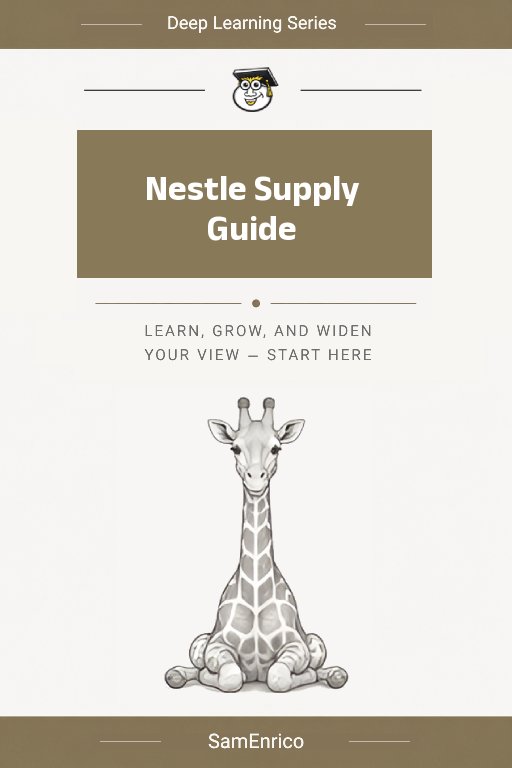
Procter Gamble Guide
Trace supplier collaboration, retail partnership,
Trace supplier collaboration, retail partnership, and demand-driven replenishment that pioneered consumer goods logistics.
Formats
About this book
Free sample
Chapter 1: The Empty Shelf--–- On a Tuesday morning in 1983, a P&G executive named Tom Muccio walked the diaper aisle of a Walmart store in Bentonville, Arkansas. He was not there to check on product placement or to ensure the P&G display looked better than Kimberly-Clark's. He was there to count empty spaces. What he found would change the course of modern commerce. Row after row, shelf after shelf, the Pampers diapers that P&G had sold to Walmart were nowhere to be seen.
Yet according to Walmart's inventory system, the warehouse was full. According to P&G's shipping records, the product had been delivered. According to both companies, everything was working perfectly. And both companies were catastrophically wrong.Mucio knelt down in the aisle, running his finger along the empty shelf. A mother with a fussy toddler walked past him, glanced at the empty space, sighed, and continued pushing her cart toward a competitor's brand.
Mucio watched her go. In that moment, he understood something that would take the rest of the industry another decade to grasp: the supply chain was not designed for her.The Consumer That No One Saw Before P&G's revolution, the consumer goods industry operated on a foundation of mutually beneficial dysfunction. Manufacturers like P&G, Unilever, and Kimberly-Clark produced goods based on internal sales forecasts that were intentionally inflated. Salespeople routinely added fifteen to twenty percent to their projections, not because they believed demand would materialize, but because their bonuses depended on exceeding their targets. If you forecast low and delivered high, you looked like a hero.
If you forecast high and delivered low, you looked for a new job. The system rewarded optimism and punished honesty.Retailers like Walmart, Kroger, and Target played an equally distorted game. Their buyers negotiated aggressively for the lowest possible price per case, then ordered in massive quantities during promotional periods, stockpiling product in warehouses that were measured for efficiency not by how quickly product moved through them, but by how much product they could hold. A full warehouse was a sign of success. An empty…
This is the end of the free sample. Get the eBook to keep going. Buy now
Contents
- Chapter 1
- Chapter 2
- Chapter 3
- Chapter 4
- Chapter 5
- Chapter 6
- Chapter 7
- Chapter 8
- Chapter 9
- Chapter 10
- Chapter 11
- Chapter 12
Details
- Author
- Heckman Karissa
- Publisher
- SamEnrico
- Language
- English
- Genre
- Non-Fiction, Strategic Atlas, CPG Logistics
- Released
- 2026-05-29
- Pages (approx.)
- 126
- Available as
- eBook, Audiobook

Read better in the ZLOADR app
Your eBooks on your phone or tablet. Sign in with your SamEnrico account and start reading.
More by Heckman Karissa
 Loving Kindness for BreakupsHeckman Karissa$11.99
 High Net Worth Wellness HabitsHeckman Karissa$11.99
 Overcoming Self Doubt in Creative FieldsHeckman Karissa$11.99
 Cameroon Union des PopulationsHeckman Karissa$11.99
 The Equifax Breach ExposedHeckman Karissa$11.99
 The Symphony of the Stars: How Apollo 8’s Christmas Broadcast United the WorldHeckman Karissa$11.99
 Technical Writing Workflow AIHeckman Karissa$12.99
 Understanding Moore–Smith–weaver SyndromeHeckman Karissa$17.99
 How to Become a Cloth-printing InspectorHeckman Karissa$11.99
 HR RecruiterHeckman Karissa$11.99