
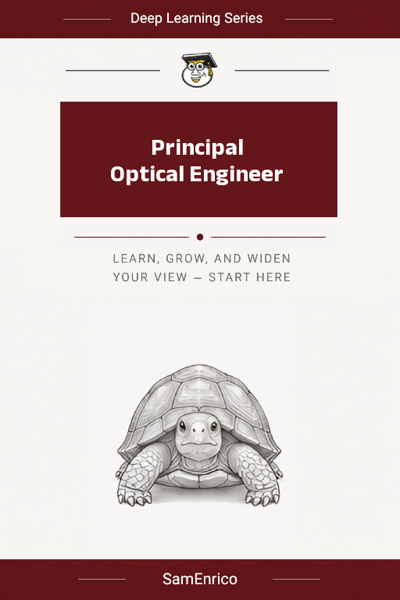
Principal Optical Engineer
A Coursebook on Principal Optical Engineer
A Coursebook on Principal Optical Engineer
Formats
About this book
Free sample
Chapter 1: The Ray's Journey...--–- Light is the messenger. It travels from distant stars, from the sun, from a lamp on a desk, from a face in a crowd. It carries energy, information, and meaning. But light, left to itself, travels in straight lines. The art and science of optical engineering is the art of bending those straight lines—of redirecting the messenger so that it arrives where we want, when we want, in the form we want.
This chapter is about the fundamental rules that govern that bending.Before we can design a camera lens, a microscope objective, a laser focusing system, or a virtual reality headset, we must understand how light behaves when it encounters a boundary between two different materials. A beam of light traveling through air strikes a piece of glass. What happens? Part of it reflects off the surface, bouncing away like a stone skipped across water. The rest enters the glass, but its path bends—sometimes sharply, sometimes subtly.
This bending is called refraction, and it is the single most important phenomenon in optical engineering.This chapter establishes the bedrock principles upon which all optical engineering is built: the behavior of light as it travels, reflects, and refracts through various media. We begin with the simplest possible model of light: the ray. A ray is an imaginary line that represents the path of a infinitesimally narrow beam of light. The ray model is an approximation—it ignores the wave nature of light, which we will explore in later chapters—but it is an extraordinarily useful approximation. When light interacts with objects much larger than its wavelength (lenses, mirrors, prisms, human eyes), rays behave in predictable, calculable ways.We will learn two fundamental laws: the law of reflection, which tells us how light bounces off surfaces, and Snell's law of refraction, which tells us how light bends when it passes from one material to another.
We will apply these laws to planar surfaces (like a flat window) and spherical surfaces (like a lens). We will introduce the paraxial approximation, which simplifies our calculations by…
This is the end of the free sample. Get the eBook to keep going. Buy now
Contents
- Chapter 1
- Chapter 2
- Chapter 3
- Chapter 4
- Chapter 5
- Chapter 6
- Chapter 7
- Chapter 8
- Chapter 9
- Chapter 10
- Chapter 11
- Chapter 12
Details
- Author
- Jasper Aracelis
- Publisher
- SamEnrico
- Language
- English
- Genre
- Non-Fiction, Informative, Educational
- Released
- 2026-05-25
- Pages (approx.)
- 128
- Available as
- eBook, Audiobook

Read better in the ZLOADR app
Your eBooks on your phone or tablet. Sign in with your SamEnrico account and start reading.
More by Jasper Aracelis
 Positioning Map Audit GuideJasper Aracelis$11.99
 Remote Retreats for MergersJasper Aracelis$11.99
 Growth Mindset for ExamsJasper Aracelis$11.99
 French Resistance Radio GuideJasper Aracelis$11.99
 Focus Partner Accountability SystemJasper Aracelis$11.99
 The Last Highlander: The Untold Story of the 18th-Century Warrior Who Defied the British EmpireJasper Aracelis$11.99
 The Last Bottle of Château Lafite: A Wine Heist That Shook the WorldJasper Aracelis$11.99
 Understanding Choroido Cerebral Calcification Syndrome InfantileJasper Aracelis$17.99
 JEE Thermodynamics PhysicsJasper Aracelis$12.99
 Department Budget BenchmarkingJasper Aracelis$12.99
 Ultimate Handbook Guide to Padang : (Indonesia) Travel GuideJasper Aracelis$11.99