

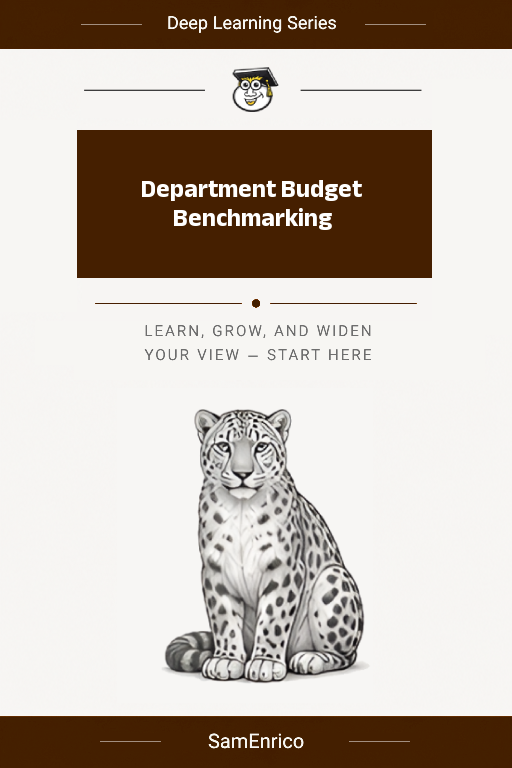
Non-FictionProfessional's Cheat SheetBenchmarkingEfficiency
Department Budget Benchmarking
Compare department spending to industry benchmarks
Compare department spending to industry benchmarks and internal peer departments to identify efficiency opportunities.
Formats
About this book
Free sample
Chapter 1: The Incremental Trap--–- Every October, the same ritual begins. Department heads across the organization open last year’s budget spreadsheet, add 3 percent for inflation, maybe subtract 2 percent if they’ve been told to “tighten belts,” and submit the result as next year’s request. Finance reviews it, trims a few line items, and sends it back. The cycle completes itself with the quiet efficiency of a machine that has been running for decades. No one questions whether the numbers made sense last year.
No one asks if the department could deliver the same results for half the cost. No one compares what one office spends against what another office spends for identical work. The budget is a fossil—a preserved record of past decisions, frozen in amber, never excavated for its underlying assumptions.This chapter is about why that ritual is failing organizations everywhere, and what replaces it. The incremental budget—last year’s number plus or minus a percentage—is the single most common budgeting method in public agencies, non-profits, and even large private corporations. It persists because it is easy, predictable, and low-conflict.
But ease and predictability come at a devastating price: incremental budgeting systematically rewards inefficiency, punishes frugality, and blinds leaders to the single most important question they could ask. That question is not “What did we spend last year?” The question is “What should we spend to deliver this service effectively?”Benchmarking is the answer. It is the practice of comparing your department’s spending, staffing, and productivity against meaningful peers—either similar departments in other organizations or comparable units inside your own organization. Benchmarking transforms budgeting from a backward-looking negotiation into a forward-looking diagnostic. It replaces opinion with evidence, politics with data, and inertia with improvement.
But before diving into the mechanics of how benchmarking works—the ratios, the data sources, the normalization techniques that fill later chapters—this first chapter makes the case for why benchmarking is necessary at all. It critiques the incremental model, defines the foundational concepts of value for money and efficiency versus effectiveness, and ends with a practical readiness assessment…
This is the end of the free sample. Get the eBook to keep going. Buy now
Contents
- Chapter 1
- Chapter 2
- Chapter 3
- Chapter 4
- Chapter 5
- Chapter 6
- Chapter 7
- Chapter 8
- Chapter 9
- Chapter 10
- Chapter 11
- Chapter 12
Details
- Author
- Jasper Aracelis
- Publisher
- SamEnrico
- Language
- English
- Genre
- Non-Fiction, Professional's Cheat Sheet, Benchmarking, Efficiency
- Released
- 2026-06-01
- Pages (approx.)
- 148
- Available as
- eBook, Audiobook

Read better in the ZLOADR app
Your eBooks on your phone or tablet. Sign in with your SamEnrico account and start reading.
More by Jasper Aracelis
 Positioning Map Audit GuideJasper Aracelis$11.99
 Remote Retreats for MergersJasper Aracelis$11.99
 Growth Mindset for ExamsJasper Aracelis$11.99
 French Resistance Radio GuideJasper Aracelis$11.99
 Focus Partner Accountability SystemJasper Aracelis$11.99
 The Last Highlander: The Untold Story of the 18th-Century Warrior Who Defied the British EmpireJasper Aracelis$11.99
 The Last Bottle of Château Lafite: A Wine Heist That Shook the WorldJasper Aracelis$11.99
 Understanding Choroido Cerebral Calcification Syndrome InfantileJasper Aracelis$17.99
 JEE Thermodynamics PhysicsJasper Aracelis$12.99
 Principal Optical EngineerJasper Aracelis$11.99
 Ultimate Handbook Guide to Padang : (Indonesia) Travel GuideJasper Aracelis$11.99
You may also like
 Hong Kong Handover 1997Dunn Johnnie$11.99
 Zumba For Postnatal Recovery CourseNeal Christian$11.99
 Zumba for BeginnersLadner Nikia$11.99
 YouTube Comment Mining GuideHumes Pandora$12.99
 Worry Box MeditationCarlin Rudy$11.99
 Workplace Stress MeditationNguyen Lynn$11.99
 Workplace Stress and Sleep RepairHawley Ivory$11.99
 Workplace Perfectionism CureDelaney Jeffry$11.99
 Workplace Injustice Anger GuideWallen Isabelle$11.99
 Work Addiction and Burnout LinkGreenwood Ester$11.99
 Women in Yoga and WellnessBeattie Galina$11.99
 Women in Stand Up ComedyChun Evangeline$11.99