
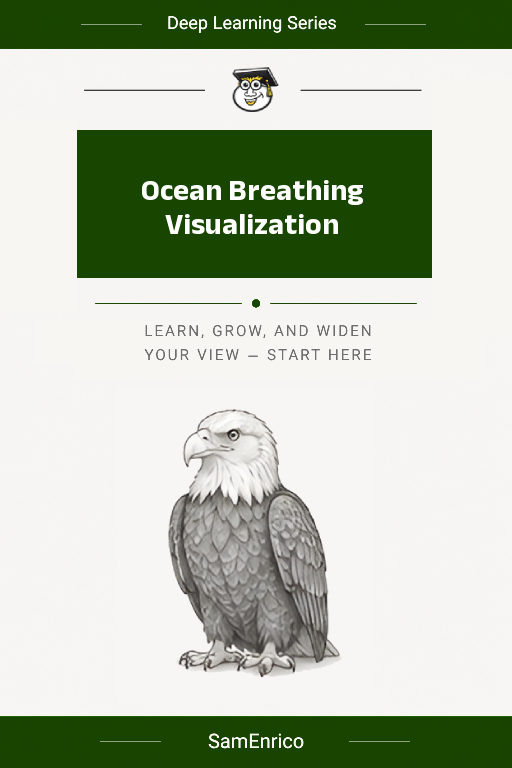
Ocean Breathing Visualization eBook
Combine extended exhale with mental imagery of wav
by Whitley Reta
Combine extended exhale with mental imagery of waves to activate parasympathetic response.
Formats
Free sample
Chapter 1: The Nervous System's Coastline...--–- Two years ago, I found myself standing in an airport security line at Chicago O'Hare, watching the digital clock tick from 6:47 to 6:48, when my heart began to hammer against my ribs like a trapped bird. One hundred forty-eight beats per minute, according to the pulse oximeter the paramedic would later clip to my finger. My vision tunneled. The fluorescent lights above bleached into a white haze. The chatter of travelers faded to a distant hum, then to silence.
I was thirty-seven years old, ostensibly healthy, and I was absolutely convinced—beyond any rational argument—that I was having a heart attack. The paramedic who arrived, a kind woman named Diane with gray-streaked hair and remarkably steady hands, did not reach for a defibrillator. She did not take my blood pressure immediately. She knelt beside me, placing herself at eye level, and said: "Watch my hand." She raised her palm slowly, fingers together, like a wave rising from calm water. She held it there for four seconds.
Then she lowered it over eight seconds, fingers curling slightly as if the wave were receding back into the ocean. "Breathe with me," she said. "In as the wave rises. Out as it falls." I did not believe it would work. I did it anyway.
Ninety seconds later, my heart rate was eighty-two. The paramedic smiled and said, "That's better." Then she walked away to answer another call. I sat on the cold airport floor for another ten minutes, trying to understand what had just happened. I was not having a heart attack. I was having a panic attack.
And Diane had just taught me—in ninety seconds, with nothing more than her hand and her breath—the single most powerful drug-free intervention I have ever encountered. This book is the result of the two years I spent after that morning trying to understand why it worked, how to make it work reliably, and how to teach it to you.The Question That Changed Everything After that airport morning, I became obsessed with a single question: Why did watching Diane's hand rise and fall—and matching my breath to that rhythm—stop a panic attack that had felt utterly unstoppable? I was not a meditator. I had never practiced yoga. I had no training in breathwork.
I was a skeptical, overworked professional who believed in pharmaceuticals and peer-reviewed studies, not in "visualization" or "energy." And yet, something had happened that I could not explain away. The paramedic had not given me a drug. She had not talked me down with logic. She had simply asked me to watch a wave and breathe along with it.I spent the following months devouring research papers on the autonomic nervous system, polyvagal theory, heart rate variability, and respiratory physiology. I read the works of Dr.
Stephen Porges, who spent decades mapping the vagus nerve. I read Dr. Andrew Weil's pioneering work on breathing ratios. I read James Nestor's Breath, which traces the forgotten science of a lost art. I interviewed breathwork coaches, neuroscientists, and trauma therapists.
And slowly, a coherent picture emerged—one that explained exactly what had happened in that airport terminal.The answer, it turns out, lies in a simple but profound fact about your nervous system: It is listening to your breath. Always. Every second of every day. And it is using the rhythm of your breath to decide whether you are safe or in danger.Your Nervous System: A Coastline in Constant Motion To understand Ocean Breathing, you must first understand a basic map of your nervous system. Think of it as a coastline.
At one end of this coastline is high tide—a state of activation, energy, and mobilization. This is your sympathetic nervous system, often called the "fight or flight" response. When you are in high tide, your heart rate accelerates, your pupils dilate, your digestion slows, and your blood rushes to your large muscle groups. This is an exquisitely useful state when you are actually in danger—when a car swerves toward you, when you need to sprint for a train, when you must defend yourself. The problem is that modern life has become a series of false alarms.
An angry email from your boss. A notification that your mortgage rate has increased. A passive-aggressive text from a family member. A scrolling news feed full of catastrophes you cannot control. Your nervous system cannot tell the difference between a saber-toothed tiger and a Slack message.
It treats both as threats. And so many of us spend our days stuck in high tide, waiting for a danger that never comes.At the other end of the coastline is low tide—a state of rest, digestion, healing, and connection. This is your parasympathetic nervous system, often called the "rest and digest" response. When you are in low tide, your heart rate slows, your blood pressure drops, your digestive system activates, and your body begins the work of repair and recovery. This is where healing happens.
This is where creativity emerges. This is where you feel safe enough to connect with others, to fall asleep, to let your guard down. Most of us spend far too little time in low tide.Between these two states—high tide and low tide—lies the shoreline. And that shoreline is constantly shifting. The question is: What controls the tide?
What determines whether your nervous system moves toward high tide (stress) or low tide (calm)?The answer, discovered by Dr. Stephen Porges in the 1990s, is the vagus nerve.The Vagus Nerve: The Brain's Communication Superhighway The vagus nerve is the longest and most complex nerve in the human body. Its name comes from the Latin word for "wandering"—and it is an apt description. The vagus nerve begins in your brainstem, just behind your ears, and wanders down through your neck, your chest, your heart, your lungs, your stomach, and all the way to your abdomen. It is not a single nerve but a bundle of thousands of fibers, some carrying signals from the brain to the body (motor) and others—about eighty percent of them—carrying signals from the body to the brain (sensory).
This is a crucial fact: Your vagus nerve is primarily a listening nerve. It is constantly monitoring your internal organs, sensing your heart rate, your breathing rhythm, your digestive activity, your inflammation levels, and sending that information back to your brain. Your brain then uses that information to decide how you feel.If your vagus nerve reports that your heart is racing and your breath is shallow and your stomach is tight, your brain concludes: I must be in danger. It activates your sympathetic nervous system. You feel anxious, alert, on edge.
If your vagus nerve reports that your heart is slow and steady and your breath is deep and your belly is soft, your brain concludes: I must be safe. It activates your parasympathetic nervous system. You feel calm, grounded, at ease.Here is the extraordinary implication: You can intentionally change what your vagus nerve reports. You can send different signals. You can, in effect, hack your nervous system from the bottom up.
And the most direct, fastest, most reliable way to do that is through your breath.Why Breath Is the Remote Control…
This is the end of the free sample. Get the eBook to keep going. Buy now
About this book
Details
- Author
- Whitley Reta
- Publisher
- SamEnrico
- Language
- English
- Genre
- Non-Fiction, Mental Wealth
- Released
- 2026-05-29
- Pages (approx.)
- 137
- Available as
- eBook, Audiobook

Read better in the ZLOADR app
Your eBooks on your phone or tablet. Sign in with your SamEnrico account and start reading.
More by Whitley Reta
 One Minute RescueWhitley Reta$11.99
 Vegan Iodine GuideWhitley Reta$11.99
 SAD And Serotonin GuideWhitley Reta$11.99
 Workplace Multitasking MythWhitley Reta$11.99
 The Online Car PurchaseWhitley Reta$11.99
 Anger De escalation with NarcissistsWhitley Reta$11.99
 Networking for AccountantsWhitley Reta$11.99
 Red Teaming Creative IdeasWhitley Reta$11.99
 The Golden Shadow: The First Olympic Doping Scandal and the Fall of a ChampionWhitley Reta$11.99
 The Earthweavers of Timbuktu: How Medieval Mali Built with the LandWhitley Reta$11.99
 Service Providers Guide to Garage SalesWhitley Reta$11.99
 How to Produce Voltage Transformers and RegulatorsWhitley Reta$11.99
You may also like
 Student Mental Health Board GuideBerg Meghann$12.99
 High Achiever Mental Health BoardRosas Synthia$12.99
 Technology Addiction AdvisorRoby Shakita$12.99
 Pet Bereavement AdvisorSam Reyna$12.99
 Peer Support Group IntegrationDuffy Renay$12.99
 Exercise Mental Health AdvisorBurnett Dewayne$12.99
 Disclosing Depression To InvestorsBadger Kazuko$12.99
 Yawn Stretch RegulationRomano Berna$12.99
 Wrist Flexion ReleaseBusch Kandace$12.99
 Workplace Mental Health AllyValentine Meta$12.99
 Workplace Mental Health AdvisorAshcraft Johnie$12.99
 Wealthy Upbringing Guilt GuideXiong Deeanna$12.99