
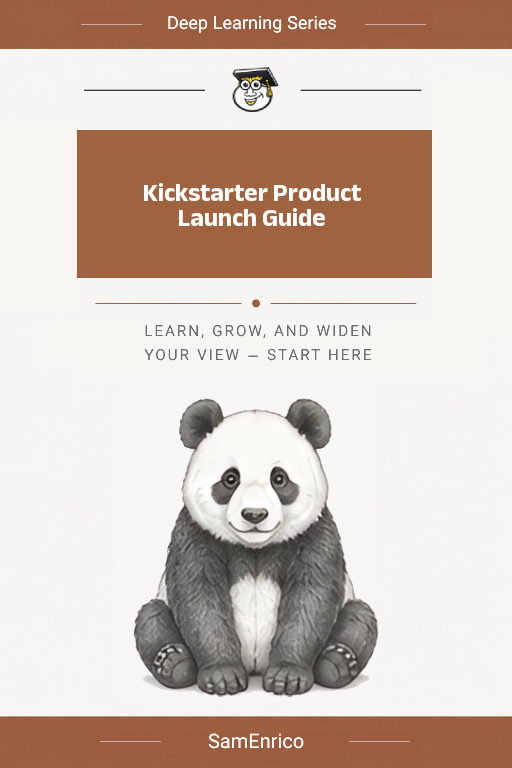
Kickstarter Product Launch Guide eBook
Launch physical product campaign on Kickstarter in
Launch physical product campaign on Kickstarter in 30 days. Set funding goal, create rewards, and produce marketing video.
Formats
Free sample
Chapter 1: The Iceberg Lies--Most creators fail on Kickstarter before they ever press the "Launch" button. They fail not because their product is bad, not because their video is ugly, and not because their pricing is wrong. They fail because they confuse a launch with a conversion event. This single misunderstanding has destroyed more promising hardware projects than any manufacturing defect or shipping delay ever could.Let me paint a scene you will recognize. You have spent six months designing your product.
You have 3D-printed a dozen prototypes. You have found a manufacturer in Shenzhen who promises a 45-day turnaround. You are excited. Your friends tell you the product is "amazing." Your family says they would "definitely buy one." So you create a Kickstarter page, upload a quick video of the prototype sitting on your kitchen table, and set a $50,000 funding goal. Then you hit "Go Live."And nothing happens.Maybe your mother pledges 50.Maybeafewcoworkersthrowin50.
Maybe a few coworkers throw in 50.Maybeafewcoworkersthrowin20 each. But after 72 hours, you are sitting at 340raised.Your340 raised. Your 340raised.Your50,000 goal now looks like Mount Everest. You start posting frantically on Facebook. You join every Kickstarter group you can find and drop your link.
You get banned from three of them for spamming. You consider paying for Facebook ads but have no idea how to target them. By Day 14, you have $1,200 and a growing sense of dread. By Day 30, the campaign fails. You have wasted six months of your life and whatever money you spent on prototypes.This story is not an exception.
It is the rule. According to Kickstarter's own data, approximately 60 percent of projects in the Design and Technology categories fail to reach their funding goal. But that number is misleading, because it counts projects that never had a chance. Among first-time creators with no pre-existing audience, the failure rate exceeds 80 percent. These are not bad products.
They are good products launched into an empty room.The fundamental error is treating Kickstarter like a store. A store has customers who are already looking for what you sell. Kickstarter does not. Kickstarter is a platform that amplifies existing demand; it does not generate demand from nothing. When you hit "Launch," Kickstarter does not send a notification to millions of eager backers telling them about your clever new gadget.
Instead, Kickstarter watches what happens in the first 48 hours. If people are already pledging—if there is velocity—the algorithm shows your project to more people. If there is silence, the algorithm buries you so deep that even your own mother would need a search engine to find you.This is what I call the Iceberg Principle. The 30 days your backers see—the live countdown, the funding bar, the comments section—is merely the tip of the iceberg. The mass below the waterline, the part that determines whether you sink or float, is the 60 to 90 days before you ever press "Go Live." That is where you validate demand, build an audience, test your messaging, and secure your first 30 percent of funding before Day 1 even begins.I learned this the hard way.The $40,000 Mistake In 2016, I was a first-time creator with a clever travel backpack.
It had a hidden pocket for a laptop, a lockable zipper that worked with TSA cables, and a water-resistant shell that could survive a monsoon. I had spent eight months developing it. I had flown to Vietnam to meet the manufacturer. I had returned with a beautiful sample that I showed to everyone who would stand still long enough to look at it.I set a 40,000goal.Ihit"Launch."Andforthefirst12hours,Iwatchedthepledgecounterlikeaparentwatchinganewbornbreathe.Itmoved.Slowly.Byhour12,Ihad40,000 goal. I hit "Launch." And for the first 12 hours, I watched the pledge counter like a parent watching a newborn breathe.
It moved. Slowly. By hour 12, I had 40,000goal.Ihit"Launch."Andforthefirst12hours,Iwatchedthepledgecounterlikeaparentwatchinganewbornbreathe.Itmoved.Slowly.Byhour12,Ihad1,400. By hour 24, I had 2,100.Byhour48,Ihad2,100. By hour 48, I had 2,100.Byhour48,Ihad3,800.
I was at less than 10 percent of my goal with 28 days remaining. I panicked. I bought 2,000in Facebookadstargeting"travelbackpack"and"carry−onluggage."Theadsgenerated47clicksandzeropledges.Ispentanother2,000 in Facebook ads targeting "travel backpack" and "carry-on luggage." The ads generated 47 clicks and zero pledges. I spent another 2,000in Facebookadstargeting"travelbackpack"and"carry−onluggage."Theadsgenerated47clicksandzeropledges.Ispentanother1,000 on a Kickstarter marketing agency that promised "guaranteed funding." They sent me a spreadsheet of email addresses that bounced at a 60 percent rate. I burned through my savings.
On Day 29, with 38 percent of my goal raised and 24 hours remaining, I cancelled the campaign.I lost $40,000 in prototype costs, travel, molds, and wasted advertising. I also lost my confidence. For six months, I could not look at a backpack without feeling sick.But I learned something that no book had taught me. I learned that the campaign did not fail because the backpack was bad. It failed because I had spent eight months building the product and zero months building an audience.
I had launched into a vacuum. The only people who knew about the campaign were the people I told after I launched—and by then, it was too late. Kickstarter's algorithm had already judged me. In the first 48 hours, I had shown no velocity, so the platform concluded that my project was not worth showing to anyone else.The Reservation Funnel The solution is what I call the Reservation Funnel. The concept is simple: you do not launch to strangers.
You launch to people who have already "reserved" the right to buy. These are people who have raised their hands, provided their email addresses, and explicitly said, "Notify me when this campaign goes live."Why does this matter? Because Kickstarter's algorithm only cares about one thing: velocity. Velocity is the speed at which pledges come in during the first 24 to 48 hours. If you have 1,000 people on your email list who all pledge within the first hour, you create a spike that the algorithm interprets as a signal.
That signal triggers "Projects We Love" consideration, pushes you into the Discovery feed, and may even land you on the front page. If you have zero people on your list, you create a flat line, and the algorithm moves on to the next project.Let me give you the number that changed my entire approach. According to data from Kickstarter's internal analytics and confirmed by Mark Pecota in the best-selling Crowdfunded, a pre-launch email list converts at a rate thirty times higher than cold social media traffic. Thirty times. If you run a Facebook ad to strangers, you might get a 0.5 percent conversion rate.
If you email the same offer to people who signed up for your waitlist, you will see conversion rates between 10 and 30 percent.This is not magic. It is basic human psychology. When someone gives you their email address, they have made a micro-commitment. They have invested a tiny amount of effort. They have signaled interest.
When you later ask them to convert into a backer, they are not being asked by a stranger. They are being asked by someone they have already acknowledged. The friction is lower. The trust is higher. The wallet opens faster.But here is the part that most first-time creators miss: building that list takes time.
You cannot build a 5,000-person email list in a week unless you already have a massive social media following or…
This is the end of the free sample. Get the eBook to keep going. Buy now
About this book
Details
- Author
- Bagwell Noreen
- Publisher
- SamEnrico
- Language
- English
- Genre
- Non-Fiction, First 30 Days
- Released
- 2026-06-01
- Pages (approx.)
- 150
- Available as
- eBook, Audiobook

Read better in the ZLOADR app
Your eBooks on your phone or tablet. Sign in with your SamEnrico account and start reading.
More by Bagwell Noreen
 Postpartum Depression GuideBagwell Noreen$11.99
 Career Transition for Retail WorkersBagwell Noreen$11.99
 Thunderbirds Pilot MemoirBagwell Noreen$11.99
 Psychological Relapse Prevention GuideBagwell Noreen$11.99
 Practical Exam Skills GuideBagwell Noreen$11.99
 Career Transition Without BurnoutBagwell Noreen$11.99
 Disappointment After SuccessBagwell Noreen$11.99
 Bombing Accuracy: Norden vs. British SightsBagwell Noreen$11.99
 Citation Rules Quick Reference Card ManualBagwell Noreen$11.99
 The Lost Giants of the Indian Ocean: Uncovering Ancient Fossils Beneath the WavesBagwell Noreen$11.99
 The Vanishing of the Honey Island Swamp MonsterBagwell Noreen$11.99
 The Frozen Hour: The 1972 Andes Flight Disaster RevisitedBagwell Noreen$11.99
You may also like
 Hong Kong Handover 1997Dunn Johnnie$11.99
 Zumba For Postnatal Recovery CourseNeal Christian$11.99
 Zumba for BeginnersLadner Nikia$11.99
 YouTube Comment Mining GuideHumes Pandora$12.99
 Worry Box MeditationCarlin Rudy$11.99
 Workplace Stress MeditationNguyen Lynn$11.99
 Workplace Stress and Sleep RepairHawley Ivory$11.99
 Workplace Perfectionism CureDelaney Jeffry$11.99
 Workplace Injustice Anger GuideWallen Isabelle$11.99
 Work Addiction and Burnout LinkGreenwood Ester$11.99
 Women in Yoga and WellnessBeattie Galina$11.99
 Women in Stand Up ComedyChun Evangeline$11.99