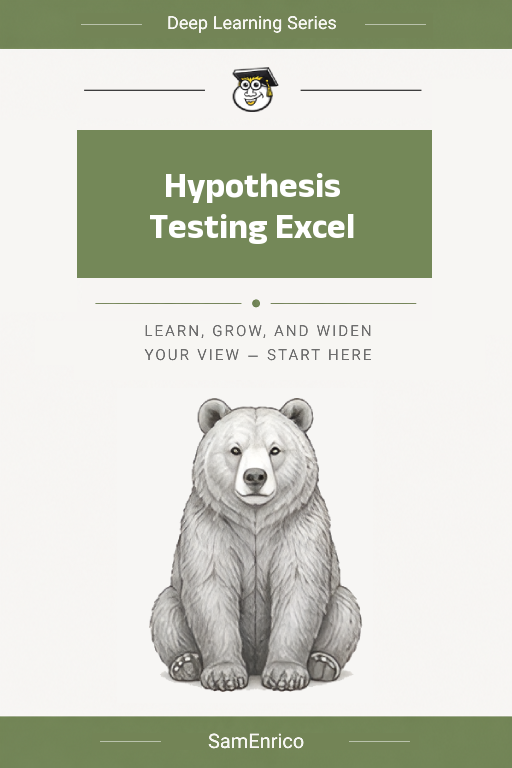
Hypothesis Testing Economics Guide Audiobook
Perform t-tests, chi-square, and F-tests for econo
Perform t-tests, chi-square, and F-tests for economics exam data. Interpret confidence intervals and significance levels using Excel statistical functions.
Formats
Free sample
Chapter 1: The Uncertainty Mandate--–- Every economics student eventually faces a moment of uncomfortable clarity. You have just completed an ambitious research project. You collected data from two hundred households, ran the numbers through Excel, and found exactly what you hoped to find: the average income in your city appears higher than the national average. The numbers are clean, the analysis is thorough, and the conclusion feels right. Then your professor asks one question: "How do you know this isn't random chance?"That question is the gateway to hypothesis testing.
It is also the most neglected concept in introductory economics education. Students learn to calculate means, standard deviations, and regression coefficients. They master the mechanics of Excel functions and the art of creating professional charts. But when confronted with the fundamental question of statistical inference – "Is this pattern real or just noise?" – many freeze. They lack the framework to distinguish between genuine economic relationships and coincidental patterns that emerge from limited samples.This book exists to close that gap.
Hypothesis Testing Economics Guide is not another theoretical statistics textbook. It is a practical, Excel-driven roadmap for economics students who need to pass exams and for professionals who need to make defensible decisions with real data. The book synthesizes the core curriculum of the top ten statistics for economics guides into a single, focused resource. Every chapter delivers step-by-step Excel workflows, real economic examples, and the interpretive skills that separate novice analysts from confident decision-makers.But before diving into t-tests, chi-square tests, and ANOVA, we must address a more fundamental question: Why does hypothesis testing matter for economists in the first place?The answer lies in the nature of economic data. Unlike physicists who can repeatedly measure the speed of light under controlled conditions, economists rarely have the luxury of complete data or controlled experiments.
We cannot re-run the 2008 financial crisis to test alternative policies. We cannot assign different inflation rates to randomly selected countries. We work with whatever data history provides – usually a single sample drawn from a vast, unknowable population. Hypothesis testing gives us the language and mathematics to make inferences from those imperfect samples. It quantifies uncertainty.
It disciplines our conclusions. And when done correctly, it prevents us from seeing patterns that do not exist.This chapter establishes the foundational framework that will guide every subsequent chapter. You will learn the formal steps of hypothesis testing, the meaning and…
This is the end of the free sample. Get the Audiobook to keep going. Buy now
About this book
Details
- Author
- Sena Broderick
- Publisher
- SamEnrico
- Language
- English
- Genre
- Non-Fiction, Student's Shortcut, Statistics
- Released
- 2026-06-01
- Pages (approx.)
- 159
- Available as
- eBook, Audiobook

Listen in the VoxFlicks app
Audiobooks and audio dramas wherever you go. Sign in with your SamEnrico account and press play.
More by Sena Broderick
 Cleopatra Succession Crisis HandlingSena Broderick$11.99
 The Asymmetric Dominance EffectSena Broderick$11.99
 Mindfulness Meditation CourseSena Broderick$11.99
 Financial Stress and DivorceSena Broderick$11.99
 The Architects of Persepolis: Nubian Masters of the Achaemenid EmpireSena Broderick$11.99
 How to Start a Boxing Glove Business (Beginners Guide)Sena Broderick$11.99
 How to Produce Audio and Video Splitters and SwitchesSena Broderick$11.99
 Corporate Travel ConsultantSena Broderick$11.99