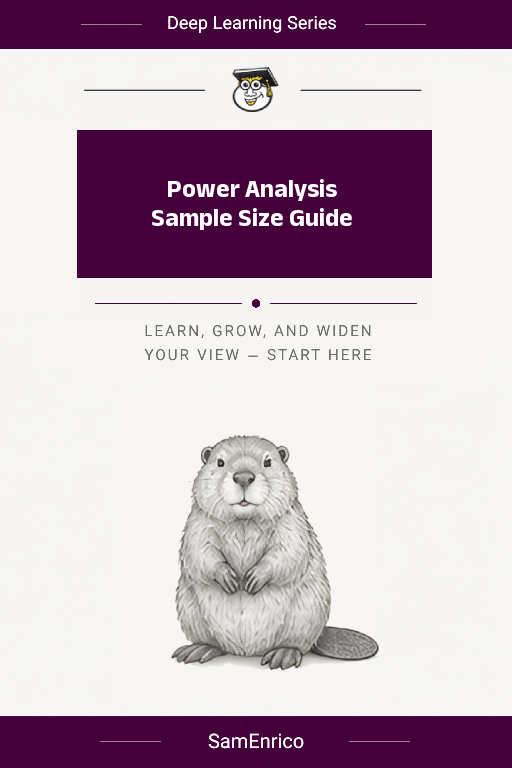
Power Analysis Sample Size Guide
Calculate required sample sizes for quantitative g
by Veal Nestor
Calculate required sample sizes for quantitative grad proposals using G*Power. Justify numbers with effect size estimates and statistical power conventions.
Formats
About this book
Free sample
Chapter 1: The 30-Participant Lie--–- The scene unfolds in windowless graduate offices and sterile committee rooms every semester. A weary Ph D student sits across from their advisor, proposal draft in hand. The advisor scans the methods section, pauses at the sample size justification, and says the seven words that launch a thousand flawed dissertations: “Thirty participants should be fine. That’s what we always use.” The student nods, scribbles a note, and never questions the number again. This chapter exists because that conversation is not merely lazy—it is unethical, unscientific, and a direct contributor to the replication crisis that has shaken confidence across psychology, medicine, education, and beyond.The 30-participant heuristic—sometimes dressed up as “30 per group” or “the central limit theorem says 30 is enough”—has no defensible statistical foundation.
It persists because it is easy. It persists because senior researchers used it when they were graduate students. And it persists because calculating a proper sample size feels intimidating, mathematical, and time-consuming. This book exists to kill that heuristic forever. By the end of this chapter, you will understand why sample size is an ethical question first and a statistical question second, why underpowered studies waste resources and harm participants, and how the four pillars of power analysis (alpha, beta, effect size, and sample size) form an unbreakable logical chain.
More importantly, you will never again write “a sample of 30 participants will be recruited” without feeling a professional obligation to defend that number.The Hidden Epidemic of Underpowered Research Let us begin with a sobering statistic. A landmark review by Button and colleagues (2013) examined neuroscience studies and found that the average statistical power was barely above 20 percent. That means for every five true effects present in the world, four were missed—not because the effects were absent, but because the studies were too small to detect them. Subsequent meta-research across social psychology (power averaging around 35-40 percent), cancer biology (power around 20 percent), and education research (power around 45 percent) tells the same story: the typical published study is a coin flip at best, and often worse…
This is the end of the free sample. Get the eBook to keep going. Buy now
Contents
- Chapter 1
- Chapter 2
- Chapter 3
- Chapter 4
- Chapter 5
- Chapter 6
- Chapter 7
- Chapter 8
- Chapter 9
- Chapter 10
- Chapter 11
- Chapter 12
Details
- Author
- Veal Nestor
- Publisher
- SamEnrico
- Language
- English
- Genre
- Non-Fiction, Student's Shortcut, Statistics
- Released
- 2026-05-30
- Pages (approx.)
- 158
- Available as
- eBook, Audiobook

Read better in the ZLOADR app
Your eBooks on your phone or tablet. Sign in with your SamEnrico account and start reading.
More by Veal Nestor
 Burnout Prevention for ConstructionVeal Nestor$11.99
 The Seafood Mercury GuideVeal Nestor$11.99
 Social Anxiety Nonverbal GuideVeal Nestor$11.99
 The Cuckoo’s Call: A Love Affair with Swiss PrecisionVeal Nestor$11.99
 Procurement ClerkVeal Nestor$11.99
 How to Produce Bicycle Child Seat AccessoriesVeal Nestor$11.99
 How to Become a Stereo-plotter OperatorVeal Nestor$11.99