
Non-FictionInformativeEducational
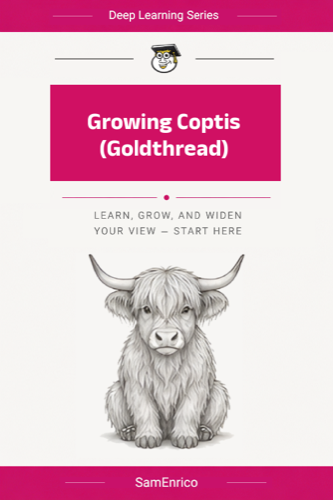
Growing Coptis (Goldthread) eBook
This publication, published by SamEnrico, covers G
This publication, published by SamEnrico, covers Growing Coptis (Goldthread)
Formats
Free sample
Chapter 1: The Golden Thread...–- The first time I dug a Goldthread rhizome from the forest floor, I understood why the plant has been called “yellow gold” for two thousand years. The root was no larger than my thumb, tangled and unremarkable at first glance—until I scraped the surface with my thumbnail. Beneath the brown skin, the interior blazed like the yolk of an egg, like turmeric fresh from the earth, like liquid sunshine solidified. That flash of yellow stopped me cold. I was holding something that had taken five years to become what it was: a quarter-ounce of concentrated botanical medicine, worth more by weight than most spices, and threatened by the very demand that made it valuable.This book is not a romance.
It is not a collection of folk tales and marketing hype designed to sell you seeds or convince you that growing rare herbs will make you rich while you sleep. This book is a practical, hands-on, soil-under-the-fingernails guide to cultivating Coptis—the genus of plants known commonly as Goldthread—for those who are willing to wait. Because waiting is the price of admission. If you cannot imagine planting a crop in the spring and harvesting it five or six years later, put this book down and walk away. I mean that with respect.
There are faster herbs to grow—mint, calendula, echinacea, even ginseng—and I encourage you to start there. But if you are the kind of person who plants an oak tree knowing you may never sit in its shade, if you find satisfaction in work that outlives you, then Goldthread may be your crop.Why This Plant, Why This Book, Why Now Goldthread belongs to the buttercup family (Ranunculaceae), a group that includes some of the most beautiful and toxic plants in the northern hemisphere. Unlike its cousins—the deadly monkshood, the skin-irritating clematis, the weedy buttercup of every lawn—Coptis is gentle enough for internal use when properly prepared and potent enough to command prices that rival ginseng. The genus contains roughly fifteen species distributed across the cool, moist forests of North America, East Asia, and the Himalayas. But for the cultivator, only four matter: Coptis chinensis (Chinese Goldthread), Coptis japonica (Japanese Goldthread), Coptis trifolia (the North American species, also called three-leaved Goldthread), and Coptis teeta (Mishmi Gold, the rarest and most endangered of the group).Each of these species has a story, and each story ends with the same problem: wild populations are collapsing under the weight of commercial demand.
In China, where Coptis chinensis has been used continuously for over two thousand years, wild plants are now so scarce that most commercial material comes from cultivated sources—and even that cultivation has struggled to keep pace with demand from the booming herbal medicine market. In Japan, Coptis japonica has been overharvested to the point where the Japanese government restricts wild collection in several prefectures. In the eastern United States and Canada, Coptis trifolia is listed as “exploitably vulnerable” in states like New York and Vermont, not because it is inherently rare but because poachers have dug it out of public lands at an unsustainable rate. And Coptis teeta—the fabled Mishmi Gold of the eastern Himalayas—is now protected under the Convention on International Trade in Endangered Species (CITES), meaning international trade is legal only with permits that are nearly impossible to obtain for wild-harvested material.This is where you come in. Every pound of Goldthread you cultivate is a pound that does not have to be torn from a forest floor.
Every plant you propagate is a seed that does not have to be stripped from a dwindling wild population. I do not say this to guilt you into growing the crop; guilt is a poor motivator over five years of waiting. I say it because the conservation argument is also a business argument. As wild supplies tighten, cultivated Goldthread—especially certified organic, especially transparently grown—will only increase in value. The grower who establishes beds today will be harvesting into a seller’s market tomorrow.The Four Faces of Goldthread: Species Profiles Before you dig a single hole or stratify a single seed, you need to know which species you intend to grow.
They are not interchangeable. They have different growing requirements, different maturation times, different berberine contents, and different market values.Coptis chinensis is the workhorse. Native to the cool, mountainous forests of central and southern China, this species accounts for perhaps eighty percent of the Goldthread in international trade. Its rhizomes are thick, heavily branched, and bright yellow throughout. In Traditional Chinese Medicine (TCM), it is known as Huang Lian—“Yellow Link”—a name that refers both to the color and to the chain-like segments of the rhizome.
The standard drying method in China involves cleaning the roots, cutting them into segments, and drying them in the sun or in low-temperature ovens. The best quality material is said to come from the Sichuan province, where the climate—cool, wet, and overcast for much of the year—produces rhizomes with particularly high alkaloid content. For the North American or European grower, Coptis chinensis is the most demanding of the four cultivated species. It requires a long, cool growing season, consistently moist soil, and protection from even brief heat waves. If you live in USDA Hardiness Zone 7 or above, you will struggle to grow this species without significant investment in cooling and shade.Coptis japonica is the refinement of the Asian line.
Japanese growers have selected this species for centuries, favoring plants with thin, straight rhizomes and exceptionally high berberine content. Whereas Coptis chinensis typically contains 5–8 percent berberine by dry weight, Coptis japonica can reach 8–10 percent in well-selected cultivars. This matters because berberine is the primary medicinal compound; higher content means higher value per pound, and it means less plant material is required to make the same amount of medicine. Coptis japonica also matures slightly faster than the Chinese species—four to five years to harvest rather than five to six—and is somewhat more tolerant of temperature fluctuations. The trade-off is that Coptis japonica produces smaller rhizomes overall, so the yield per plant is lower even if the alkaloid concentration is higher.
Japanese growers have traditionally grown this species as an understory crop in Cryptomeria (Japanese cedar) plantations, a system that provides the perfect balance of shade, moisture, and air movement.Coptis trifolia is your species if you live in North America, especially if you live in the northern tier of the United States or in Canada. This is the cold-hardy Goldthread, found from Newfoundland to Minnesota and south along the Appalachian Mountains to northern Georgia. The rhizomes are smaller than those of the Asian species—pencil-thin rather than thumb-thick—and the berberine content is lower, typically 3–5 percent. But what Coptis trifolia lacks in size and potency, it makes up in resilience. This species can survive winter temperatures as low as -40°F without protection, provided it is covered by snow.
It can tolerate brief flooding in the spring. It can grow under dense conifer canopies that would shade out the Asian species. For the small-scale grower who simply wants to produce their own medicine…
This is the end of the free sample. Get the eBook to keep going. Buy now
About this book
Details
- Author
- Basham Loraine
- Publisher
- SamEnrico
- Language
- English
- Genre
- Non-Fiction, Informative, Educational
- Released
- 2026-05-09
- Pages (approx.)
- 124
- Available as
- eBook, Audiobook

Read better in the ZLOADR app
Your eBooks on your phone or tablet. Sign in with your SamEnrico account and start reading.
More by Basham Loraine
 Drug Dependency and Overdose AftercareBasham Loraine$11.99
 Shenandoah Missing PersonsBasham Loraine$11.99
 Nobel Laureates In Particle PhysicsBasham Loraine$11.99
 Rewire Betrayal Self TalkBasham Loraine$11.99
 Sighing as Emotional ReleaseBasham Loraine$11.99
 Adam Neumann WeWorkBasham Loraine$11.99
 The Nobel Laureate Refugee StoriesBasham Loraine$11.99
 Beginner Meditation MistakesBasham Loraine$11.99
 The Rendlesham Forest Incident: Britain’s RoswellBasham Loraine$11.99
 The Green Banner of the Qing: How the Manchus Conquered the Forests of ChinaBasham Loraine$11.99
 The Velvet Revolution: How Mozart Redefined Royal CourtsBasham Loraine$11.99
 How to Produce a Breast FormBasham Loraine$11.99
You may also like
 Hong Kong Handover 1997Dunn Johnnie$11.99
 Zumba For Postnatal Recovery CourseNeal Christian$11.99
 Zumba for BeginnersLadner Nikia$11.99
 YouTube Comment Mining GuideHumes Pandora$12.99
 Worry Box MeditationCarlin Rudy$11.99
 Workplace Stress MeditationNguyen Lynn$11.99
 Workplace Stress and Sleep RepairHawley Ivory$11.99
 Workplace Perfectionism CureDelaney Jeffry$11.99
 Workplace Injustice Anger GuideWallen Isabelle$11.99
 Work Addiction and Burnout LinkGreenwood Ester$11.99
 Women in Yoga and WellnessBeattie Galina$11.99
 Women in Stand Up ComedyChun Evangeline$11.99