
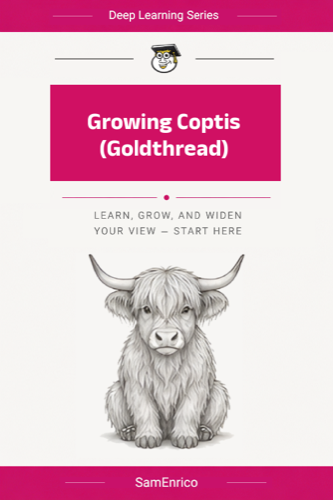
Growing Coptis (Goldthread) Audiobook
This publication, published by SamEnrico, covers G
This publication, published by SamEnrico, covers Growing Coptis (Goldthread)
Formats
Free sample
Chapter 1: The Golden Thread...–- The first time I dug a Goldthread rhizome from the forest floor, I understood why the plant has been called “yellow gold” for two thousand years. The root was no larger than my thumb, tangled and unremarkable at first glance—until I scraped the surface with my thumbnail. Beneath the brown skin, the interior blazed like the yolk of an egg, like turmeric fresh from the earth, like liquid sunshine solidified. That flash of yellow stopped me cold. I was holding something that had taken five years to become what it was: a quarter-ounce of concentrated botanical medicine, worth more by weight than most spices, and threatened by the very demand that made it valuable.This book is not a romance.
It is not a collection of folk tales and marketing hype designed to sell you seeds or convince you that growing rare herbs will make you rich while you sleep. This book is a practical, hands-on, soil-under-the-fingernails guide to cultivating Coptis—the genus of plants known commonly as Goldthread—for those who are willing to wait. Because waiting is the price of admission. If you cannot imagine planting a crop in the spring and harvesting it five or six years later, put this book down and walk away. I mean that with respect.
There are faster herbs to grow—mint, calendula, echinacea, even ginseng—and I encourage you to start there. But if you are the kind of person who plants an oak tree knowing you may never sit in its shade, if you find satisfaction in work that outlives you, then Goldthread may be your crop.Why This Plant, Why This Book, Why Now Goldthread belongs to the buttercup family (Ranunculaceae), a group that includes some of the most beautiful and toxic plants in the northern hemisphere. Unlike its cousins—the deadly monkshood, the skin-irritating clematis, the weedy buttercup of every lawn—Coptis is gentle enough for internal use when properly prepared and potent enough to command prices that rival ginseng. The genus contains roughly fifteen species distributed across the cool, moist forests of North America, East Asia, and the Himalayas. But for the cultivator, only four matter: Coptis chinensis (Chinese Goldthread), Coptis japonica (Japanese Goldthread), Coptis trifolia (the North American species, also called three-leaved Goldthread), and Coptis teeta (Mishmi Gold, the rarest and most endangered of the group).Each of these species has a story, and each story…
This is the end of the free sample. Get the Audiobook to keep going. Buy now
About this book
Details
- Author
- Basham Loraine
- Publisher
- SamEnrico
- Language
- English
- Genre
- Non-Fiction, Informative, Educational
- Released
- 2026-05-09
- Pages (approx.)
- 124
- Available as
- eBook, Audiobook

Listen in the VoxFlicks app
Audiobooks and audio dramas wherever you go. Sign in with your SamEnrico account and press play.
More by Basham Loraine
 Drug Dependency and Overdose AftercareBasham Loraine$11.99
 Shenandoah Missing PersonsBasham Loraine$11.99
 Nobel Laureates In Particle PhysicsBasham Loraine$11.99
 Rewire Betrayal Self TalkBasham Loraine$11.99
 Sighing as Emotional ReleaseBasham Loraine$11.99
 Adam Neumann WeWorkBasham Loraine$11.99
 The Nobel Laureate Refugee StoriesBasham Loraine$11.99
 Beginner Meditation MistakesBasham Loraine$11.99
 The Rendlesham Forest Incident: Britain’s RoswellBasham Loraine$11.99
 The Green Banner of the Qing: How the Manchus Conquered the Forests of ChinaBasham Loraine$11.99
 The Velvet Revolution: How Mozart Redefined Royal CourtsBasham Loraine$11.99
 How to Produce a Breast FormBasham Loraine$11.99