
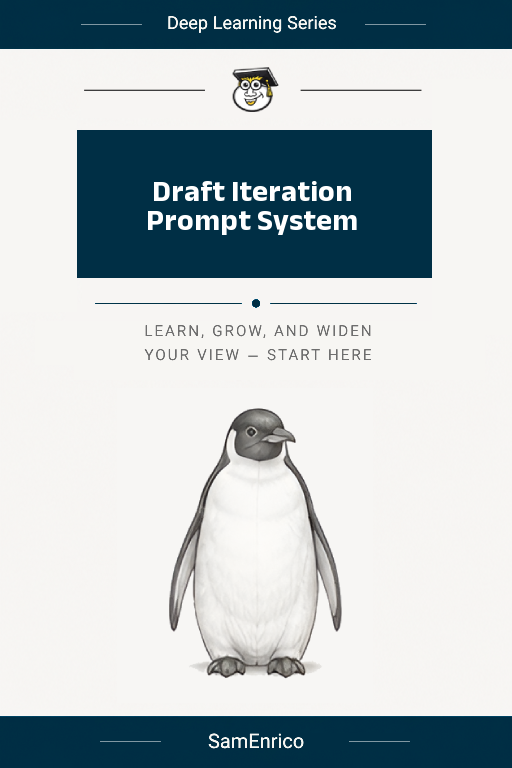
Draft Iteration Prompt System eBook
Move from rough draft to final version using GPT p
Move from rough draft to final version using GPT prompts for content, organization, style, and mechanics in successive passes.
Formats
Free sample
Chapter 1: The Layered Revision...–- Most writers fail不是因为才华不足,而是因为他们在同一个散步里试图解决所有问题。他们会看着自己粗糙的初稿,感到一阵恶心,然后开始漫无目的地修补——这里加一个形容词,那里删一个句子,改一个逗号,又改回来。半小时后,稿子看起来不同了,但并不更好。他们陷入了我称之为“修订漩涡”的状态:在内容的真空中移动词语,在不存在的结构上打磨句子。This chapter introduces the foundational insight upon which this entire book rests: revision is not a single activity but four distinct activities, and artificial intelligence—specifically GPT—is uniquely suited to help with each, provided you separate them. The Four-Pass Framework is not just a method; it is the cure for the revision漩涡.The Myth of Simultaneous Revision Let me describe a scene that may feel familiar. You have just finished a rough draft. Perhaps it is an essay, a report, a blog post, or a chapter of a book. You read it over and feel a diffuse sense of dissatisfaction.
The argument seems thin in places, the organization feels jumbled, some sentences are awkward, and you are pretty sure there is a comma splice on page two.So you begin. You rewrite the first paragraph to make it more compelling. Then you notice a grammatical error in the third paragraph, so you fix that. Then you realize that fixing that error revealed a logical leap, so you add a sentence to bridge it. Then you see that the new sentence made the paragraph too long, so you cut something else.
Two hours later, you have touched every paragraph but accomplished little. The draft is different but not fundamentally better.This is the trap of simultaneous revision. It feels productive because you are moving, but you are moving in circles. The problem is structural, not personal: the human brain is not good at holding content, organization, style, and mechanics in working memory at the same time. Each time you switch from fixing a comma to strengthening an argument, you pay a cognitive switching penalty.
After three or four switches, you are exhausted and confused, and the draft reflects that exhaustion.The evidence for this is both neurological and experiential. Psychologists call it task-switching cost: shifting between different types of cognitive work reduces speed and accuracy by as much as 40 percent. When you revise, you are not simply shifting between similar tasks. You are shifting between fundamentally different modes of thinking. Fixing a comma requires rule-based, local attention.
Strengthening an argument requires global, strategic attention. Your brain cannot do both well at the same time.Yet most writing advice ignores this reality. We are told to "revise ruthlessly" or "polish until it shines" without being told how to sequence that work. The result is that many writers never learn to revise systematically. They either stop too early, leaving significant problems unaddressed, or they revise endlessly, never confident that they are done.The Four Passes Defined The Four-Pass Framework solves this by separating revision into four distinct passes, each with a single focus.
You complete each pass before moving to the next. You never mix passes. This is not a suggestion; it is the core discipline of this book.Pass One: Content – What you say. This pass addresses the substance of your writing: your argument, your claims, your evidence, your examples, and the gaps between them. In Pass One, you do not care about organization, style, or mechanics.
You care only about whether you have said what you mean to say and whether what you have said is true, well-supported, and complete. You add missing evidence, delete irrelevant tangents, strengthen weak claims, and fill logical gaps. You are a developmental editor looking at the skeleton of your piece.Pass Two: Organization – How it flows. This pass addresses the structure of your writing: the sequence of your points, the transitions between paragraphs, the pacing of information, and the placement of section breaks. In Pass Two, you do not care about sentence-level style or grammar.
You care only about whether a reader can follow your argument from beginning to end without getting lost. You reorder paragraphs, rewrite topic sentences, insert signposts, add subheadings, and balance exposition with narrative. You are a structural editor looking at the architecture of your piece.Pass Three: Style – How it sounds. This pass addresses the sentence-level craft of your writing: clarity, rhythm, voice, tone, and figurative language. In Pass Three, you do not care about content or organization (those are locked from the previous passes) and you do not yet care about mechanics (that comes last).
You care only about whether each sentence is clear, whether your voice is consistent, and whether your prose has energy and music. You cut wordiness, replace passive voice with active verbs, vary sentence length, add metaphors, and eliminate jargon. You are a line editor looking at the surface of your piece.Pass Four: Mechanics – How it obeys the rules. This pass addresses grammar, punctuation, spelling, and consistency. In Pass Four, you do not care about anything else because everything else has already been fixed.
You care only about whether your writing conforms to the conventions of standard written English (or your chosen style guide). You fix comma splices, correct subject-verb agreement, standardize hyphenation, and catch typos. You are a proofreader looking at the polish of your piece.These four passes are sequential and non-negotiable. You cannot do Pass Four before Pass One because fixing a comma in a sentence that should be deleted is wasted effort. You cannot do Pass Two before Pass One because organizing weak content only makes the weakness more visible.
Each pass builds on the previous passes. Content first, then organization, then style, then mechanics.Why GPT Excels at Layered Revision You might be thinking: this sounds like a lot of work. And it is. But here is where GPT changes everything.Traditional revision tools—spell checkers, grammar checkers, even human editors—struggle with layered revision because they are not designed to separate passes. A human editor can do all four passes at once, but that is expensive and slow.
A grammar checker can only do Pass Four. A readability score can only hint at Pass Three.GPT is different. Because GPT processes language as a pattern-matching system without an inherent sense of priority, it can be prompted to focus on a single pass with remarkable accuracy. You can tell GPT: "Ignore grammar and style. Only tell me where my argument has gaps." And GPT will do exactly that.
You can tell GPT: "Do not change any content. Only suggest better transitions between paragraphs." And GPT will do that too.This is the revolutionary insight: GPT does not have a built-in editorial hierarchy, so you can impose your own. In traditional revision, you fight against your own brain's tendency to see everything at once. With GPT, you can delegate each pass to a machine that never gets distracted, never gets tired, and never accidentally mixes passes.Consider the difference. A human revising without GPT might spend three hours on a 2,000-word draft, unconsciously switching between passes dozens of times, and end with modest improvements.
A writer using the Four-Pass Framework with GPT might spend:Pass One (Content): 20 minutes with GPT, identifying gaps and weak evidence Pass Two (Organization): 15 minutes with GPT, restructuring and adding transitions Pass Three (Style): 25 minutes with GPT, tightening sentences and improving voice Pass Four (Mechanics): 10 minutes with GPT, catching errors Total: 70 minutes, with significantly better results than three hours of untethered revision. This…
This is the end of the free sample. Get the eBook to keep going. Buy now
About this book
Details
- Author
- Cavanaugh Cherelle
- Publisher
- SamEnrico
- Language
- English
- Genre
- Non-Fiction, Student's Shortcut
- Released
- 2026-06-02
- Pages (approx.)
- 149
- Available as
- eBook, Audiobook

Read better in the ZLOADR app
Your eBooks on your phone or tablet. Sign in with your SamEnrico account and start reading.
More by Cavanaugh Cherelle
 Women in Military Combat RolesCavanaugh Cherelle$11.99
 Political Donation BehaviorCavanaugh Cherelle$11.99
 Money Habit FormationCavanaugh Cherelle$11.99
 SM 2 Algorithm ExplainedCavanaugh Cherelle$11.99
 Managing Focus Drift ManualCavanaugh Cherelle$11.99
 Sexual Offender PsychopathyCavanaugh Cherelle$11.99
 Step Six and Seven DefectsCavanaugh Cherelle$11.99
 Challenging Limiting BeliefsCavanaugh Cherelle$11.99
 The Spy Who Vanished: The Ottoman Empire’s Forgotten InformantCavanaugh Cherelle$11.99
 The Forgotten Front: The Secret War in the HimalayasCavanaugh Cherelle$11.99
 Understanding Kugelberg-welander DiseaseCavanaugh Cherelle$11.99
 How to Become a Marble SetterCavanaugh Cherelle$11.99
You may also like
 Hong Kong Handover 1997Dunn Johnnie$11.99
 Zumba For Postnatal Recovery CourseNeal Christian$11.99
 Zumba for BeginnersLadner Nikia$11.99
 YouTube Comment Mining GuideHumes Pandora$12.99
 Worry Box MeditationCarlin Rudy$11.99
 Workplace Stress MeditationNguyen Lynn$11.99
 Workplace Stress and Sleep RepairHawley Ivory$11.99
 Workplace Perfectionism CureDelaney Jeffry$11.99
 Workplace Injustice Anger GuideWallen Isabelle$11.99
 Work Addiction and Burnout LinkGreenwood Ester$11.99
 Women in Yoga and WellnessBeattie Galina$11.99
 Women in Stand Up ComedyChun Evangeline$11.99