
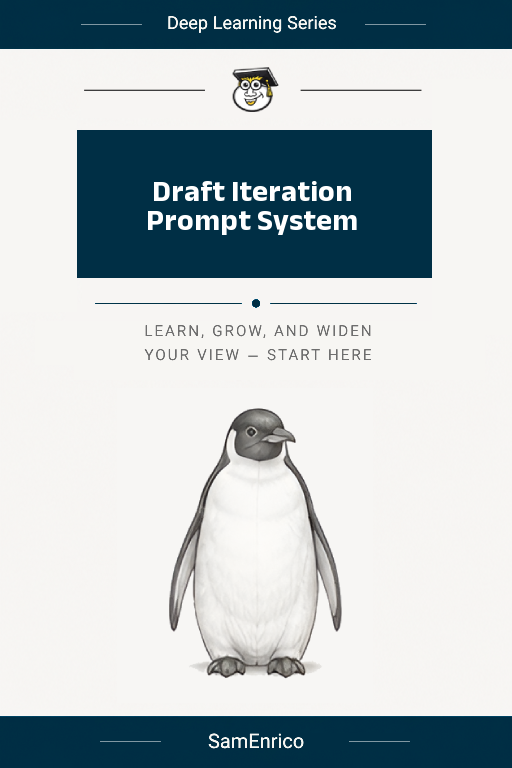
Draft Iteration Prompt System
Move from rough draft to final version using GPT p
Move from rough draft to final version using GPT prompts for content, organization, style, and mechanics in successive passes.
Formats
About this book
Free sample
Chapter 1: The Layered Revision...–- Most writers fail不是因为才华不足,而是因为他们在同一个散步里试图解决所有问题。他们会看着自己粗糙的初稿,感到一阵恶心,然后开始漫无目的地修补——这里加一个形容词,那里删一个句子,改一个逗号,又改回来。半小时后,稿子看起来不同了,但并不更好。他们陷入了我称之为“修订漩涡”的状态:在内容的真空中移动词语,在不存在的结构上打磨句子。This chapter introduces the foundational insight upon which this entire book rests: revision is not a single activity but four distinct activities, and artificial intelligence—specifically GPT—is uniquely suited to help with each, provided you separate them. The Four-Pass Framework is not just a method; it is the cure for the revision漩涡.The Myth of Simultaneous Revision Let me describe a scene that may feel familiar. You have just finished a rough draft. Perhaps it is an essay, a report, a blog post, or a chapter of a book. You read it over and feel a diffuse sense of dissatisfaction.
The argument seems thin in places, the organization feels jumbled, some sentences are awkward, and you are pretty sure there is a comma splice on page two.So you begin. You rewrite the first paragraph to make it more compelling. Then you notice a grammatical error in the third paragraph, so you fix that. Then you realize that fixing that error revealed a logical leap, so you add a sentence to bridge it. Then you see that the new sentence made the paragraph too long, so you cut something else.
Two hours later, you have touched every paragraph but accomplished little. The draft is different but not fundamentally better.This is the trap of simultaneous revision. It feels productive because you are moving, but you are moving in circles. The problem is structural, not personal: the human brain is not good at holding content, organization, style, and mechanics in working memory at the same time. Each time you switch from fixing a comma to strengthening an argument, you pay a cognitive switching penalty.
After three or four switches, you are exhausted and confused, and the draft reflects that exhaustion.The evidence for this is both neurological and experiential. Psychologists call it task-switching cost: shifting between different types of cognitive work reduces speed and accuracy by as much as 40 percent. When you revise, you are not simply shifting between similar tasks. You are shifting between fundamentally different modes of thinking. Fixing a…
This is the end of the free sample. Get the eBook to keep going. Buy now
Contents
- Chapter 1
- Chapter 2
- Chapter 3
- Chapter 4
- Chapter 5
- Chapter 6
- Chapter 7
- Chapter 8
- Chapter 9
- Chapter 10
- Chapter 11
- Chapter 12
Details
- Author
- Cavanaugh Cherelle
- Publisher
- SamEnrico
- Language
- English
- Genre
- Non-Fiction, Student's Shortcut
- Released
- 2026-06-02
- Pages (approx.)
- 149
- Available as
- eBook, Audiobook

Read better in the ZLOADR app
Your eBooks on your phone or tablet. Sign in with your SamEnrico account and start reading.
More by Cavanaugh Cherelle
 Women in Military Combat RolesCavanaugh Cherelle$11.99
 Political Donation BehaviorCavanaugh Cherelle$11.99
 Money Habit FormationCavanaugh Cherelle$11.99
 SM 2 Algorithm ExplainedCavanaugh Cherelle$11.99
 Managing Focus Drift ManualCavanaugh Cherelle$11.99
 Sexual Offender PsychopathyCavanaugh Cherelle$11.99
 Step Six and Seven DefectsCavanaugh Cherelle$11.99
 Challenging Limiting BeliefsCavanaugh Cherelle$11.99
 The Spy Who Vanished: The Ottoman Empire’s Forgotten InformantCavanaugh Cherelle$11.99
 The Forgotten Front: The Secret War in the HimalayasCavanaugh Cherelle$11.99
 Understanding Kugelberg-welander DiseaseCavanaugh Cherelle$11.99
 How to Become a Marble SetterCavanaugh Cherelle$11.99
You may also like
 LSE Online Program LengthAgee Letisha$11.99
 Harvard Extension School for Working AdultsRoush Yer$11.99
 LSE Online Reading ListAshford Ludivina$11.99
 LSE Online Language RequirementsWhitten Daphine$11.99
 LSE Online Class SizeHughey Garret$11.99
 LSE Online Alumni MentorshipWild Lyla$11.99
 London School of Economics Alumni NetworkDutton Chantal$11.99
 Harvard Extension School Student SupportCantrell Christene$11.99
 Harvard Extension School Library AccessSantana Adah$11.99
 Harvard Extension School Degree CompletionBray Wyatt$11.99
 Harvard Extension School Course AuditingAbbott Craig$11.99
 Harvard Extension School Extension DiplomaNew Joane$11.99