
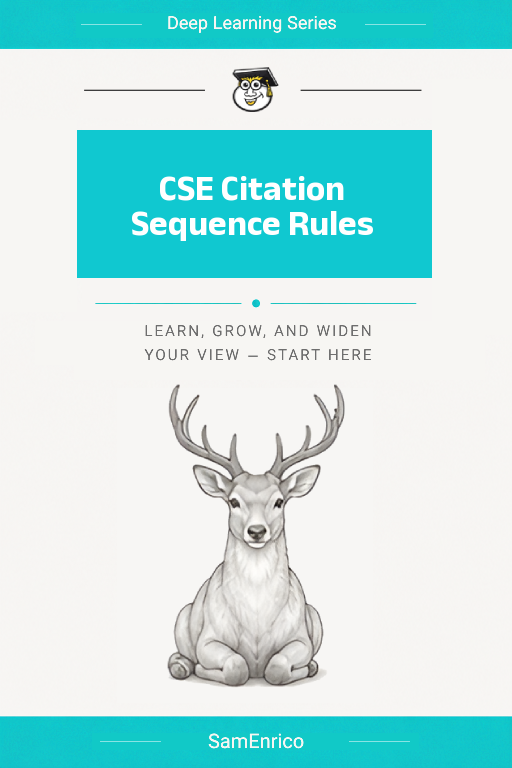
Non-FictionStudent's ShortcutScientific WritingBiology Reference
CSE Citation Sequence Rules Audiobook
Format scientific papers with numbered in-text cit
by Lai Velva
Format scientific papers with numbered in-text citations and corresponding reference lists for journals and data sets.
Formats
Free sample
Chapter 1: The Citation Trap...--–- You have just finished a six-month research project. Your data are clean. Your figures are publication-ready. Your discussion section is eloquent. You upload your manuscript to a journal’s submission portal, fill out the metadata forms, and press submit.
Three days later, a decision arrives. Not peer review. Not “revise and resubmit.” A desk rejection. The editor’s note is polite but firm: “Your manuscript does not conform to our reference formatting requirements. Please review the CSE Citation-Sequence guidelines and resubmit.”You open the rejection email again, scanning for something substantive—a critique of your methods, a question about your sample size, anything.
There is nothing. The only barrier between you and review is a handful of misplaced commas, incorrectly abbreviated journal titles, and a reference list ordered alphabetically instead of by citation order. Six months of work, stalled by formatting.If this scenario feels familiar, you are not alone. Every year, thousands of manuscripts are returned without review because of citation errors. Journal editors report that reference list problems are among the top three reasons for immediate desk rejection, alongside poor English and mismatched journal scope.
The tragedy is not that researchers do not care about citations. The tragedy is that no one ever taught them the logic behind the rules.This book exists to fix that problem for one specific citation system: CSE Citation-Sequence. Not because it is the only system you will ever need—you may also encounter APA, Chicago, Vancouver, or IEEE depending on your field—but because CSE is the dominant system in the life sciences, environmental sciences, and many physical sciences. More importantly, Citation-Sequence (C-S) has a unique logic that, once understood, makes all other numbered citation systems easier to learn.This chapter will answer three fundamental questions. First, why do we cite sources at all?
Second, what are the three CSE systems, and how do you choose between them? Third, what makes CSE Citation-Sequence the right choice for most scientific writers, and how do major journals implement it? By the end of this chapter, you will understand not just the mechanics of citation but the scientific values that make citation essential to the enterprise of research itself.The Scientific Ethos: Why Citation Is Not a Formality Before you learn any rule, you must understand why the rule exists. Citation is not a bureaucratic hoop designed to frustrate you.…
This is the end of the free sample. Get the Audiobook to keep going. Buy now
About this book
Details
- Author
- Lai Velva
- Publisher
- SamEnrico
- Language
- English
- Genre
- Non-Fiction, Student's Shortcut, Scientific Writing, Biology Reference
- Released
- 2026-05-30
- Pages (approx.)
- 160
- Available as
- eBook, Audiobook

Listen in the VoxFlicks app
Audiobooks and audio dramas wherever you go. Sign in with your SamEnrico account and press play.
More by Lai Velva
 The Nap Journaling MethodLai Velva$11.99
 Study Schedule PlannerLai Velva$11.99
 Zumba for Stress ReliefLai Velva$11.99
 Parent Death and AdoptionLai Velva$11.99
 The Cruise Ship EnslavementLai Velva$11.99
 Google Calendar MemoryLai Velva$11.99
 Cessation For Mental Health PatientsLai Velva$11.99
 Child Loss And AdoptionLai Velva$11.99Child Loss And AdoptionLai Velva$11.99
 Assertiveness For The BedriddenLai Velva$11.99
 Seams of Time: The Unseen Threads of Dior’s New LookLai Velva$11.99
 The Silent Rebellion: The Forgotten Uprising of the Women of HollowayLai Velva$11.99
You may also like
 Hong Kong Handover 1997Dunn Johnnie$11.99
 Zumba For Postnatal Recovery CourseNeal Christian$11.99
 Zumba for BeginnersLadner Nikia$11.99
 YouTube Comment Mining GuideHumes Pandora$12.99
 Worry Box MeditationCarlin Rudy$11.99
 Workplace Stress MeditationNguyen Lynn$11.99
 Workplace Stress and Sleep RepairHawley Ivory$11.99
 Workplace Perfectionism CureDelaney Jeffry$11.99
 Workplace Injustice Anger GuideWallen Isabelle$11.99
 Work Addiction and Burnout LinkGreenwood Ester$11.99
 Women in Yoga and WellnessBeattie Galina$11.99
 Women in Stand Up ComedyChun Evangeline$11.99