
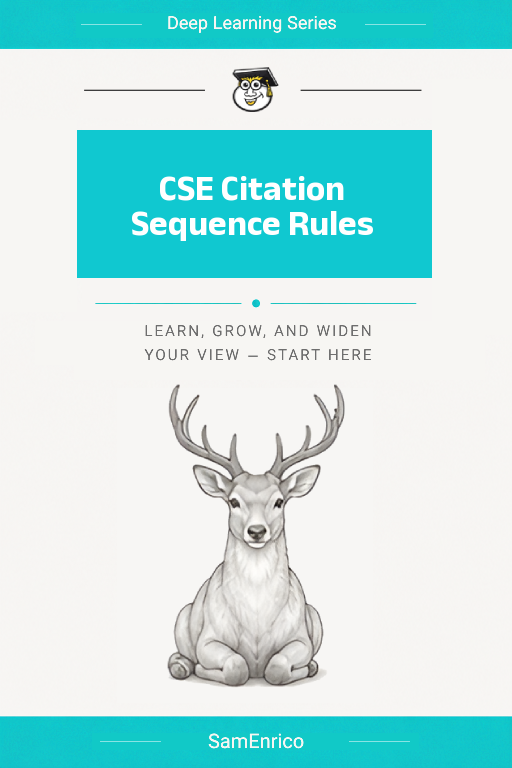
CSE Citation Sequence Rules eBook
Format scientific papers with numbered in-text cit
by Lai Velva
Format scientific papers with numbered in-text citations and corresponding reference lists for journals and data sets.
Formats
Free sample
Chapter 1: The Citation Trap...--–- You have just finished a six-month research project. Your data are clean. Your figures are publication-ready. Your discussion section is eloquent. You upload your manuscript to a journal’s submission portal, fill out the metadata forms, and press submit.
Three days later, a decision arrives. Not peer review. Not “revise and resubmit.” A desk rejection. The editor’s note is polite but firm: “Your manuscript does not conform to our reference formatting requirements. Please review the CSE Citation-Sequence guidelines and resubmit.”You open the rejection email again, scanning for something substantive—a critique of your methods, a question about your sample size, anything.
There is nothing. The only barrier between you and review is a handful of misplaced commas, incorrectly abbreviated journal titles, and a reference list ordered alphabetically instead of by citation order. Six months of work, stalled by formatting.If this scenario feels familiar, you are not alone. Every year, thousands of manuscripts are returned without review because of citation errors. Journal editors report that reference list problems are among the top three reasons for immediate desk rejection, alongside poor English and mismatched journal scope.
The tragedy is not that researchers do not care about citations. The tragedy is that no one ever taught them the logic behind the rules.This book exists to fix that problem for one specific citation system: CSE Citation-Sequence. Not because it is the only system you will ever need—you may also encounter APA, Chicago, Vancouver, or IEEE depending on your field—but because CSE is the dominant system in the life sciences, environmental sciences, and many physical sciences. More importantly, Citation-Sequence (C-S) has a unique logic that, once understood, makes all other numbered citation systems easier to learn.This chapter will answer three fundamental questions. First, why do we cite sources at all?
Second, what are the three CSE systems, and how do you choose between them? Third, what makes CSE Citation-Sequence the right choice for most scientific writers, and how do major journals implement it? By the end of this chapter, you will understand not just the mechanics of citation but the scientific values that make citation essential to the enterprise of research itself.The Scientific Ethos: Why Citation Is Not a Formality Before you learn any rule, you must understand why the rule exists. Citation is not a bureaucratic hoop designed to frustrate you. It is one of the core practices that distinguish science from opinion, propaganda, and pseudoscience.Intellectual Honesty: Giving Credit Where Credit Is Due The most obvious reason to cite sources is ethical.
When you use another researcher’s idea, data, method, or phrasing, you owe them credit. This is not merely about avoiding plagiarism, though plagiarism is certainly a cardinal sin in academia. It is about participating in a community where recognition for discovery is the primary currency. Scientists do not get wealthy from their publications. They get reputation, grants, tenure, and the intangible reward of seeing their name associated with an advance in human knowledge.
When you fail to cite someone whose work enabled yours, you are not just breaking a rule. You are stealing their currency.Consider the case of a young postdoctoral researcher who publishes a paper describing a new statistical method for analyzing gene expression data. That method takes three years to develop. Another research group uses the method in a high-profile paper but buries the citation in a supplementary materials section or, worse, omits it entirely. The original developer receives no recognition.
When they apply for tenure, the citation count for their method paper is artificially low. A funding agency reviewing their grant sees limited impact. The failure to cite has real-world consequences.CSE Citation-Sequence, like all citation systems, exists to make credit visible and verifiable. The numbered citation in your text is a promise to the reader: “I did not invent this claim. Here is exactly where you can find its origin.”Reproducibility: The Reader’s Right to Trace Your Steps Science is not a collection of facts.
It is a process for generating reliable knowledge. A scientific paper is not a final statement of truth. It is an invitation: “Here is what we did. Here is what we found. Here is how you can do it yourself.”Citations are the trail of breadcrumbs that allows another researcher to replicate your work.
If you cite a source incorrectly—wrong author, wrong journal, wrong year—you break that trail. The reader who wants to verify your claim or build upon your methods may not be able to find the source. In some cases, an incorrect citation leads to a different paper entirely, one that does not actually support your claim. This is not merely sloppy. It is a threat to the integrity of the scientific record.The CSE Citation-Sequence system places a premium on precision.
Every element of a citation—author initials without periods, the specific punctuation pattern of semicolons and colons, the abbreviation of journal titles—serves the goal of unambiguous identification. When you see Smith J. 2024. J Exp Med. 35(2):123-35, you know exactly where to look.
The journal abbreviation follows a standardized list (the NLM Catalog or ISSN LTWA). The volume and issue numbers are clearly separated. The page range is complete. No guesswork is required.Scholarly Dialogue: Positioning Your Work in a Conversation Every scientific paper enters an ongoing conversation. Other researchers have asked similar questions, tested similar hypotheses, and published their results.
Your work does not exist in a vacuum. It responds to, extends, or challenges previous work.Citations are the grammar of that conversation. When you write “Smith et al. (2024) demonstrated X, but our results suggest Y,” you are not just citing a source. You are positioning your contribution relative to existing knowledge.
The reader understands that you are aware of Smith’s work, that you respect it enough to engage with it, and that you have something new to add.A well-cited paper is a map of the conversation. It shows which ideas are settled, which are contested, and which questions remain open. A poorly cited paper—one that omits key sources, cites irrelevancies, or misrepresents what previous authors said—signals that the author is not a competent participant in the conversation. Editors and peer reviewers notice this immediately.The CSE Citation-Sequence system, with its numbered in-text citations, makes this dialogue efficient to read. Unlike Name-Year systems, where parenthetical author names and dates can interrupt the flow of a sentence, CSE’s superscript numbers or parenthetical numbers are unobtrusive.
The reader can follow your argument without being distracted by repeated author names. When they want to check a source, they glance at the numbered reference list. This efficiency is why CSE is preferred in biomedical writing, where papers often cite dozens or hundreds of sources.The Three CSE Systems: A Clear Comparison The Council of Science Editors (CSE) recognizes three distinct citation systems. They are not interchangeable. Most journals specify which system they require, and submitting a paper in the wrong system is a fast path to desk rejection.
Understanding the differences is your first line of defense.CSE Citation-Sequence (C-S)Citation-Sequence is the subject of this book. Its defining characteristic…
This is the end of the free sample. Get the eBook to keep going. Buy now
About this book
Details
- Author
- Lai Velva
- Publisher
- SamEnrico
- Language
- English
- Genre
- Non-Fiction, Student's Shortcut, Scientific Writing, Biology Reference
- Released
- 2026-05-30
- Pages (approx.)
- 160
- Available as
- eBook, Audiobook

Read better in the ZLOADR app
Your eBooks on your phone or tablet. Sign in with your SamEnrico account and start reading.
More by Lai Velva
 The Nap Journaling MethodLai Velva$11.99
 Study Schedule PlannerLai Velva$11.99
 Zumba for Stress ReliefLai Velva$11.99
 Parent Death and AdoptionLai Velva$11.99
 The Cruise Ship EnslavementLai Velva$11.99
 Google Calendar MemoryLai Velva$11.99
 Cessation For Mental Health PatientsLai Velva$11.99
 Child Loss And AdoptionLai Velva$11.99Child Loss And AdoptionLai Velva$11.99
 Assertiveness For The BedriddenLai Velva$11.99
 Seams of Time: The Unseen Threads of Dior’s New LookLai Velva$11.99
 The Silent Rebellion: The Forgotten Uprising of the Women of HollowayLai Velva$11.99