
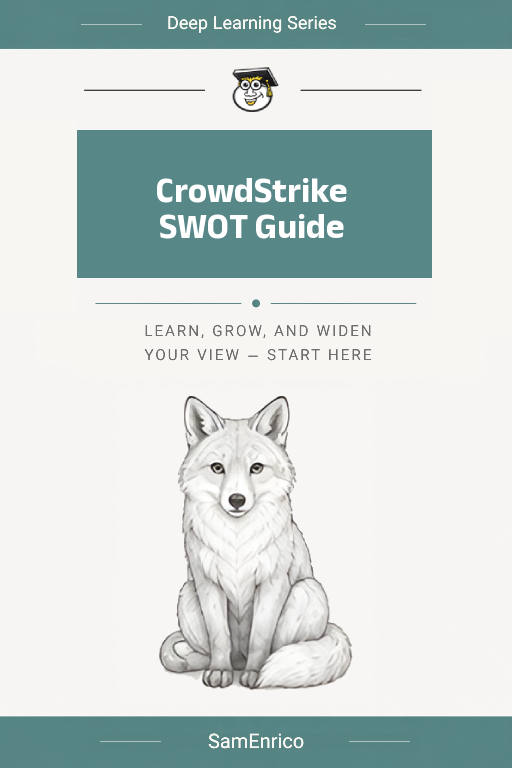
Non-FictionStrategic AtlasCybersecurity
CrowdStrike SWOT Guide eBook
Analyze endpoint security leadership, cloud-native
Analyze endpoint security leadership, cloud-native architecture, competition from Microsoft, and outage recovery.
Formats
Free sample
Chapter 1: The Speed Paradox--–- On July 18, 2024, the day before the world broke, Crowd Strike’s Falcon sensor was the most trusted piece of security software on the planet. Banks routed billions through systems it protected. Hospitals relied on it to keep patient data safe. Airlines used it to safeguard ticketing and operations. The company’s stock had climbed over 1,000% since its 2019 IPO, and its CEO, George Kurtz, was regularly introduced as the man who had helped stop the 2014 Sony hack and who had built a cybersecurity juggernaut from scratch.
The narrative was simple and seductive: legacy antivirus was dead, cloud-native security was the future, and Crowd Strike had won.Twenty-four hours later, that narrative lay in ruins. On July 19, 2024, a routine content update – a “channel file” that had been deployed safely thousands of times before – triggered the largest IT outage in history. Eight point five million Windows machines crashed simultaneously. Airports from Singapore to London to Atlanta ground to a halt. Emergency 911 systems failed across multiple states.
Hospitals canceled surgeries. Banks could not process transactions. And Crowd Strike, the company that had built its brand on being “the cybersecurity leader,” found itself explaining why its software had blue-screened the world.The immediate question was technical: what went wrong? The deeper question – the one that would haunt the company for years – was strategic: how could a company that had mastered speed and agility fall victim to its own velocity? How could the same attribute that made Crowd Strike a disruptive genius become the weapon of its own near-destruction?This chapter answers that question by introducing the Speed Paradox Framework – a concept that distinguishes between low-risk and high-risk updates in security software.
We will explore how Crowd Strike’s rise was built on architectural agility, how that agility created unprecedented competitive advantage against legacy vendors, and how a failure to categorize risk correctly turned a strength into a weakness on July 19. By the end of this chapter, you will understand why speed is not inherently good or bad – it depends entirely on what you are speeding up.The Innovator’s Dilemma, Revisited To understand Crowd Strike’s rise, you must first understand the graveyard of the companies it left behind. In 2010, the endpoint security market was dominated by Symantec, Mc Afee, and Trend Micro – household names that had built billion-dollar franchises on the back of a simple model: on-premise appliances that scanned for known virus signatures. The model had worked for two decades. But it carried a hidden vulnerability: the update cycle.Every time a new virus emerged, these legacy vendors had to identify the signature, package it, test it, and push it to customers.
The process took weeks. In the meantime, enterprises were exposed. Crowd Strike’s founders recognized that the future belonged to real-time detection, not weekly signature updates. They bet everything on a radical alternative: put the security logic in the cloud, keep only a lightweight “sensor” on the endpoint, and let the sensor send telemetry to a central AI for instant decisioning.This was, in Clayton Christensen’s framing, a classic disruptive innovation. Legacy vendors were trapped by their own business models.
They had built complex on-premise ecosystems that generated high maintenance revenue. Moving to the cloud would cannibalize that revenue. So they clung to the past, dismissing Crowd Strike as a niche player for tech-forward enterprises.Crowd Strike, meanwhile, was free to build from scratch. Its founders had learned from the Phoenix Project and the Dev Ops revolution that software could be updated not in weeks, but in minutes. The Falcon sensor could receive new detection logic multiple times per day.
When a new threat appeared, Crowd Strike could update its global customer base in under an hour. Legacy vendors could not match this. Their on-premise appliances required manual updates, customer approval windows, and reboot cycles. By the time they deployed a signature, Crowd Strike had already detected and blocked the threat for days.This speed advantage transformed the competitive landscape. Between 2015 and 2020, Crowd Strike grew from a startup to a public company with a market capitalization exceeding $30 billion.
Symantec and Mc Afee were sold to private equity at distressed valuations. Trend Micro retreated to Asian markets. The message was clear: in endpoint security, speed kills – or rather, speed wins.But there was a nuance that almost everyone missed. The updates that Crowd Strike pushed daily were detection logic updates – new rules for identifying malware based on behavioral patterns. These updates operated in user mode, not kernel mode.
They could be rolled back instantly if something went wrong because they did not touch the operating system’s core. They were, in risk terms, low-impact.The July 19 update was something entirely different.The Kernel Question: Where Security Meets Catastrophe To understand the difference, we need to take a brief detour into operating system architecture – not at the level of a kernel engineer, but at the level that matters for investors and strategists.Every modern operating system – Windows, mac OS, Linux – has two primary modes: user mode and kernel mode. User mode is where applications like Word, Chrome, and Excel run. If an application crashes, the operating system continues running. You close the application, maybe lose some unsaved work, but your computer stays on.
Kernel mode is where the operating system core runs – the code that manages memory, processes, and hardware. If kernel-mode code crashes, the entire operating system crashes. You get the Blue Screen of Death (BSOD).Security software faces a fundamental choice. You can run in user mode, which is safer but slower. To detect a threat, you have to ask the operating system for data, wait for a response, and then act.
This latency can be measured in milliseconds – enough for sophisticated malware to execute. Or you can run in kernel mode, which gives you direct, real-time visibility into every system call, every memory access, every process creation. You can block a threat before the operating system even knows it exists. But if your kernel-mode code contains a bug, you take down the entire machine.Crowd Strike chose kernel mode. This was not a controversial decision at the time – every serious endpoint security vendor ran in kernel mode because the performance advantage was simply too large to ignore.
Microsoft’s own Defender ran partially in kernel mode. Sentinel One ran in kernel mode. The industry consensus was that kernel access was necessary for real protection.What was different about Crowd Strike was the frequency of its kernel-mode updates. Legacy vendors updated their kernel drivers once per quarter, sometimes once per year, after months of testing. Crowd Strike updated its kernel-mode components – including channel files, which were configuration data interpreted by the kernel driver – every few days.
Sometimes every few hours.This was the hidden trade-off. Crowd Strike had built a machine that could deliver incredible speed and agility, but that speed applied to kernel-mode code as much as to user-mode detection logic. And kernel-mode updates carried a risk profile that was orders of magnitude higher. A bad detection logic update could be rolled back in minutes with no system crash. A bad channel file update could – and on July 19, did – crash every Windows…
This is the end of the free sample. Get the eBook to keep going. Buy now
About this book
Details
- Author
- Merriman Carisa
- Publisher
- SamEnrico
- Language
- English
- Genre
- Non-Fiction, Strategic Atlas, Cybersecurity
- Released
- 2026-05-29
- Pages (approx.)
- 148
- Available as
- eBook, Audiobook

Read better in the ZLOADR app
Your eBooks on your phone or tablet. Sign in with your SamEnrico account and start reading.
More by Merriman Carisa
 Senior Garden Esteem GuideMerriman Carisa$11.99
 The Joy of TravelMerriman Carisa$11.99
 Couponing Survival GuideMerriman Carisa$11.99
 Assertive Customer Service GuideMerriman Carisa$11.99
 The Mindfulness App Selection GuideMerriman Carisa$11.99
 The Billion-Dollar Corkscrew: The World's Most Expensive Wine FraudMerriman Carisa$11.99
 How to Start a Standup Comedians - Independent BusinessMerriman Carisa$11.99
 Accounting Formulas for Tax ReturnsMerriman Carisa$12.99
 Camping Sales AssociateMerriman Carisa$11.99
 Understanding Myoneurogastrointestinal Encephalopathy SyndromeMerriman Carisa$17.99
You may also like
 Hong Kong Handover 1997Dunn Johnnie$11.99
 Zumba For Postnatal Recovery CourseNeal Christian$11.99
 Zumba for BeginnersLadner Nikia$11.99
 YouTube Comment Mining GuideHumes Pandora$12.99
 Worry Box MeditationCarlin Rudy$11.99
 Workplace Stress MeditationNguyen Lynn$11.99
 Workplace Stress and Sleep RepairHawley Ivory$11.99
 Workplace Perfectionism CureDelaney Jeffry$11.99
 Workplace Injustice Anger GuideWallen Isabelle$11.99
 Work Addiction and Burnout LinkGreenwood Ester$11.99
 Women in Yoga and WellnessBeattie Galina$11.99
 Women in Stand Up ComedyChun Evangeline$11.99