
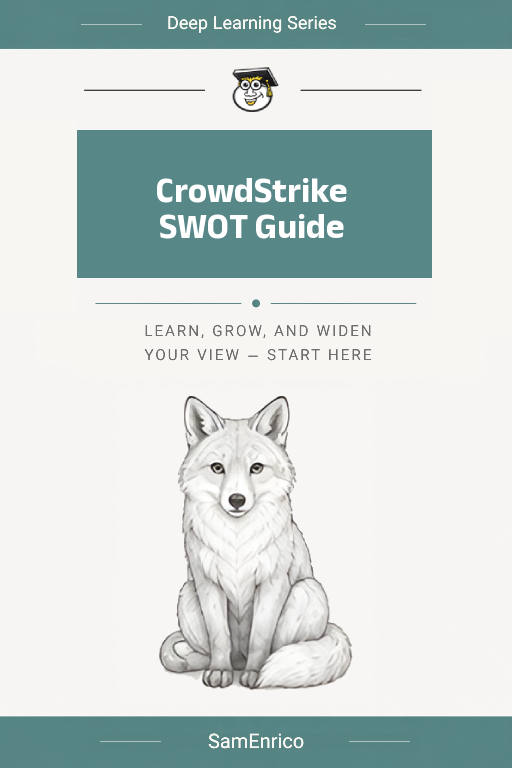
Non-FictionStrategic AtlasCybersecurity
CrowdStrike SWOT Guide
Analyze endpoint security leadership, cloud-native
Analyze endpoint security leadership, cloud-native architecture, competition from Microsoft, and outage recovery.
Formats
About this book
Free sample
Chapter 1: The Speed Paradox--–- On July 18, 2024, the day before the world broke, Crowd Strike’s Falcon sensor was the most trusted piece of security software on the planet. Banks routed billions through systems it protected. Hospitals relied on it to keep patient data safe. Airlines used it to safeguard ticketing and operations. The company’s stock had climbed over 1,000% since its 2019 IPO, and its CEO, George Kurtz, was regularly introduced as the man who had helped stop the 2014 Sony hack and who had built a cybersecurity juggernaut from scratch.
The narrative was simple and seductive: legacy antivirus was dead, cloud-native security was the future, and Crowd Strike had won.Twenty-four hours later, that narrative lay in ruins. On July 19, 2024, a routine content update – a “channel file” that had been deployed safely thousands of times before – triggered the largest IT outage in history. Eight point five million Windows machines crashed simultaneously. Airports from Singapore to London to Atlanta ground to a halt. Emergency 911 systems failed across multiple states.
Hospitals canceled surgeries. Banks could not process transactions. And Crowd Strike, the company that had built its brand on being “the cybersecurity leader,” found itself explaining why its software had blue-screened the world.The immediate question was technical: what went wrong? The deeper question – the one that would haunt the company for years – was strategic: how could a company that had mastered speed and agility fall victim to its own velocity? How could the same attribute that made Crowd Strike a disruptive genius become the weapon of its own near-destruction?This chapter answers that question by introducing the Speed Paradox Framework – a concept that distinguishes between low-risk and high-risk updates in security software.
We will explore how Crowd Strike’s rise was built on architectural agility, how that agility created unprecedented competitive advantage against legacy vendors, and how a failure to categorize risk correctly turned a strength into a weakness on July 19. By the end of this chapter, you will understand why speed is not inherently good or bad – it depends entirely on what you are speeding up.The Innovator’s Dilemma, Revisited…
This is the end of the free sample. Get the eBook to keep going. Buy now
Contents
- Chapter 1
- Chapter 2
- Chapter 3
- Chapter 4
- Chapter 5
- Chapter 6
- Chapter 7
- Chapter 8
- Chapter 9
- Chapter 10
- Chapter 11
- Chapter 12
Details
- Author
- Merriman Carisa
- Publisher
- SamEnrico
- Language
- English
- Genre
- Non-Fiction, Strategic Atlas, Cybersecurity
- Released
- 2026-05-29
- Pages (approx.)
- 148
- Available as
- eBook, Audiobook

Read better in the ZLOADR app
Your eBooks on your phone or tablet. Sign in with your SamEnrico account and start reading.
More by Merriman Carisa
 Senior Garden Esteem GuideMerriman Carisa$11.99
 The Joy of TravelMerriman Carisa$11.99
 Couponing Survival GuideMerriman Carisa$11.99
 Assertive Customer Service GuideMerriman Carisa$11.99
 The Mindfulness App Selection GuideMerriman Carisa$11.99
 The Billion-Dollar Corkscrew: The World's Most Expensive Wine FraudMerriman Carisa$11.99
 How to Start a Standup Comedians - Independent BusinessMerriman Carisa$11.99
 Accounting Formulas for Tax ReturnsMerriman Carisa$12.99
 Camping Sales AssociateMerriman Carisa$11.99
 Understanding Myoneurogastrointestinal Encephalopathy SyndromeMerriman Carisa$17.99
You may also like
 Hong Kong Handover 1997Dunn Johnnie$11.99
 Zumba For Postnatal Recovery CourseNeal Christian$11.99
 Zumba for BeginnersLadner Nikia$11.99
 YouTube Comment Mining GuideHumes Pandora$12.99
 Worry Box MeditationCarlin Rudy$11.99
 Workplace Stress MeditationNguyen Lynn$11.99
 Workplace Stress and Sleep RepairHawley Ivory$11.99
 Workplace Perfectionism CureDelaney Jeffry$11.99
 Workplace Injustice Anger GuideWallen Isabelle$11.99
 Work Addiction and Burnout LinkGreenwood Ester$11.99
 Women in Yoga and WellnessBeattie Galina$11.99
 Women in Stand Up ComedyChun Evangeline$11.99