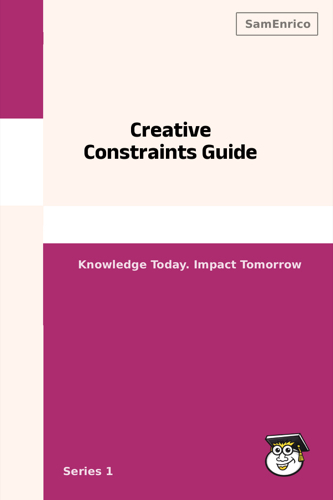
Creative Constraints Guide eBook
Use deliberate limitations to focus and intensify
by Couch Ned
Use deliberate limitations to focus and intensify group creative output.
Formats
Free sample
Chapter 1: The Six Locks...--–- Every creative group I have ever worked with begins in the same place: drowning in possibility. I have watched marketing teams stare at blank whiteboards for forty-five minutes. I have seen product designers cycle through seventeen identical ideas because no one dared to say “that’s been done.” I have sat through engineering meetings where the first hour was spent arguing over which problem to solve, not how to solve it. The common thread in all of these failures was not a lack of talent, intelligence, or motivation. It was a lack of structure.
More precisely, it was a lack of the right kind of structure.This chapter introduces the foundational framework of this book: the six types of creative constraints that groups can deliberately impose to focus and intensify their output. I call them the Six Locks, because like locks on a door, they do not trap you inside a small space—they protect the space where real work happens. Without them, your team’s creative process is not free; it is merely exposed to every distraction, every bad idea, and every meandering detour that possibility offers.The Six Locks are time, materials, process, format, social, and cognitive. Each lock restricts a different dimension of group creative work. Each one, when applied correctly, produces a different kind of focus.
And each one can be tightened or loosened depending on the challenge at hand. By the end of this chapter, you will understand not only what these locks are, but how to choose which ones to use, when to combine them, and how to avoid the single most common mistake that facilitators make: using too many at once.Let me begin with a story that illustrates all six locks in action, even though the people involved had no idea they were using them.The Forty-Five Minute Miracle In 2017, I was called into a struggling software company. Their design team had been trying to redesign their flagship dashboard for three months. Three months. They had produced exactly zero finished concepts.
Every Monday, they would gather in a conference room with a large whiteboard. Every Monday, someone would say, “Let’s just brainstorm some ideas.” And every Monday, they would spend four hours generating vague, overlapping, impossible-to-implement notions that no one could commit to.The team was smart. They were experienced. They had all the resources they could want. And they were failing because they had no locks.I walked into their Monday meeting and asked a simple question: “What is the single most important task a user should be able to complete on this dashboard?”After fifteen minutes of debate, they landed on “view their top three priorities for the day.”I then introduced six constraints, one from each lock, without using those terms.
I said: “Here are the rules for the next forty-five minutes. First, you have exactly forty-five minutes. Second, you can only use paper and black markers—no computers. Third, you will work in pairs, not as a full group. Fourth, each pair must produce three rough sketches, no more and no less.
Fifth, no one speaks during the first fifteen minutes except to ask clarifying questions about the task. Sixth, each pair can only consider three data points about user behavior—choose them now.”The team looked at me like I had asked them to build a rocket out of cardboard. But they followed the rules.Forty-five minutes later, they had twelve distinct sketches. Three of them were genuinely novel. One of them became the foundation of their new dashboard, which shipped six weeks later and increased user engagement by 34 percent.What happened in that room?
The team did not suddenly become more creative. They became more focused. The six locks did not restrict their talent; they channeled it. And that is the central insight of this entire book: constraints are not the enemy of creativity. They are the architecture that makes creativity possible.Now let me break down each of the six locks in detail.Lock One: Time The first and most accessible lock is time.
Time constraints limit how long a group has to generate, develop, or deliver creative work. They are powerful because they exploit a basic psychological reality: without a deadline, most groups will expand their work to fill whatever time is available, a phenomenon known as Parkinson’s Law. But time constraints do more than just speed things up. They force prioritization. When you have only thirty minutes, you cannot explore every tangent.
You cannot wait for the perfect idea to arrive. You must work with what you have, where you are, and move forward.Time constraints come in several varieties. Fixed deadlines are the most common: “We will present concepts at 2:00 PM, no exceptions.” Time-boxing is another: “We will spend exactly twenty minutes on ideation, then twenty minutes on selection, then twenty minutes on prototyping.” Blitz sessions are ultra-short constraints, often fifteen minutes or less, designed to generate volume over quality. And rhythmic constraints—like a daily standup limited to fifteen minutes—build creative momentum through repetition.The key to effective time constraints is the Goldilocks zone, a concept that will appear throughout this book. Too much time, and the group dilutes its focus.
Too little time, and the group produces panic-driven garbage. The sweet spot depends on the task, the group’s familiarity with the work, and the phase of the creative process. For warm-ups or resistant groups, fifteen minutes is ideal. For focused problem-solving on a well-defined challenge, thirty minutes works best. For complex, multi-step challenges, forty-five minutes is the upper limit before fatigue sets in.Time constraints have one additional benefit that is rarely discussed: they create a shared rhythm.
When a group knows that the clock is running, they stop negotiating about when to start. They stop waiting for the perfect moment. They simply begin. And in creative work, beginning is often the hardest part.Lock Two: Materials The second lock limits the physical or digital resources a group can use. Material constraints include limits on tools (only paper and pencil, no software), budget (you have five dollars to build a prototype), physical materials (only cardboard and tape), and digital assets (no stock photography, only hand-drawn images).Material constraints work through scarcity.
When groups have unlimited resources, they tend toward complexity. They add features. They use expensive tools. They assume that more is better. But scarcity flips this assumption.
It forces groups to ask: What is the minimum we need to solve this problem? What can we do with what we already have? How can we combine existing resources in novel ways?The most famous example of material constraints in action is the Apollo 13 mission. When an oxygen tank exploded, the astronauts lost power, heat, and clean air. The only way to fix the carbon dioxide filters was to fit a square filter into a round hole using only the materials available on the spacecraft: duct tape, plastic bags, and cardboard.
Engineers on the ground simulated the problem with identical materials and solved it in hours. That solution saved three lives. The constraint was not a hindrance; it was the mother…
This is the end of the free sample. Get the eBook to keep going. Buy now
About this book
Details
- Author
- Couch Ned
- Publisher
- SamEnrico
- Language
- English
- Genre
- Non-Fiction, Self-Help, Constraints
- Released
- 2026-06-08
- Pages (approx.)
- 136
- Available as
- eBook, Audiobook

Read better in the ZLOADR app
Your eBooks on your phone or tablet. Sign in with your SamEnrico account and start reading.
More by Couch Ned
 Parent Growth Mindset GuideCouch Ned$11.99
 Flow and Exercise GuideCouch Ned$11.99
 Assertiveness for Medical SettingsCouch Ned$11.99
 The Committed OKR GuideCouch Ned$11.99
 Money Affirmation Daily GuideCouch Ned$11.99
 Mindfulness for Beginners WorkbookCouch Ned$11.99
 Delegation for Nonprofit LeadersCouch Ned$11.99
 The Jade Dragon’s Last Flight: A Forgotten Tale of the Celestial BeastsCouch Ned$11.99
 The Lost Ballad of the Pacific Pitcher: A Medieval Baseball LegendCouch Ned$11.99
 Ryegrass Seed: Perennial & AnnualCouch Ned$11.99
 How to Start a Man-made Fibres and Yarns (commission Agent) Business (Beginners Guide)Couch Ned$11.99
 Flow State Prerequisites HandbookCouch Ned$12.99