
Non-FictionBusiness BriefCreative Strategy
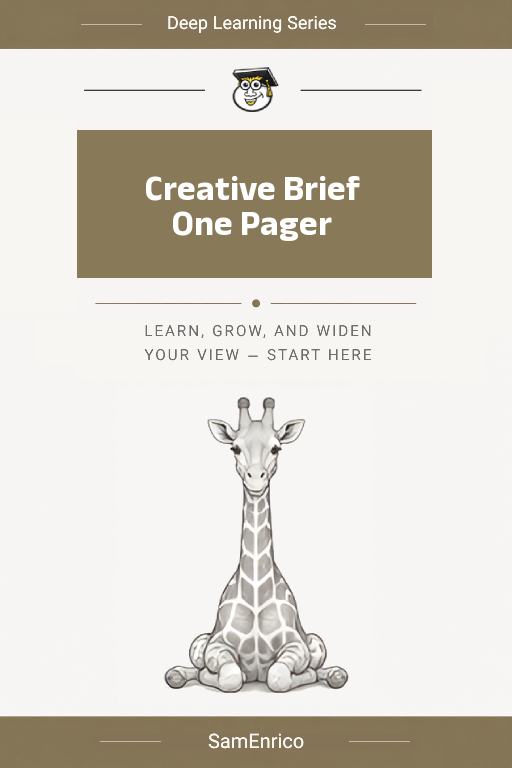
Creative Brief One Pager
Document campaign concept, audience, messaging, an
by Gladden Chin
Document campaign concept, audience, messaging, and deliverables for creative teams.
Formats
About this book
Free sample
Chapter 1: The Fourteen-Page Funeral...--–- The email arrived at 4:47 PM on a Friday. The subject line read: “Final Creative Brief – Please Review.” Attached was a fourteen-page document. Within its pages were three different audience definitions, two competing business objectives, a SWOT analysis, nine customer testimonials, six months of sales data, four stakeholder opinions that contradicted each other, and, buried on page eleven, a single sentence that vaguely suggested the creative team should “make something inspiring.” The creative director closed her laptop, looked at her team, and said, “I have no idea what we’re supposed to do.”That campaign launched six weeks later. It was beautiful. The cinematography was stunning.
The copy was clever. And it failed. It failed because the creative team had to guess which of the fourteen pages actually mattered. They guessed wrong.This chapter is not about that failed campaign. It is about why that campaign failed, why your campaigns are probably failing for the same reason, and what you can steal from emergency medicine, military aviation, and restaurant menus to fix it.Welcome to the paradox of the creative brief: more information rarely leads to better creative.
Usually, it leads to safer, duller, more forgettable work. And the only way out is to embrace the opposite of what every instinct tells you. You must learn to leave things out.The Cognitive Science of Creative Failure Let us start with a simple experiment. I am going to give you two versions of the same instruction. Version A: “Design a logo that is modern, trustworthy, scalable, memorable, distinctive, simple, appropriate, timeless, and versatile.” Version B: “Design a logo that works in one color at the size of a postage stamp.”Which one gives you a clearer path forward?Most people choose Version B, despite Version A containing more “good” attributes.
This is not an accident. It is a feature of how the human brain processes information under creative load. The term for this is cognitive load theory, and it has been studied extensively in educational psychology, human factors engineering, and—more recently—creative workflow design.Cognitive load theory, first…
This is the end of the free sample. Get the eBook to keep going. Buy now
Contents
- Chapter 1
- Chapter 2
- Chapter 3
- Chapter 4
- Chapter 5
- Chapter 6
- Chapter 7
- Chapter 8
- Chapter 9
- Chapter 10
- Chapter 11
- Chapter 12
Details
- Author
- Gladden Chin
- Publisher
- SamEnrico
- Language
- English
- Genre
- Non-Fiction, Business Brief, Creative Strategy
- Released
- 2026-06-01
- Pages (approx.)
- 140
- Available as
- eBook, Audiobook

Read better in the ZLOADR app
Your eBooks on your phone or tablet. Sign in with your SamEnrico account and start reading.
More by Gladden Chin
 Personal Life PrioritizationGladden Chin$11.99
 Self Hypnosis Parts Therapy CourseGladden Chin$11.99
 Angry Parent Self Compassion CourseGladden Chin$11.99
 Out of the Shadows CourseGladden Chin$11.99
 George W Bush War PresidentGladden Chin$11.99
 Ashen Echoes: The Great Fire That Reshaped a NationGladden Chin$11.99
 The Silk Road’s Forgotten Tomb: Unlocking China’s Lost DynastyGladden Chin$11.99
 How to Start a Hobby in MakingWalking SticksGladden Chin$11.99
 Renewable Energy Certificate GuideGladden Chin$12.99
 Customer Delivery ManagerGladden Chin$11.99
 Understanding Czeizel–losonci SyndromeGladden Chin$17.99
You may also like
 Hong Kong Handover 1997Dunn Johnnie$11.99
 Zumba For Postnatal Recovery CourseNeal Christian$11.99
 Zumba for BeginnersLadner Nikia$11.99
 YouTube Comment Mining GuideHumes Pandora$12.99
 Worry Box MeditationCarlin Rudy$11.99
 Workplace Stress MeditationNguyen Lynn$11.99
 Workplace Stress and Sleep RepairHawley Ivory$11.99
 Workplace Perfectionism CureDelaney Jeffry$11.99
 Workplace Injustice Anger GuideWallen Isabelle$11.99
 Work Addiction and Burnout LinkGreenwood Ester$11.99
 Women in Yoga and WellnessBeattie Galina$11.99
 Women in Stand Up ComedyChun Evangeline$11.99