
Non-FictionBusiness BriefCreative Strategy
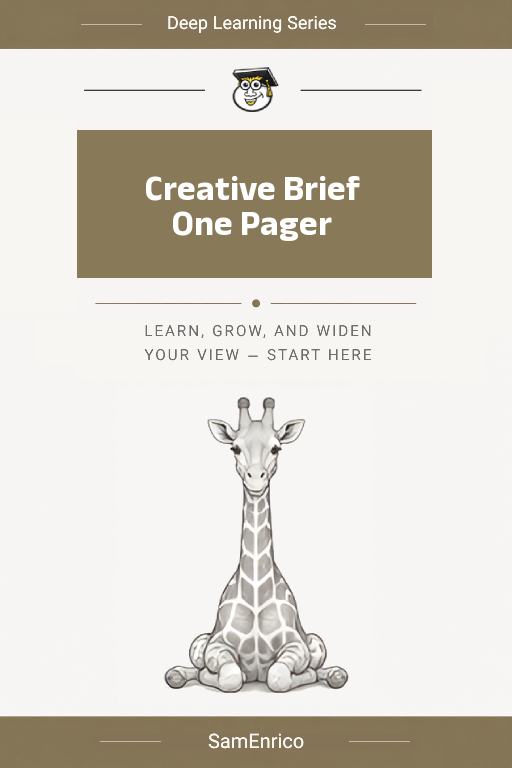
Creative Brief One Pager eBook
Document campaign concept, audience, messaging, an
by Gladden Chin
Document campaign concept, audience, messaging, and deliverables for creative teams.
Formats
Free sample
Chapter 1: The Fourteen-Page Funeral...--–- The email arrived at 4:47 PM on a Friday. The subject line read: “Final Creative Brief – Please Review.” Attached was a fourteen-page document. Within its pages were three different audience definitions, two competing business objectives, a SWOT analysis, nine customer testimonials, six months of sales data, four stakeholder opinions that contradicted each other, and, buried on page eleven, a single sentence that vaguely suggested the creative team should “make something inspiring.” The creative director closed her laptop, looked at her team, and said, “I have no idea what we’re supposed to do.”That campaign launched six weeks later. It was beautiful. The cinematography was stunning.
The copy was clever. And it failed. It failed because the creative team had to guess which of the fourteen pages actually mattered. They guessed wrong.This chapter is not about that failed campaign. It is about why that campaign failed, why your campaigns are probably failing for the same reason, and what you can steal from emergency medicine, military aviation, and restaurant menus to fix it.Welcome to the paradox of the creative brief: more information rarely leads to better creative.
Usually, it leads to safer, duller, more forgettable work. And the only way out is to embrace the opposite of what every instinct tells you. You must learn to leave things out.The Cognitive Science of Creative Failure Let us start with a simple experiment. I am going to give you two versions of the same instruction. Version A: “Design a logo that is modern, trustworthy, scalable, memorable, distinctive, simple, appropriate, timeless, and versatile.” Version B: “Design a logo that works in one color at the size of a postage stamp.”Which one gives you a clearer path forward?Most people choose Version B, despite Version A containing more “good” attributes.
This is not an accident. It is a feature of how the human brain processes information under creative load. The term for this is cognitive load theory, and it has been studied extensively in educational psychology, human factors engineering, and—more recently—creative workflow design.Cognitive load theory, first developed by John Sweller in the 1980s, argues that working memory has a limited capacity. When you overload that capacity with irrelevant, redundant, or contradictory information, learning and problem-solving suffer. For a creative professional, the “problem” is not memorizing facts.
The problem is generating novel connections between disparate ideas. Novelty requires mental bandwidth. Overloading the brief consumes that bandwidth before the work even begins.Here is what happens inside a creative team’s brain when they receive a bloated brief. First, they must filter. They must decide which of the fifty pieces of information are actually decision-relevant.
This filtering consumes energy. Second, they must reconcile contradictions. One stakeholder says the brand is “luxury.” Another says “accessible.” The brief includes both. The creative team must resolve this contradiction themselves, often without authority to do so. Third, they default to the safest possible interpretation.
When uncertainty is high, creativity plummets. The brain retreats to familiar patterns, proven solutions, and feature-heavy executions. The result is not breakthrough work. The result is a competitor clone.The Paradox of Choice, a concept popularized by psychologist Barry Schwartz, extends this finding to decision-making. Schwartz found that when consumers face too many options, they become paralyzed, make worse choices, and report lower satisfaction.
The same applies to creative briefs. A brief with too many “options” (messaging pillars, audience segments, success metrics) does not empower the creative team. It paralyzes them.The Fourteen-Page Funeral: A Case Study Let me tell you about a real campaign. The client was a mid-sized software company launching a new project management tool. The marketing director assembled a fourteen-page brief.
It included:Three different audience personas (The Overwhelmed Manager, The Disconnected Remote Worker, The Efficiency-Obsessed CEO)Two competing brand positionings (“The simplest way to manage work” and “Enterprise-grade power for everyone”)A list of seventeen features that “could be highlighted depending on the asset”Legal disclaimers for five different countries Six months of competitor analysis Nine customer quotes from user testing The creative team spent three days just reading the brief. They spent another two days in meetings trying to resolve contradictions that the brief never acknowledged. When they finally presented concepts, they presented three different directions, each built on a different interpretation of which audience and which positioning actually mattered.The client chose the safest direction. The campaign launched. It generated no measurable lift in brand awareness or trial signups.
In the post-mortem, the creative director said something revealing: “We had so much information that we had no information. Everything was important, so nothing was important.”This is the pathology of the bloated brief. It is not caused by malice or incompetence. It is caused by fear. Stakeholders add information because they are afraid of being wrong.
They include every data point because they cannot bear to exclude something that might be useful. They refuse to prioritize because prioritization requires accountability. The fourteen-page brief is not a strategy document. It is a liability shield.But here is the truth that no one tells you: creative teams do not need more information. They need better information.
They need the right information. And the right information can almost always fit on one page.The Must Have vs. Nice to Have Framework If you have ever watched a chef work in a professional kitchen, you have seen the opposite of the fourteen-page brief. A chef’s station is organized with ruthless economy. The tools within arm’s reach are only the tools needed for the next hour of service.
Everything else—the backup knives, the specialty molds, the rarely used spices—lives somewhere else. The chef does not need to see every tool they own to cook a great meal. They need to see the right tools.The creative brief works the same way. The question is not “What information exists?” The question is “What information is essential for the creative team to make decisions right now?”This is the Must Have vs. Nice to Have framework.
It is brutally simple and surprisingly difficult to execute. Here is how it works.Take your current brief—or any brief you have recently used. Go through every sentence, every data point, every bullet point. For each piece of information, ask exactly one question: “If the creative team did not have this information, would they be unable to make a critical decision?”If the answer is yes, it is a Must Have. It stays in the brief.If the answer is no, it is a Nice to Have.
It moves to the appendix.That is the entire framework. There is no third category. There is no “maybe.” There is no “but this is interesting.” Interesting is the enemy of essential. Interesting is how the fourteen-page brief happens.Let me give you concrete examples.Must Have: “The current belief we need to shift is that meal kits are expensive and wasteful.”Nice to Have: “According to a 2022 survey, 43% of respondents cited cost as their primary barrier to trying meal kits.”The first sentence gives the creative team a target. They know what belief to attack.
The second sentence gives them a statistic. Statistics are useful evidence, but they do not define the creative problem. The…
This is the end of the free sample. Get the eBook to keep going. Buy now
About this book
Details
- Author
- Gladden Chin
- Publisher
- SamEnrico
- Language
- English
- Genre
- Non-Fiction, Business Brief, Creative Strategy
- Released
- 2026-06-01
- Pages (approx.)
- 140
- Available as
- eBook, Audiobook

Read better in the ZLOADR app
Your eBooks on your phone or tablet. Sign in with your SamEnrico account and start reading.
More by Gladden Chin
 Personal Life PrioritizationGladden Chin$11.99
 Self Hypnosis Parts Therapy CourseGladden Chin$11.99
 Angry Parent Self Compassion CourseGladden Chin$11.99
 Out of the Shadows CourseGladden Chin$11.99
 George W Bush War PresidentGladden Chin$11.99
 Ashen Echoes: The Great Fire That Reshaped a NationGladden Chin$11.99
 The Silk Road’s Forgotten Tomb: Unlocking China’s Lost DynastyGladden Chin$11.99
 How to Start a Hobby in MakingWalking SticksGladden Chin$11.99
 Renewable Energy Certificate GuideGladden Chin$12.99
 Customer Delivery ManagerGladden Chin$11.99
 Understanding Czeizel–losonci SyndromeGladden Chin$17.99
You may also like
 Hong Kong Handover 1997Dunn Johnnie$11.99
 Zumba For Postnatal Recovery CourseNeal Christian$11.99
 Zumba for BeginnersLadner Nikia$11.99
 YouTube Comment Mining GuideHumes Pandora$12.99
 Worry Box MeditationCarlin Rudy$11.99
 Workplace Stress MeditationNguyen Lynn$11.99
 Workplace Stress and Sleep RepairHawley Ivory$11.99
 Workplace Perfectionism CureDelaney Jeffry$11.99
 Workplace Injustice Anger GuideWallen Isabelle$11.99
 Work Addiction and Burnout LinkGreenwood Ester$11.99
 Women in Yoga and WellnessBeattie Galina$11.99
 Women in Stand Up ComedyChun Evangeline$11.99