
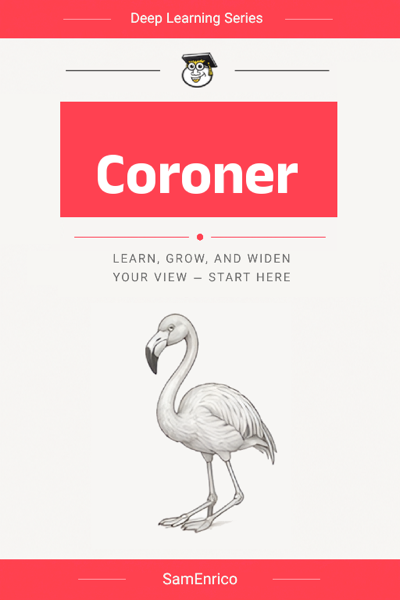
Coroner eBook
A Coursebook on Coroner
by Stearns Yang
A Coursebook on Coroner
Formats
Free sample
Chapter 1: The Legal Blade...--The telephone rang at 2:47 on a Tuesday morning—the kind of call that etches itself into permanent memory not because of what was said, but because of what the silence afterward implied. On the other end of the line was a police sergeant whose voice carried the strained neutrality that law enforcement officers develop after delivering bad news. There had been a death. A woman in her late thirties, found by her husband when he returned from a night shift. No obvious signs of violence.
No suicide note. No history of terminal illness. The body was still warm. The husband was inconsolable. The responding officers had done everything correctly: secured the scene, preserved evidence, kept the family in another room.
But now they needed the coroner. The question that hung in the predawn air was deceptively simple: did this death belong to me?Every coroner, medical examiner, and death investigator faces this threshold moment on every single case. Before the autopsy table, before the toxicology screen, before the courtroom testimony, there is a prior question that determines whether any of those subsequent steps will happen at all. Jurisdiction. The word sounds dry on its face—a legal term, a procedural formality, the kind of thing that fills government manuals and training slides.
But in practice, jurisdiction is the blade that separates the routine from the extraordinary, the natural death that belongs to a family doctor from the suspicious death that belongs to the state. To wield that blade correctly is the first and most fundamental duty of the coroner. To wield it incorrectly is to risk sending a killer free, imprisoning an innocent person, or violating a family's grief with an unnecessary intrusion they will never forgive.This chapter is about that blade. It draws from the hard-won lessons of Thomas Noguchi, the legendary Los Angeles County Coroner whose investigations into the deaths of Marilyn Monroe, Robert F. Kennedy, and Natalie Wood made him both famous and controversial.
It draws from Michael Baden, whose work on the deaths of President John F. Kennedy, Kitty Genovese, and countless others set standards for forensic pathology that endure today. And it draws from the collective experience of coroners and medical examiners who have learned, often through painful error, that the question of jurisdiction is never as simple as the law books make it seem. What follows is a systematic examination of which deaths belong to the coroner, how to navigate the overlapping and sometimes conflicting claims of other agencies, and how to exercise the extraordinary legal authority that society grants to those who speak for the dead. By the end of this chapter, you will understand not only the statutory rules of jurisdiction but also the practical wisdom that separates a competent coroner from an exceptional one.The Statutory Mandate: Which Deaths Trigger Coroner Jurisdiction The first thing any aspiring coroner must memorize is not a technique but a list.
Every state, province, and nation has its own statutory language defining which deaths fall under coroner or medical examiner jurisdiction, but the categories are remarkably consistent across jurisdictions. These are the deaths that cannot be signed off by a family physician, cannot be handled by a funeral director, and cannot be buried or cremated until a coroner has investigated.Sudden deaths top the list. When a person dies unexpectedly and was not under the recent care of a physician for the condition that caused death, the law presumes that the death warrants investigation. "Recent care" is a phrase that generates endless debate. Does a visit to a cardiologist six months ago count as recent care for a heart attack death?
What about a primary care physician who prescribed blood pressure medication but never performed diagnostic testing? The general standard, drawn from Noguchi's work in California and Baden's in New York, is that the treating physician must have seen the decedent within a reasonable time window—typically 30 to 90 days—and must have had a sufficient understanding of the decedent's condition to certify the cause of death with reasonable medical certainty. If the physician hesitates, the coroner takes jurisdiction.Unexpected deaths of healthy persons form a second category. This is different from sudden death in that it captures situations where a person was under medical care but died from something unrelated to their known condition. A cancer patient who dies in a car accident.
An elderly person with dementia who drowns in a bathtub. A diabetic who dies from a drug overdose. The treating physician may be comfortable certifying the cancer, the dementia, or the diabetes, but the violent or unnatural nature of the death overrides that comfort.Violent deaths—homicide, suicide, and accident—are the most obvious category. Any death involving trauma, whether inflicted by another person, by oneself, or by circumstance, belongs to the coroner. What many people do not realize is that "violence" includes deaths from medical interventions gone wrong, deaths from neglect, and deaths from exposure to hazardous substances.
A patient who dies from a surgical error is a violent death. A nursing home resident who dies from dehydration because staff failed to provide water is a violent death. A factory worker who dies from asbestos exposure is a violent death. The weapon may be a scalpel, an empty cup, or a cloud of microscopic fibers, but the coroner's jurisdiction attaches all the same.Suspicious deaths sweep up everything else. If the circumstances raise questions—inconsistent statements from witnesses, a body found in an unusual position, unexplained injuries, a history of domestic violence, a missing will, a recent change in life insurance—the coroner has discretion to investigate.
This discretionary authority is both a power and a trap. Noguchi learned this lesson during the Marilyn Monroe investigation, when the initial presumption of suicide was challenged by evidence of inconsistent witness statements and missing toxicology samples. By exercising jurisdiction aggressively, he exposed the flaws in the initial investigation. But he also drew the ire of powerful people who preferred that the matter remain closed. The coroner's discretion is a blade that cuts both ways.Unattended deaths occur when no physician was present at the time of death and no physician is willing to certify the cause.
This includes deaths in which the decedent lived alone and was found hours or days later, deaths in which the decedent was traveling away from home, and deaths in which the decedent's medical records are unavailable. The key principle here is that absence of medical oversight creates a presumption of coroner jurisdiction. Better to investigate and find nothing suspicious than to fail to investigate and miss a crime.In-custody deaths are a category unto themselves. When a person dies while under the supervision of law enforcement, corrections, or any governmental agency, the public has an overwhelming interest in independent investigation. The potential for abuse of power, the vulnerability of detainees, and the documented history of custodial deaths being misclassified as natural or accidental require that the coroner take jurisdiction as a matter of course.
This includes deaths in jails, prisons, juvenile detention centers, immigration detention, mental health facilities, and during arrest or transport.Source Spotlight: From Noguchi's "Coroner" – "The dead cannot file…
This is the end of the free sample. Get the eBook to keep going. Buy now
About this book
Details
- Author
- Stearns Yang
- Publisher
- SamEnrico
- Language
- English
- Genre
- Non-Fiction, Informative, Educational
- Released
- 2026-05-04
- Pages (approx.)
- 138
- Available as
- eBook, Audiobook

Read better in the ZLOADR app
Your eBooks on your phone or tablet. Sign in with your SamEnrico account and start reading.
More by Stearns Yang
 Phobia Catastrophic ThinkingStearns Yang$11.99
 Habit Stacking Goal MethodStearns Yang$11.99
 Snapchat Spotlight ComparisonStearns Yang$11.99
 The Assertive ApologyStearns Yang$11.99
 The Alcohol Freedom Evening RoutineStearns Yang$11.99
 The Vanishing Act of the Blackbeard’s ShadowStearns Yang$11.99
 A Beginners Guide to Blokus (Volume 1)Stearns Yang$11.99
 Understanding Intercellular Cholesterol Esterification DiseaseStearns Yang$17.99
 Desk Escape Movement PlanStearns Yang$12.99
 Experiential Spending Trends GuideStearns Yang$12.99