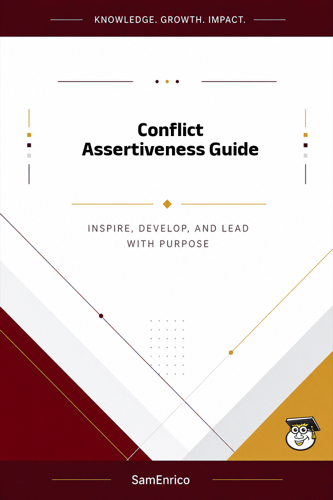
Conflict Assertiveness Guide eBook
Stand your ground in disagreements without aggress
Stand your ground in disagreements without aggression using this practical skills workbook.
Formats
Free sample
Chapter 1: The Hidden Autopilot--Most people believe they choose how to respond in a disagreement. They imagine themselves as rational captains steering a calm ship through choppy conversational waters. This is a comforting illusion. In reality, you have been running on autopilot during conflicts for years—likely since childhood—and you have never once stopped to examine the programming.Before you bristle at this claim, consider a simple experiment. Think back to the last time someone criticized your work, interrupted you mid-sentence, or dismissed an idea you cared about.
Without forcing it, notice what happened inside your body within the first two seconds. Did your chest tighten? Did your jaw clench? Did your face feel warm? Did you suddenly want to explain, defend, retreat, or attack?
That cascade of physical sensation and reflexive impulse was not a conscious choice. It was your autopilot engaging before your rational brain could even form a sentence.This chapter is not about fixing your conflict style. It is about discovering what your style actually is—without judgment, without shame, and with the kind of clear-eyed curiosity that makes real change possible. You cannot upgrade software you refuse to acknowledge exists. By the end of this chapter, you will name your default conflict pattern, identify the physical and emotional signals that precede your every overreaction or shutdown, and map the specific rungs of your personal escalation ladder.
You will also complete the first workbook exercise that turns abstract self-awareness into a usable baseline for everything that follows in this book.The Myth of the Rational Disputant We like to think of ourselves as reasonable people. When conflict arises, we believe we evaluate the situation, consider the other person’s perspective, and then choose an appropriate response. Neuroscience tells a different story. The amygdala—your brain’s rapid-threat-detection system—activates within milliseconds of perceiving a disagreement. It does not wait for context, nuance, or history.
It simply asks: “Is this a threat?” If the answer is even maybe, your body prepares to fight, flee, or freeze before your prefrontal cortex (the reasoning center) has finished waking up.This means your conflict behavior is not primarily a matter of personality or character. It is a matter of conditioned responses layered on top of biological survival wiring. The good news is that conditioned responses can be reconditioned. But first, you have to know what they are.Consider four different people walking into the same meeting. A manager says, “I think we need to reconsider your approach on this project.” Person A feels their stomach drop, says nothing, and spends the rest of the day ruminating.
Person B’s face flushes, and they immediately fire back: “My approach has been working fine.” Person C laughs nervously and says, “Yeah, you’re probably right,” while secretly feeling furious. Person D takes a breath and says, “I’d like to understand what you’re seeing. Can you share more?”Only Person D is operating from conscious choice. Persons A, B, and C are running on autopilot—different autopilots, but autopilots nonetheless. The goal of this chapter is to help you recognize which autopilot you have been flying and to land the plane so you can take manual control.The Five Conflict Animals: Finding Your Default Psychologists Kenneth Thomas and Ralph Kilmann developed one of the most widely used conflict style assessments in the world.
Their model identifies five primary modes of responding to disagreement. While no one uses a single style exclusively, most people have a dominant pattern—a default setting they revert to under stress. Think of these as five different animals living inside you. One of them is the loudest.The Turtle (Avoidance) withdraws from conflict entirely. Turtles hope problems will disappear on their own.
They change the subject, physically leave the room, or agree superficially just to end the discussion. The turtle’s unconscious logic is: “If I don’t engage, I can’t get hurt.” The cost is that issues never resolve, resentment builds silently, and the turtle often feels invisible and unheard. In relationships, turtles frustrate partners who need resolution. At work, turtles get overlooked for opportunities because they never advocate for themselves.The Shark (Competition) charges toward conflict with full force. Sharks believe conflict is a battle with a winner and a loser, and they intend to win.
They raise their voices, interrupt, make demands, and prioritize their own needs above all else. The shark’s unconscious logic is: “If I don’t dominate, I will be dominated.” The cost is damaged relationships, alienated colleagues, and a reputation for being difficult. Sharks often get short-term wins but long-term isolation. They may be promoted for being “strong” but not loved for being safe.The Teddy Bear (Accommodation) surrenders immediately to keep the peace. Teddy bears say “whatever you want,” apologize excessively, and prioritize others’ needs even when doing so harms themselves.
The teddy bear’s unconscious logic is: “If I make everyone happy, no one will be mad at me, and I will be loved.” The cost is chronic resentment, burnout, and a gradual disappearance of their own identity. Teddy bears are exhausted because they are constantly contorting themselves to fit others’ expectations. They are the nice people who finish last not because the world is cruel, but because they never make a request.The Fox (Compromise) seeks quick middle-ground solutions. Foxes split differences, trade concessions, and prioritize resolution over depth. The fox’s unconscious logic is: “Half a loaf is better than none, and moving on is more important than getting it right.” Compromise is useful in low-stakes situations, but the cost is that foxes often leave deeper needs unmet.
They solve the surface problem while the underlying issue festers and returns later. Foxes are efficient but not necessarily effective.The Owl (Collaboration) engages conflict as a problem to be solved together. Owls state their needs clearly, invite the other person to state theirs, and brainstorm solutions that satisfy both. The owl’s conscious logic is: “Our relationship and the outcome both matter. Let’s find a way that works for everyone.” Owls are rare not because collaboration is impossible, but because most people have never been taught how to do it.
Owls take more time upfront but save enormous time later because conflicts actually resolve rather than repeating.Here is the uncomfortable truth that no popular personality quiz will tell you: every single one of these styles is useful in certain situations. Turtles are wise when emotions are too hot and a pause is needed. Sharks are appropriate when immediate danger requires swift action. Teddy bears are generous when the issue truly matters more to the other person. Foxes are efficient for trivial decisions.
Owls are ideal for important, recurring, or relationship-critical conflicts.The problem is not that you have a default style. The problem is that you use your default style for every situation, whether it fits or not. A turtle who avoids conflict with a passive-aggressive roommate never gets peace. A shark who attacks a critical boss gets fired. A teddy bear who accommodates a demanding parent loses their own life.
The first step toward flexibility is knowing what you are flexing from.The Self-Assessment: Finding Your Dominant Animal Below is a…
This is the end of the free sample. Get the eBook to keep going. Buy now
About this book
Details
- Author
- Bustamante Sabra
- Publisher
- SamEnrico
- Language
- English
- Genre
- Non-Fiction, Self-Help, Conflict Skills
- Released
- 2026-06-08
- Pages (approx.)
- 138
- Available as
- eBook, Audiobook

Read better in the ZLOADR app
Your eBooks on your phone or tablet. Sign in with your SamEnrico account and start reading.
More by Bustamante Sabra
 Ancestral Fire SleepBustamante Sabra$11.99
 The Comparison CycleBustamante Sabra$11.99
 Hip Flexor Pelvic ConnectionBustamante Sabra$11.99
 The Intuitive Eating Diabetes GuideBustamante Sabra$11.99
 The Commonwealth’s Scientific Dawn: The Empire’s Pioneers of Medicine and ExplorationBustamante Sabra$11.99
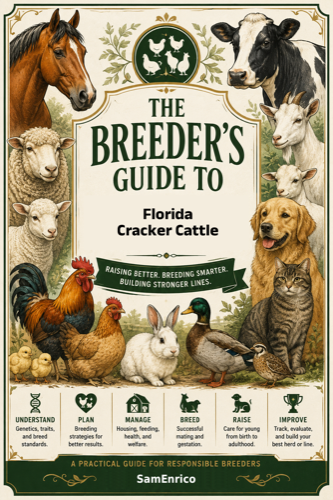 The Breeder's Guide to Florida Cracker CattleBustamante Sabra$11.99
 Conversion Email SequencesBustamante Sabra$12.99
 Top Performers Retention PlaybookBustamante Sabra$12.99
 Field Services RepresentativeBustamante Sabra$11.99
 How to Become a GeographerBustamante Sabra$11.99