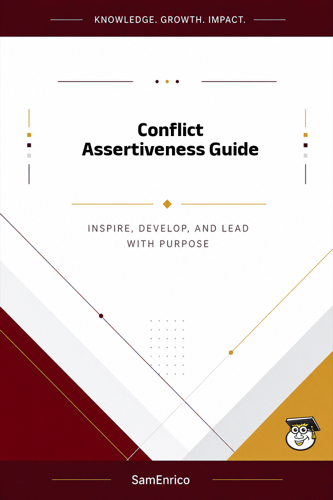
Conflict Assertiveness Guide
Stand your ground in disagreements without aggress
Stand your ground in disagreements without aggression using this practical skills workbook.
Formats
About this book
Free sample
Chapter 1: The Hidden Autopilot--Most people believe they choose how to respond in a disagreement. They imagine themselves as rational captains steering a calm ship through choppy conversational waters. This is a comforting illusion. In reality, you have been running on autopilot during conflicts for years—likely since childhood—and you have never once stopped to examine the programming.Before you bristle at this claim, consider a simple experiment. Think back to the last time someone criticized your work, interrupted you mid-sentence, or dismissed an idea you cared about.
Without forcing it, notice what happened inside your body within the first two seconds. Did your chest tighten? Did your jaw clench? Did your face feel warm? Did you suddenly want to explain, defend, retreat, or attack?
That cascade of physical sensation and reflexive impulse was not a conscious choice. It was your autopilot engaging before your rational brain could even form a sentence.This chapter is not about fixing your conflict style. It is about discovering what your style actually is—without judgment, without shame, and with the kind of clear-eyed curiosity that makes real change possible. You cannot upgrade software you refuse to acknowledge exists. By the end of this chapter, you will name your default conflict pattern, identify the physical and emotional signals that precede your every overreaction or shutdown, and map the specific rungs of your personal escalation ladder.
You will also complete the first workbook exercise that turns abstract self-awareness into a usable baseline for everything that follows in this book.The Myth of the Rational Disputant We like to think of ourselves as reasonable people. When conflict arises, we believe we evaluate the situation, consider the other person’s perspective, and then choose an appropriate response. Neuroscience tells a different story. The amygdala—your brain’s rapid-threat-detection system—activates within milliseconds of perceiving a disagreement. It does not wait for context, nuance, or history.
It simply asks: “Is this a threat?” If the answer is even maybe, your body prepares to fight, flee, or freeze before your prefrontal cortex (the reasoning center) has finished waking up.This…
This is the end of the free sample. Get the eBook to keep going. Buy now
Contents
- Chapter 1
- Chapter 2
- Chapter 3
- Chapter 4
- Chapter 5
- Chapter 6
- Chapter 7
- Chapter 8
- Chapter 9
- Chapter 10
- Chapter 11
- Chapter 12
Details
- Author
- Bustamante Sabra
- Publisher
- SamEnrico
- Language
- English
- Genre
- Non-Fiction, Self-Help, Conflict Skills
- Released
- 2026-06-08
- Pages (approx.)
- 138
- Available as
- eBook, Audiobook

Read better in the ZLOADR app
Your eBooks on your phone or tablet. Sign in with your SamEnrico account and start reading.
More by Bustamante Sabra
 Ancestral Fire SleepBustamante Sabra$11.99
 The Comparison CycleBustamante Sabra$11.99
 Hip Flexor Pelvic ConnectionBustamante Sabra$11.99
 The Intuitive Eating Diabetes GuideBustamante Sabra$11.99
 The Commonwealth’s Scientific Dawn: The Empire’s Pioneers of Medicine and ExplorationBustamante Sabra$11.99
 The Breeder's Guide to Florida Cracker CattleBustamante Sabra$11.99
 Conversion Email SequencesBustamante Sabra$12.99
 Top Performers Retention PlaybookBustamante Sabra$12.99
 Field Services RepresentativeBustamante Sabra$11.99
 How to Become a GeographerBustamante Sabra$11.99