
Non-FictionSelf-HelpLearning Culture
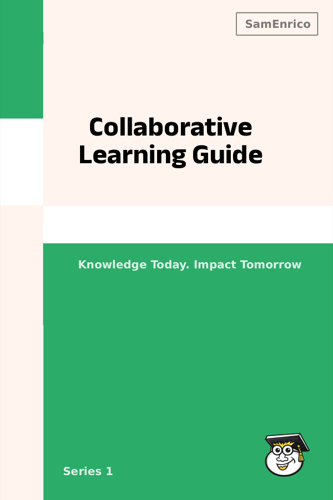
Collaborative Learning Guide eBook
Share new skills and knowledge across teams to fue
by Hwang Connie
Share new skills and knowledge across teams to fuel creative cross pollination.
Formats
Free sample
Chapter 1: The Silo Trap--–- Every organization is born curious. In its earliest days, a startup or a new division within a larger company operates like a jazz ensemble—musicians from different backgrounds listen intently, respond to one another, and create something no single player could have imagined alone. The marketer sits next to the engineer. The salesperson overhears the product manager's user research. Knowledge flows not through formal channels but through proximity, urgency, and the sheer thrill of building something new.
Then success arrives. Headcount grows. Teams move to different floors, different buildings, different Slack channels. Efficiency becomes the god, and specialization its high priest. The marketing team perfects its funnel metrics.
Engineering optimizes its deployment pipeline. Sales refines its quarterly rhythm. Each team becomes brilliant within its own silo. And that is precisely when innovation begins to die.This is the Silo Trap: the gradual, almost invisible process by which functional excellence destroys cross-functional creativity. It is not malice.
It is not incompetence. It is the natural consequence of scaling without designing for connection. The trap has three jaws that close around organizations of every size, from five-person startups to hundred-thousand-person enterprises. Understanding these jaws is the first step toward escaping them.The First Jaw: The Efficiency Obsession Modern management inherited a worldview from Frederick Taylor and the industrial revolution: break work into the smallest possible pieces, assign each piece to a specialist, and measure each specialist on their piece alone. This logic produced miracles of manufacturing efficiency.
It also produced the assembly line, the departmental silo, and the spreadsheet where your team's numbers look great while the company burns.Here is the contradiction that most leaders refuse to acknowledge: efficiency and innovation are not allies; they are often enemies. Efficiency seeks to reduce variation. Innovation requires variation. Efficiency seeks to repeat what works. Innovation requires experimenting with what might fail.
Efficiency rewards depth within a domain. Innovation requires breadth across domains. The Silo Trap convinces smart people that if every team optimizes its own performance, the organization as a whole will optimize automatically. This is false. A collection of perfectly optimized silos is a collection of perfectly isolated geniuses who never speak to one another.Consider a common scenario.
The engineering team optimizes for code stability. Their metric is "bugs per release," and they are winning. The product team optimizes for feature velocity. Their metric is "features shipped per quarter," and they are winning. The sales team optimizes for quarterly revenue.
Their metric is "deals closed," and they are winning. Every team is winning. And the product is a bloated, buggy, hard-to-sell mess because no one optimized for how the pieces fit together. The Silo Trap rewards local optimization and punishes global intelligence.The Second Jaw: The Curse of Expertise In 1999, two psychologists named Chi and Snyder made a surprising discovery. They asked expert chess players and novices to look at a chessboard for five seconds and then reconstruct the positions of the pieces.
The experts performed dramatically better than the novices—but only when the pieces were arranged in plausible game positions. When the pieces were placed randomly, the experts performed no better than the novices. The experts had not memorized the board. They had memorized patterns. Their expertise allowed them to see meaningful configurations that novices could not see.This is the paradox of expertise.
It makes you faster and more accurate within your domain. It also makes you blind to possibilities outside that domain. You do not see what you do not have a pattern for. The marketing expert looks at a customer problem and sees a messaging issue. The engineering expert looks at the same problem and sees a technical architecture issue.
The finance expert looks and sees a pricing issue. Each expert is correct within their own frame. Each expert is incomplete. And because expertise feels like clarity, experts rarely realize how much they are missing.The curse deepens with seniority. The longer someone has worked in a single function, the more their brain has pruned away the neural pathways that once connected to other functions.
They literally lose the ability to think like a marketer if they have spent fifteen years in engineering. This is not a character flaw. It is neurobiology. But it means that the very people you promote for their deep expertise are the ones least equipped to see across silos. The Silo Trap is not just a structural problem.
It is a cognitive problem baked into the way human beings learn.The Third Jaw: The Knowledge Hoarding Incentive In most organizations, power flows from unique knowledge. The person who knows how the legacy database really works, or who understands the key client's unspoken objections, or who holds the template for the quarterly board deck—that person becomes indispensable. Indispensability brings job security, respect, and often compensation. So organizations unintentionally reward employees for not sharing what they know.This is the most pernicious jaw of the trap because it turns colleagues into competitors. The marketing team develops a new segmentation model.
Keeping it secret means they look brilliant in the next review. Sharing it with sales means sales gets credit for better targeting. The engineering team builds a clever testing framework. Keeping it secret means they retain control over the deployment pipeline. Sharing it with product means product can run their own experiments without engineering oversight.
In each case, the rational individual choice is to hoard. And the rational individual choice produces collective stupidity.Even well-intentioned employees hoard without realizing it. Tacit knowledge—the kind you cannot write down because it lives in your muscles and intuitions—is genuinely hard to share. You do not know that you know something until someone asks the right question. And in a siloed organization, no one asks because no one knows what you know.
The knowledge sits in your head, invisible to the network, until you retire or quit or move to another team. Then the organization discovers what it lost. The trap has claimed another victim.Why Breaking the Trap Requires More Than "Open Office Plans"Most leaders, when they recognize the Silo Trap, reach for superficial solutions. They knock down walls and install open floor plans. They mandate cross-functional meetings.
They create a Slack channel called #random and hope for magic. These interventions fail because they address architecture without addressing behavior, and behavior without addressing incentives.The open office does not create collaboration. It creates noise and distraction. Studies consistently show that open offices reduce face-to-face interaction because people put on headphones to concentrate. The cross-functional meeting does not create knowledge transfer.
It creates performance theater, where each team presents polished slides that hide their real struggles. The #random Slack channel does not create serendipity. It creates a wasteland of pet photos and lunch plans—pleasant, but not innovative.What actually breaks the Silo Trap is a systematic approach to collaborative learning: the deliberate, structured, and rewarded practice of sharing skills and knowledge across team boundaries. Collaborative learning is not about being nice or getting along. It is about survival.
Organizations that learn across silos adapt faster, solve harder problems, and retain smarter people. Organizations that do not learn across…
This is the end of the free sample. Get the eBook to keep going. Buy now
About this book
Details
- Author
- Hwang Connie
- Publisher
- SamEnrico
- Language
- English
- Genre
- Non-Fiction, Self-Help, Learning Culture
- Released
- 2026-06-11
- Pages (approx.)
- 144
- Available as
- eBook, Audiobook

Read better in the ZLOADR app
Your eBooks on your phone or tablet. Sign in with your SamEnrico account and start reading.
More by Hwang Connie
 Self Esteem for InternsHwang Connie$11.99
 Growth Mindset For NursesHwang Connie$11.99
 Lateral Thinking for BusinessHwang Connie$11.99
 Gobi Desert NomadsHwang Connie$11.99
 The OKR for Engineering TeamsHwang Connie$11.99
 Outsourcing for House CleaningHwang Connie$11.99
 Mindfulness for Teens BeginnersHwang Connie$11.99
 When the World Was Carved from Bone: The Tezcatlipoca’s Cosmic VisionHwang Connie$11.99
 Blood and Ink: The Forgotten War of the QuillHwang Connie$11.99
 Squash: Summer & Winter SquashHwang Connie$11.99
 South Africa Business Credit Fast Track GuideHwang Connie$12.99
 Mailchimp Pop Up Form GuideHwang Connie$12.99
You may also like
 Hong Kong Handover 1997Dunn Johnnie$11.99
 Zumba For Postnatal Recovery CourseNeal Christian$11.99
 Zumba for BeginnersLadner Nikia$11.99
 YouTube Comment Mining GuideHumes Pandora$12.99
 Worry Box MeditationCarlin Rudy$11.99
 Workplace Stress MeditationNguyen Lynn$11.99
 Workplace Stress and Sleep RepairHawley Ivory$11.99
 Workplace Perfectionism CureDelaney Jeffry$11.99
 Workplace Injustice Anger GuideWallen Isabelle$11.99
 Work Addiction and Burnout LinkGreenwood Ester$11.99
 Women in Yoga and WellnessBeattie Galina$11.99
 Women in Stand Up ComedyChun Evangeline$11.99