
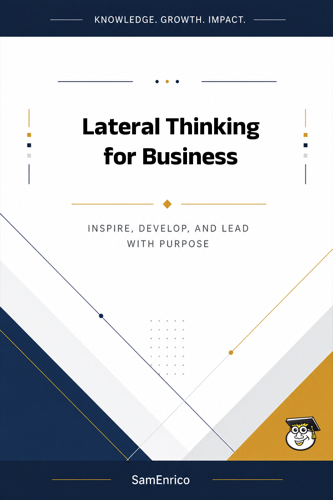
About this book
Free sample
Chapter 1: The Logic Trap--–- On a Tuesday morning in March 2017, a team of sixteen highly intelligent, well-educated, and thoroughly motivated executives gathered in a glass-walled conference room on the forty-second floor of a Manhattan skyscraper. They had flown in from Chicago, Atlanta, and San Francisco. They had prepared ninety-seven slides. They had three spreadsheets, each audited twice. And over the next four hours, they made exactly one decision—a decision so logical, so meticulously reasoned, and so flawlessly executed that it would ultimately cost their company $412 million and the jobs of 1,200 people.Not one person in that room was stupid.
Not one person was lazy. Not one person intended to destroy value. Every single person believed, with complete sincerity, that they were doing the right thing. And that is the most terrifying truth about business failure: it rarely wears a mask of incompetence. It wears the tailored suit of impeccable logic applied to the wrong question.This book is about what happened in that room—and how to make sure it never happens in yours.The Paradox of Progress Let me offer you a paradox that will define everything that follows: most business failures are not caused by a lack of thinking.
They are caused by too much thinking of the wrong kind.We have been trained, from our first day in business school or our first week on the job, to think vertically. Vertical thinking is the step-by-step, analytical, "if A then B, if B then C" approach that drives every spreadsheet, every forecast, every project plan, and every quarterly review. It is logical. It is linear. It is safe.
And for routine operations—processing payroll, managing inventory, executing a known process—vertical thinking is exactly what you need.But vertical thinking has a shadow. When applied to problems that require new thinking—disruption, innovation, strategic pivots, market creation—vertical thinking becomes a trap. It takes you efficiently in the wrong direction. It optimizes processes that should be abandoned. It solves problems that should never have been posed.Here is the distinction that will save you years of wasted effort: Vertical thinking is for…
This is the end of the free sample. Get the eBook to keep going. Buy now
Contents
- Chapter 1
- Chapter 2
- Chapter 3
- Chapter 4
- Chapter 5
- Chapter 6
- Chapter 7
- Chapter 8
- Chapter 9
- Chapter 10
- Chapter 11
- Chapter 12
Details
- Author
- Hwang Connie
- Publisher
- SamEnrico
- Language
- English
- Genre
- Non-Fiction, Self-Help
- Released
- 2026-06-07
- Pages (approx.)
- 150
- Available as
- eBook, Audiobook

Read better in the ZLOADR app
Your eBooks on your phone or tablet. Sign in with your SamEnrico account and start reading.
More by Hwang Connie
 Collaborative Learning GuideHwang Connie$11.99
 Self Esteem for InternsHwang Connie$11.99
 Growth Mindset For NursesHwang Connie$11.99
 Gobi Desert NomadsHwang Connie$11.99
 The OKR for Engineering TeamsHwang Connie$11.99
 Outsourcing for House CleaningHwang Connie$11.99
 Mindfulness for Teens BeginnersHwang Connie$11.99
 When the World Was Carved from Bone: The Tezcatlipoca’s Cosmic VisionHwang Connie$11.99
 Blood and Ink: The Forgotten War of the QuillHwang Connie$11.99
 Squash: Summer & Winter SquashHwang Connie$11.99
 South Africa Business Credit Fast Track GuideHwang Connie$12.99
 Mailchimp Pop Up Form GuideHwang Connie$12.99
You may also like
 Hong Kong Handover 1997Dunn Johnnie$11.99
 Zumba For Postnatal Recovery CourseNeal Christian$11.99
 Zumba for BeginnersLadner Nikia$11.99
 YouTube Comment Mining GuideHumes Pandora$12.99
 Worry Box MeditationCarlin Rudy$11.99
 Workplace Stress MeditationNguyen Lynn$11.99
 Workplace Stress and Sleep RepairHawley Ivory$11.99
 Workplace Perfectionism CureDelaney Jeffry$11.99
 Workplace Injustice Anger GuideWallen Isabelle$11.99
 Work Addiction and Burnout LinkGreenwood Ester$11.99
 Women in Yoga and WellnessBeattie Galina$11.99
 Women in Stand Up ComedyChun Evangeline$11.99