
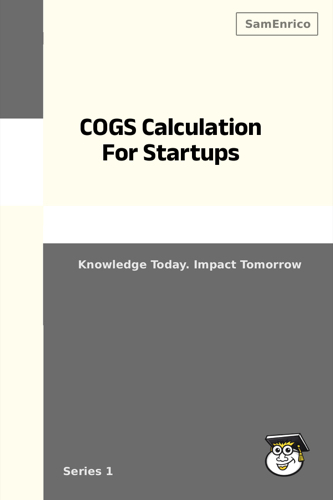
Non-FictionStartup GuideProduct Costing
COGS Calculation For Startups eBook
Measures cost of goods sold accurately.
Measures cost of goods sold accurately.
Formats
Free sample
Chapter 1: The $18.96 Mistake--A quarter of a million dollars in revenue. That was the number Alex had just celebrated with his team. Bottles clinked. High-fives were exchanged. A toast was made to "scaling like crazy." The year was 2019, and Alex's direct-to-consumer coffee subscription startup, Bean There Brewed That, had just crossed $240,000 in sales for the first quarter.
He was living every founder's dream: hockey-stick growth, a waiting list of customers, and a feature in a popular food blog.Three months later, Alex could not make payroll.His bank account was overdrawn. His suppliers were demanding payment for the green coffee beans he had already roasted, bagged, and shipped. His investors, who had been thrilled by the revenue numbers, were now silent. The same hockey-stick growth had become a sledgehammer, and Alex had no idea why—until 2:00 AM on a Tuesday, staring at a spreadsheet he had cobbled together from his payment processor, his bank statements, and a growing sense of dread.That night, Alex discovered the $18.96.Every time a customer clicked "Buy Now" on his website for the flagship "Explorer's Bundle" (three bags of single-origin coffee, a branded mug, and free shipping), Alex's business lost $18.96. Not made.
*Lost*. The revenue hit his account: $45.00. But the costs kept flowing out like a hidden leak: $12.50 for the coffee beans and packaging, $8.00 for the mug, $9.50 for shipping (thanks to the mug's weight), $3.50 for payment processing fees, and $6.50 for the free sample he included to boost retention. Total cost: $63.96. Loss per unit: $18.96.He had sold 7,400 of those bundles.
He had lost over $140,000 on his "best-selling" product.Alex's story is not an outlier. It is the single most common startup failure mode that no one talks about. Founders obsess over revenue. Investors ask about revenue. The media celebrates revenue.
But revenue, as Alex learned in the worst possible way, is a vanity metric. Gross profit is sanity. And gross profit begins and ends with one deceptively simple number: Cost of Goods Sold, or COGS.The COGS Trap: Why Revenue Can Be a Lie If you take nothing else from this chapter, take this: Revenue does not pay bills. Gross profit pays bills. Gross profit is what remains after you subtract the direct costs of delivering your product or service from the revenue you collected.
And if you do not know your gross profit per unit—not per month, not per quarter, but per unit—you are not running a business. You are running a lottery.The reason most founders fall into the COGS trap is that they intuitively understand operating expenses. Rent, salaries, software subscriptions, marketing spend—these are obvious. They hurt when you pay them. You feel the sting.
But COGS is sneakier. COGS is the cost that only appears because you made a sale. It is the cost of the raw materials, the labor to assemble or code, the shipping, the payment processing, the hosting fees for the API call. And because it scales with revenue, it can hide in plain sight while growing just as fast as your top line.Here is the equation that will save your startup, repeated throughout this book because it is that important:Gross Margin = (Revenue – COGS) / Revenue Multiply by 100 to get a percentage. For a healthy, venture-scalable startup, the rough benchmarks are:Physical products (e.g., coffee, apparel, hardware): 40–60% gross margin Saa S (software as a service): 70–85% gross margin Hybrid (hardware + subscription): 50–70% gross margin If your gross margin falls below these thresholds, you cannot afford customer acquisition, you cannot absorb unexpected costs, and you will never become profitable at scale.
Alex's gross margin on the Explorer's Bundle was not 40% or even 10%. It was negative 42%. He was paying people to take his product.The Three Case Studies You'll Meet in This Book Throughout this book, we will follow three founders who represent the three major startup archetypes. Their stories will appear in every chapter, showing how COGS works (and breaks) in different business models.Case Study #1: Bean There Brewed That (Physical Product)Alex's coffee subscription company is the cautionary tale that opens this chapter. Over the course of the book, we will watch Alex rebuild his business from the brink of bankruptcy by recalculating every cost, killing his "Villain" products, and raising prices.
By Chapter 12, Bean There Brewed That will be profitable, but the path is brutal—and educational.Case Study #2: Dash Stack (Pure Saa S)Maya is the founder of Dash Stack, a B2B analytics dashboard that helps e-commerce companies visualize their sales data. She has 400 paying customers, $60,000 in monthly recurring revenue, and a problem she cannot identify: her gross margin has been slipping from 78% to 62% over six months, and she has no idea why. She will learn that digital COGS (hosting, API calls, support) can be just as deadly as physical inventory.Case Study #3: Therma Smart (Hybrid Hardware + Subscription)Kevin is the founder of Therma Smart, a smart thermostat that learns user preferences and automatically adjusts heating and cooling. He sells the hardware for $199 (cost to manufacture: $87) and a monthly subscription for $4.99 (cost to serve: $1.20). His gross margin looks healthy at 56% overall, but he is about to discover that his hardware and subscription have radically different economics—and that cash flow timing is about to nearly kill him.By the end of this book, you will know each of these companies as well as your own.
More importantly, you will know exactly how to apply their lessons to your startup, whether you sell coffee, code, or connected devices.Gross Profit vs. Net Profit: The Critical Distinction Before we go further, we need to clear up a confusion that has bankrupted more founders than any other single misunderstanding: gross profit is not net profit.Gross Profit = Revenue – COGS. It tells you whether your product itself is profitable before accounting for the cost of running your company.Net Profit = Revenue – COGS – Operating Expenses (OPEX). OPEX includes rent, salaries for non-production employees, marketing, legal fees, software subscriptions, and everything else that is not directly tied to making or delivering your product.Here is why the distinction matters. A startup can have a healthy gross profit (say, 60%) but still be unprofitable because their operating expenses are too high (too many salespeople, expensive office, huge ad spend).
That is a spending problem, and it is fixable by cutting costs.But a startup with a low gross margin (say, 20% for a physical product) cannot fix that problem by cutting operating expenses. The product itself is the problem. No amount of layoffs or rent renegotiation will save you if you lose money on every sale. As the old business adage goes: "You can lose money on every sale and make it up in volume." That is a joke. It is not a strategy.Alex learned this the hard way.
He had tried to cut operating expenses first—he let go of his part-time social media manager, moved from a small office to his garage, and canceled his project management software. None of it made a dent. The hole was in the product itself, not in the overhead.The Gross Margin Reality Check: Three Questions Before You Scale Before you raise prices, launch a new product, or even think about scaling, you must answer these…
This is the end of the free sample. Get the eBook to keep going. Buy now
About this book
Details
- Author
- Brandon Jonnie
- Publisher
- SamEnrico
- Language
- English
- Genre
- Non-Fiction, Startup Guide, Product Costing
- Released
- 2026-06-05
- Pages (approx.)
- 129
- Available as
- eBook, Audiobook

Read better in the ZLOADR app
Your eBooks on your phone or tablet. Sign in with your SamEnrico account and start reading.
More by Brandon Jonnie
 Self Esteem for Anxious AttachmentBrandon Jonnie$11.99
 Hypothyroidism and FoodBrandon Jonnie$11.99
 ACT for Dysthymia GuideBrandon Jonnie$11.99
 Alcoholism Recovery for PerfectionistsBrandon Jonnie$11.99
 Brainstorming FacilitationBrandon Jonnie$11.99
 Senior Housing ESG GuideBrandon Jonnie$11.99
 Quality Time StressBrandon Jonnie$11.99
 Frostbound: The Troll King's Forbidden LoveBrandon Jonnie$11.99
 The Samurai Strategist: How a Forgotten Warlord Built Japan's First Elite Warrior TeamBrandon Jonnie$11.99
 Disadvantaged Business Enterprise GuideBrandon Jonnie$12.99
 Cradle to Cradle CertificationBrandon Jonnie$12.99
 Mastering The Art of German Ju-jutsuBrandon Jonnie$11.99
You may also like
 Hong Kong Handover 1997Dunn Johnnie$11.99
 Zumba For Postnatal Recovery CourseNeal Christian$11.99
 Zumba for BeginnersLadner Nikia$11.99
 YouTube Comment Mining GuideHumes Pandora$12.99
 Worry Box MeditationCarlin Rudy$11.99
 Workplace Stress MeditationNguyen Lynn$11.99
 Workplace Stress and Sleep RepairHawley Ivory$11.99
 Workplace Perfectionism CureDelaney Jeffry$11.99
 Workplace Injustice Anger GuideWallen Isabelle$11.99
 Work Addiction and Burnout LinkGreenwood Ester$11.99
 Women in Yoga and WellnessBeattie Galina$11.99
 Women in Stand Up ComedyChun Evangeline$11.99