
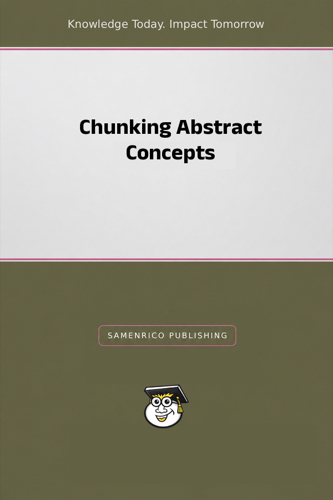
Chunking Abstract Concepts
Break complex theories into smaller understandable
by Marx Lane
Break complex theories into smaller understandable sub ideas.
Formats
About this book
Free sample
Chapter 1: The Capacity Crisis...--–- The student stared at the open textbook for twenty minutes. The page was not exceptionally dense—a single diagram, three paragraphs, and a set of equations that looked like Sanskrit. She had read the same sentence eleven times. Each time, the words entered her consciousness, pinged around like a pinball, and then vanished without leaving a trace. She felt something she had felt a thousand times before: the peculiar, suffocating sensation of a brain that was full.This was not a matter of intelligence.
She had passed every exam for four years. It was not a matter of effort. She had slept eight hours, drunk the right amount of coffee, and eliminated all distractions. It was not a matter of interest. She had chosen this field because she loved it.
And yet here she was, staring at three paragraphs as if they were written in a language that her mind refused to speak.What she was experiencing has a name. Cognitive scientists call it cognitive load. Neurologists call it working memory saturation. You probably call it "my brain is full." Whatever you call it, the experience is universal. Every person who has ever tried to learn something genuinely difficult has hit this wall.
The wall does not discriminate by IQ, by educational background, or by grit. It is a biological constraint, baked into the architecture of the human brain, and it is the single most important reason why most people fail to understand abstract concepts.This book is about how to climb that wall. But before we can climb it, we must understand what it is made of.The Magical Number Seven, Plus or Minus Two In 1956, a cognitive psychologist named George Miller published a paper with one of the most famous titles in the history of psychology: "The Magical Number Seven, Plus or Minus Two: Some Limits on Our Capacity for Processing Information." Miller had been running experiments on something deceptively simple: how many random items can a person hold in their mind at once?The answer, it turned out, was consistently around seven. Give…
This is the end of the free sample. Get the eBook to keep going. Buy now
Contents
- Chapter 1
- Chapter 2
- Chapter 3
- Chapter 4
- Chapter 5
- Chapter 6
- Chapter 7
- Chapter 8
- Chapter 9
- Chapter 10
- Chapter 11
- Chapter 12
Details
- Author
- Marx Lane
- Publisher
- SamEnrico
- Language
- English
- Genre
- Non-Fiction, Self-Help, Learning Strategies
- Released
- 2026-06-08
- Pages (approx.)
- 146
- Available as
- eBook, Audiobook

Read better in the ZLOADR app
Your eBooks on your phone or tablet. Sign in with your SamEnrico account and start reading.
More by Marx Lane
 Identity Theft Protection BenefitMarx Lane$11.99
 Networking for PharmacistsMarx Lane$11.99Identity Theft Protection BenefitMarx Lane$11.99
 Active Listening in Remote TeamsMarx Lane$11.99
 Fear of Failure Tracking LogMarx Lane$11.99
 Dating Small Talk GuideMarx Lane$11.99
 SAD And Social ConnectionMarx Lane$11.99
 Remote Energy Management GuideMarx Lane$11.99
 The Last Flight of the Miracle Mile: The 1957 B-47 Crash That Defied PhysicsMarx Lane$11.99
 The Unstoppable Run: The 1990s Dream Team of Women's VolleyballMarx Lane$11.99
 How to Produce Wallboard AdhesiveMarx Lane$11.99
 Service Providers Guide to Home FurnishingsMarx Lane$11.99
You may also like
 Interleaved Studying PracticeLarue Lera$11.99
 Chunking Study MaterialThomson Lucina$11.99
 Interleaving Practice for Problem SolvingMcgrath Rueben$11.99
 Memory Retention Study GuideReiter Bonny$11.99
 Interleaving Study MethodKroll Ermelinda$11.99
 Pattern Recognition for LearningBenitez Horacio$11.99
 Loci Palace Construction HandbookStover Tenisha$11.99
 The Sleep Dependent Learning GuideHammonds Warner$11.99