
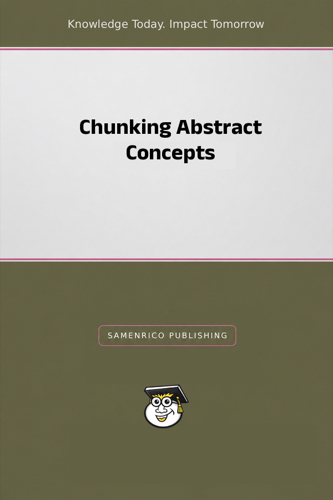
Chunking Abstract Concepts eBook
Break complex theories into smaller understandable
by Marx Lane
Break complex theories into smaller understandable sub ideas.
Formats
Free sample
Chapter 1: The Capacity Crisis...--–- The student stared at the open textbook for twenty minutes. The page was not exceptionally dense—a single diagram, three paragraphs, and a set of equations that looked like Sanskrit. She had read the same sentence eleven times. Each time, the words entered her consciousness, pinged around like a pinball, and then vanished without leaving a trace. She felt something she had felt a thousand times before: the peculiar, suffocating sensation of a brain that was full.This was not a matter of intelligence.
She had passed every exam for four years. It was not a matter of effort. She had slept eight hours, drunk the right amount of coffee, and eliminated all distractions. It was not a matter of interest. She had chosen this field because she loved it.
And yet here she was, staring at three paragraphs as if they were written in a language that her mind refused to speak.What she was experiencing has a name. Cognitive scientists call it cognitive load. Neurologists call it working memory saturation. You probably call it "my brain is full." Whatever you call it, the experience is universal. Every person who has ever tried to learn something genuinely difficult has hit this wall.
The wall does not discriminate by IQ, by educational background, or by grit. It is a biological constraint, baked into the architecture of the human brain, and it is the single most important reason why most people fail to understand abstract concepts.This book is about how to climb that wall. But before we can climb it, we must understand what it is made of.The Magical Number Seven, Plus or Minus Two In 1956, a cognitive psychologist named George Miller published a paper with one of the most famous titles in the history of psychology: "The Magical Number Seven, Plus or Minus Two: Some Limits on Our Capacity for Processing Information." Miller had been running experiments on something deceptively simple: how many random items can a person hold in their mind at once?The answer, it turned out, was consistently around seven. Give a person a sequence of random digits—3, 8, 2, 5, 9, 1, 4—and most can repeat it back correctly. Make it eight digits, and errors start to creep in.
Make it nine or ten, and performance collapses. The same pattern holds for letters, for words, for shapes, for almost any discrete piece of information. The human working memory has a hard limit of approximately seven items, plus or minus two.Let that sink in. Your brain—the same brain that can recognize faces in a millisecond, that can navigate a city without a map, that can compose a symphony or solve a differential equation—cannot hold more than about seven unrelated pieces of information at the same time.This is not a design flaw. It is a design feature.
The brain's working memory is not a hard drive; it is a scratchpad. It is meant to hold information just long enough for you to do something with it—to manipulate it, to transform it, to connect it to something you already know. Once that manipulation is complete, the information is either encoded into long-term memory (where the capacity is effectively infinite) or it is discarded. The scratchpad is small because it is supposed to be fast. The problem is that abstract concepts do not arrive in nicely packaged, scratchpad-sized pieces.The Digit-Span Test You Just Took Before we go further, let me prove this limit to you.
Read the following sequence of digits once, slowly, then look away and try to repeat them:7, 2, 9, 4, 1, 6, 3Easy. That is seven items. Now try this one:5, 8, 2, 9, 1, 4, 7, 3, 6, 2, 8, 5, 1, 9, 4, 7, 3, 6You could not do it. No one could. Not because you are forgetful, not because you did not try hard enough, but because the number of items exceeded the biological capacity of your working memory.
Your brain simply does not have the slots to hold eighteen unrelated digits.This is the same mechanism that makes a dense textbook page feel impossible. That page is not a single item. It is dozens of items—concepts, definitions, relationships, implications, exceptions—all competing for the same seven slots. When the incoming information exceeds seven items, something has to give. What gives is comprehension.
The words enter your eyes, bounce around your working memory for a moment, and then fall out because there is nowhere to put them.The Tragic Mistake Most Learners Make Here is where most people go wrong. When they encounter a complex abstract concept—say, quantum entanglement, or the principle of comparative advantage, or the structure of a federalist system—they try to learn it by processing the raw data. They read the definition. They memorize the key terms. They write down the equations.
They highlight the important sentences. They are doing everything they were taught to do.And it fails. It fails every time, because the raw data contains far more than seven items. A single paragraph about quantum entanglement might contain: the concept of superposition, the phenomenon of measurement collapse, the idea of non-locality, the EPR paradox, the Bell inequality, the experimental confirmation, and the implications for information theory. That is seven items already, and we have not even gotten to the math.The learner tries to hold all of these items in working memory at once.
The working memory fills up. The learner feels confused, then frustrated, then stupid. But the problem is not a lack of intelligence. The problem is a mismatch between the structure of the information and the structure of the mind. The information is a densely woven tapestry.
The mind is a small table. You cannot put a tapestry on a small table. You have to fold it.Folding the Tapestry: The Concept of a Chunk Folding the tapestry is what cognitive scientists call chunking. A chunk is a mental package that treats multiple pieces of information as a single unit. When you see the letters "C," "I," and "A" together, you do not process them as three separate items.
You process them as one item: the CIA. That is chunking. When you see the sequence "1-8-0-0-F-L-O-W-E-R-S," you do not try to remember eleven digits. You remember one thing: a toll-free number for a flower delivery service. That is chunking.Chunking works because the limit of seven applies to chunks, not to raw items.
Once you have formed a chunk, that chunk takes up only one slot in working memory, regardless of how much information is packed inside it. The CIA chunk contains three letters, but it consumes one slot. The phone number chunk contains eleven digits, but it consumes one slot.This is the secret that experts know and novices do not. The difference between a physics professor and a physics student is not that the professor has a larger working memory. It is that the professor has chunked the basic concepts so thoroughly that what used to be twenty items is now one item.
The professor sees "F = ma" not as three symbols but as a single chunk representing the entire Newtonian worldview. The student sees three symbols and tries to hold them separately.The Difference Between Complicated and…
This is the end of the free sample. Get the eBook to keep going. Buy now
About this book
Details
- Author
- Marx Lane
- Publisher
- SamEnrico
- Language
- English
- Genre
- Non-Fiction, Self-Help, Learning Strategies
- Released
- 2026-06-08
- Pages (approx.)
- 146
- Available as
- eBook, Audiobook

Read better in the ZLOADR app
Your eBooks on your phone or tablet. Sign in with your SamEnrico account and start reading.
More by Marx Lane
 Identity Theft Protection BenefitMarx Lane$11.99
 Networking for PharmacistsMarx Lane$11.99Identity Theft Protection BenefitMarx Lane$11.99
 Active Listening in Remote TeamsMarx Lane$11.99
 Fear of Failure Tracking LogMarx Lane$11.99
 Dating Small Talk GuideMarx Lane$11.99
 SAD And Social ConnectionMarx Lane$11.99
 Remote Energy Management GuideMarx Lane$11.99
 The Last Flight of the Miracle Mile: The 1957 B-47 Crash That Defied PhysicsMarx Lane$11.99
 The Unstoppable Run: The 1990s Dream Team of Women's VolleyballMarx Lane$11.99
 How to Produce Wallboard AdhesiveMarx Lane$11.99
 Service Providers Guide to Home FurnishingsMarx Lane$11.99
You may also like
 Interleaved Studying PracticeLarue Lera$11.99
 Chunking Study MaterialThomson Lucina$11.99
 Interleaving Practice for Problem SolvingMcgrath Rueben$11.99
 Memory Retention Study GuideReiter Bonny$11.99
 Interleaving Study MethodKroll Ermelinda$11.99
 Pattern Recognition for LearningBenitez Horacio$11.99
 Loci Palace Construction HandbookStover Tenisha$11.99
 The Sleep Dependent Learning GuideHammonds Warner$11.99