
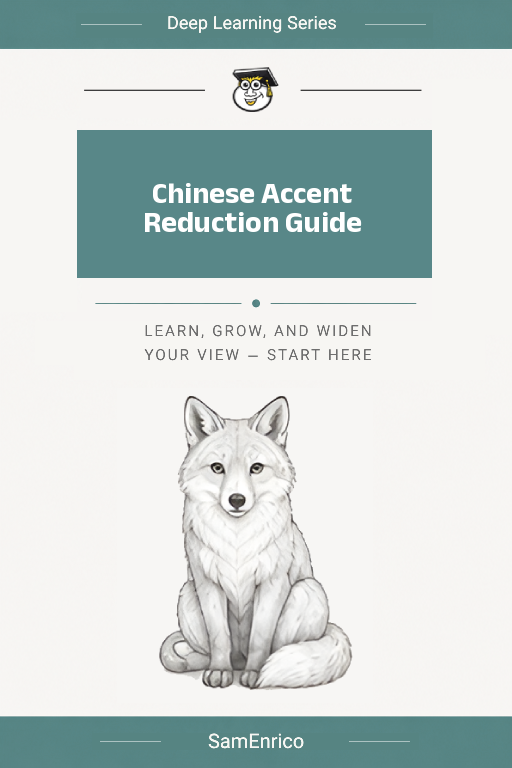
Non-FictionSide Hustle ArchitectAccent
Chinese Accent Reduction Guide
Help Chinese students neutralize accents for profe
Help Chinese students neutralize accents for professional English. Focus on rhythm, stress patterns, and connected speech for natural sounding conversation.
Formats
About this book
Free sample
Chapter 1: The Rhythm Trap--You have been working on your English for years. Perhaps you studied it in school, watched American television shows, or even lived in an English-speaking country. You know thousands of words. You can read contracts, write emails, and understand meetings—at least most of what is said. Yet something still feels wrong.When you speak, people sometimes ask you to repeat yourself.
Not because they didn't hear you, but because something sounded… off. Colleagues smile and nod, but you can see the flicker of confusion in their eyes. In conference calls, you notice that others interrupt you more often than they interrupt native speakers. Worse, you have a nagging suspicion that your accent is holding you back from promotions, leadership roles, or simply being taken as seriously as you deserve.Here is the truth that no one has told you: Your individual sounds are probably fine.The vast majority of Chinese professionals do not mispronounce English sounds in ways that truly block understanding. You can probably say "think," "this," "very," and "light" well enough.
So why do you still sound "Chinese" in a way that bothers you and confuses listeners?The answer lies not in your mouth, but in your rhythm.The Great Linguistic Clash Every language has a heartbeat. Mandarin Chinese beats like a metronome: tick, tick, tick, tick. Each syllable gets roughly the same amount of time, the same amount of energy, the same amount of emphasis. This is called syllable-timing.English, on the other hand, beats like jazz. Some syllables are stretched, held, and emphasized.
Others are crushed, reduced, and almost whispered. The time between stressed syllables remains roughly constant, which means unstressed syllables get squeezed into whatever time remains. This is called stress-timing.When you learned English, no one explained this difference to you. Your teachers focused on individual sounds: "This is how to say 'th.' This is how to roll your 'r.'" They gave you vocabulary lists and grammar rules. But they never told you that English has a completely different musical structure from Mandarin.So you did what every human brain does: you…
This is the end of the free sample. Get the eBook to keep going. Buy now
Contents
- Chapter 1
- Chapter 2
- Chapter 3
- Chapter 4
- Chapter 5
- Chapter 6
- Chapter 7
- Chapter 8
- Chapter 9
- Chapter 10
- Chapter 11
- Chapter 12
Details
- Author
- Rivas Kaleigh
- Publisher
- SamEnrico
- Language
- English
- Genre
- Non-Fiction, Side Hustle Architect, Accent
- Released
- 2026-06-01
- Pages (approx.)
- 153
- Available as
- eBook, Audiobook

Read better in the ZLOADR app
Your eBooks on your phone or tablet. Sign in with your SamEnrico account and start reading.
More by Rivas Kaleigh
 Networking for the Financial Services ProfessionalRivas Kaleigh$11.99
 Gut Brain Axis and FibromyalgiaRivas Kaleigh$11.99
 Stress and Teen Parent RelationshipsRivas Kaleigh$11.99
 MBSR Eight Week CourseRivas Kaleigh$11.99
 The Last Waltz of the Moonlight Serenade: Benny Goodman’s Secret Jazz RevolutionRivas Kaleigh$11.99
 Director of Business OperationsRivas Kaleigh$11.99
 How to Produce Bass DrumsRivas Kaleigh$11.99
You may also like
 Hong Kong Handover 1997Dunn Johnnie$11.99
 Zumba For Postnatal Recovery CourseNeal Christian$11.99
 Zumba for BeginnersLadner Nikia$11.99
 YouTube Comment Mining GuideHumes Pandora$12.99
 Worry Box MeditationCarlin Rudy$11.99
 Workplace Stress MeditationNguyen Lynn$11.99
 Workplace Stress and Sleep RepairHawley Ivory$11.99
 Workplace Perfectionism CureDelaney Jeffry$11.99
 Workplace Injustice Anger GuideWallen Isabelle$11.99
 Work Addiction and Burnout LinkGreenwood Ester$11.99
 Women in Yoga and WellnessBeattie Galina$11.99
 Women in Stand Up ComedyChun Evangeline$11.99