
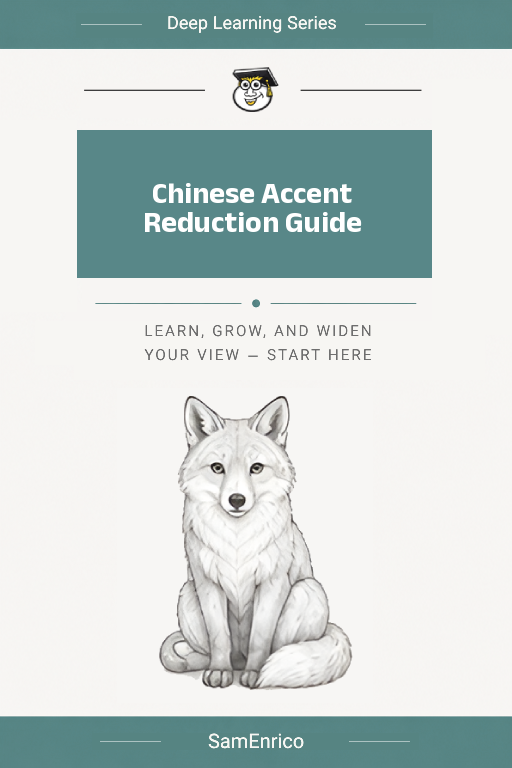
Non-FictionSide Hustle ArchitectAccent
Chinese Accent Reduction Guide eBook
Help Chinese students neutralize accents for profe
Help Chinese students neutralize accents for professional English. Focus on rhythm, stress patterns, and connected speech for natural sounding conversation.
Formats
Free sample
Chapter 1: The Rhythm Trap--You have been working on your English for years. Perhaps you studied it in school, watched American television shows, or even lived in an English-speaking country. You know thousands of words. You can read contracts, write emails, and understand meetings—at least most of what is said. Yet something still feels wrong.When you speak, people sometimes ask you to repeat yourself.
Not because they didn't hear you, but because something sounded… off. Colleagues smile and nod, but you can see the flicker of confusion in their eyes. In conference calls, you notice that others interrupt you more often than they interrupt native speakers. Worse, you have a nagging suspicion that your accent is holding you back from promotions, leadership roles, or simply being taken as seriously as you deserve.Here is the truth that no one has told you: Your individual sounds are probably fine.The vast majority of Chinese professionals do not mispronounce English sounds in ways that truly block understanding. You can probably say "think," "this," "very," and "light" well enough.
So why do you still sound "Chinese" in a way that bothers you and confuses listeners?The answer lies not in your mouth, but in your rhythm.The Great Linguistic Clash Every language has a heartbeat. Mandarin Chinese beats like a metronome: tick, tick, tick, tick. Each syllable gets roughly the same amount of time, the same amount of energy, the same amount of emphasis. This is called syllable-timing.English, on the other hand, beats like jazz. Some syllables are stretched, held, and emphasized.
Others are crushed, reduced, and almost whispered. The time between stressed syllables remains roughly constant, which means unstressed syllables get squeezed into whatever time remains. This is called stress-timing.When you learned English, no one explained this difference to you. Your teachers focused on individual sounds: "This is how to say 'th.' This is how to roll your 'r.'" They gave you vocabulary lists and grammar rules. But they never told you that English has a completely different musical structure from Mandarin.So you did what every human brain does: you transferred the rhythm of your first language onto your second language.
You gave every English syllable equal time, equal weight, equal stress. And that decision—unconscious, well-intentioned, and completely invisible to you—is what creates the "Chinese accent" that native speakers hear.The Neutralization Trap Let me show you what I mean.Here is an English sentence written as if every syllable had equal stress:"I will meet you at the office tomorrow morning."Now read that aloud, giving every single syllable the same length, the same volume, the same pitch. Do it right now. Say it like a robot.It sounds flat, doesn't it? Mechanical.
Exhausting to listen to. Worse, the meaning is unclear. Which word matters? Is it "I" as opposed to someone else? Is it "meet" as opposed to call?
Is it "tomorrow" as opposed to today? The listener cannot tell because everything is equally loud.Now here is the same sentence as a native speaker would say it naturally:"I'll MEET you at the OFFICE to MORrow MORNing."Notice what happened. "I will" became "I'll"—two syllables crushed into one quick sound. "Meet" became longer, louder, and higher in pitch. "Office" stressed on the first syllable, the second syllable reduced almost to nothing.
"Tomorrow" stressed on the middle syllable. "Morning" stressed on the first syllable. The sentence now has a shape, a melody, a pulse.This is the difference between syllable-timed English (what you are doing now) and stress-timed English (what native speakers do). And here is the brutal truth: Native listeners do not hear your individual sounds as the primary marker of your accent. They hear the flat, equal stress.
They hear the machine-gun rhythm. They hear the neutralization of strong and weak syllables.I call this the Neutralization Trap. You add equal stress to every word because that is what Mandarin trained you to do. But in English, adding equal stress to every word makes you sound robotic, aggressive, or bored. In professional settings, this is often misinterpreted as:Lack of confidence (because your voice does not rise and fall with conviction)Bad attitude (because flat delivery sounds dismissive or angry)Low intelligence (because important words do not stand out from unimportant ones)None of this is fair.
None of this reflects who you really are. But it is real, and it is costing you.The Cost of a Flat Accent Let me share a story. I worked with a Chinese software engineer named Wei. He had been at Google for four years. His code was excellent.
His technical documentation was flawless. But he had been passed over for promotion three times.His manager gave vague feedback: "We need to see more leadership presence." "Your communication style feels a bit flat." "People have trouble reading your tone in meetings."Wei was frustrated and confused. He spoke English every day. He understood everything. What did they want?When I listened to Wei speak, I immediately identified the problem.
His individual sounds were fine. His grammar was correct. But every sentence came out with equal stress on every syllable. When he said "I think we should try a different approach," it sounded like "I THINK WE SHOULD TRY A DIFFERENT APPROACH"—all caps, no variation. Native listeners heard aggression where Wei intended enthusiasm.
They heard boredom where Wei intended thoughtful consideration.We spent eight weeks working exclusively on rhythm and stress patterns. We did not practice individual sounds at all. By the end, Wei's delivery had transformed. He learned to compress function words, stretch content words, and use pitch to signal his intent. In his next performance review, he was promoted to staff engineer.Here is what Wei told me afterward: "I spent ten years learning English sounds.
No one ever told me about rhythm. It was the missing piece."You are not Wei, but you are like Wei. You have been working on the wrong thing.What This Book Will Do For You Most accent reduction books make a critical mistake. They focus on segments—the individual vowels and consonants that make up words. They drill you on "th" and "r" and "v" and "w." They give you minimal pairs: "light vs.
right," "very vs. berry," "think vs. sink."These books are not wrong. Those sounds matter. But they are only 20% of the problem.The other 80% is suprasegmentals—the features that apply to syllables and words and sentences as a whole:Rhythm: The pattern of stressed and unstressed syllables Stress: Which syllables and words get emphasis Intonation: The rise and fall of pitch Connected speech: How words link together in natural flow This book is different.
We will focus 80% of our effort on suprasegmentals because that is where the biggest gains live. The remaining 20% will target the specific sounds that genuinely block intelligibility for Chinese speakers—the sounds that, if mispronounced, actually change meaning.Here is what you will learn, chapter by chapter:Chapter 2: How to train your ear to hear stress patterns you have been missing your whole life Chapter 3: How to stress individual words correctly, even words you…
This is the end of the free sample. Get the eBook to keep going. Buy now
About this book
Details
- Author
- Rivas Kaleigh
- Publisher
- SamEnrico
- Language
- English
- Genre
- Non-Fiction, Side Hustle Architect, Accent
- Released
- 2026-06-01
- Pages (approx.)
- 153
- Available as
- eBook, Audiobook

Read better in the ZLOADR app
Your eBooks on your phone or tablet. Sign in with your SamEnrico account and start reading.
More by Rivas Kaleigh
 Networking for the Financial Services ProfessionalRivas Kaleigh$11.99
 Gut Brain Axis and FibromyalgiaRivas Kaleigh$11.99
 Stress and Teen Parent RelationshipsRivas Kaleigh$11.99
 MBSR Eight Week CourseRivas Kaleigh$11.99
 The Last Waltz of the Moonlight Serenade: Benny Goodman’s Secret Jazz RevolutionRivas Kaleigh$11.99
 Director of Business OperationsRivas Kaleigh$11.99
 How to Produce Bass DrumsRivas Kaleigh$11.99
You may also like
 Hong Kong Handover 1997Dunn Johnnie$11.99
 Zumba For Postnatal Recovery CourseNeal Christian$11.99
 Zumba for BeginnersLadner Nikia$11.99
 YouTube Comment Mining GuideHumes Pandora$12.99
 Worry Box MeditationCarlin Rudy$11.99
 Workplace Stress MeditationNguyen Lynn$11.99
 Workplace Stress and Sleep RepairHawley Ivory$11.99
 Workplace Perfectionism CureDelaney Jeffry$11.99
 Workplace Injustice Anger GuideWallen Isabelle$11.99
 Work Addiction and Burnout LinkGreenwood Ester$11.99
 Women in Yoga and WellnessBeattie Galina$11.99
 Women in Stand Up ComedyChun Evangeline$11.99