
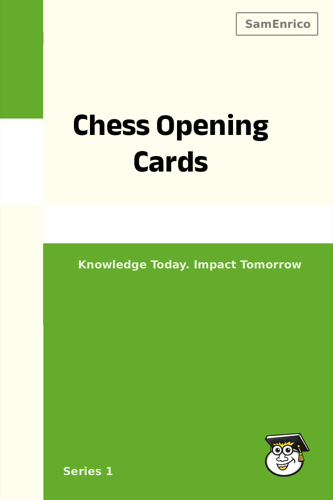
Chess Opening Cards
Memorize chess openings and tactics.
Memorize chess openings and tactics.
Formats
About this book
Free sample
Chapter 1: The Portal Effect...--–- You have just spent three hours studying a sharp line of the French Defense Winawer. You followed grandmaster analysis fifteen moves deep. You repeated the sequence until your fingers could play it blindfolded. You felt prepared. You felt confident.
Then, at your club the next evening, your opponent plays the French. You exchange the first five moves without thinking. On move six, they deviate. Not a wild deviation—just a different knight development, a different pawn push. And you freeze.
Your mind becomes a white screen. You cannot remember whether to capture, retreat, or advance. The position looks vaguely familiar, like a face you once met at a crowded party. But the sequence is gone. The fifteen moves you memorized evaporated the moment the board stopped matching the book.This is the Portal Effect.You have entered a portal of study—intense, focused, seemingly productive—and emerged on the other side with nothing usable.
The hours you invested have turned into dust. And if you are like most chess players, you have experienced this not once but dozens of times. You have blamed your memory. You have told yourself that you are simply not good at remembering openings. You have considered switching to the London System just to avoid the pain.
But the problem is not your memory. The problem is how you have been using it.The Hidden Neuroscience of Opening Amnesia The human brain did not evolve to memorize chess openings. It evolved to track moving animals, remember which berries caused stomach pain, and navigate complex social hierarchies. Your working memory—the part of your brain that holds information temporarily—can store roughly seven pieces of information for about twenty seconds. That is the famous 7±2 rule discovered by cognitive psychologist George Miller in 1956.
Seven digits. Seven words. Seven chess moves, if you are lucky.When you study a chess opening by reading a book or watching a video, you are feeding information into your working memory. You see 1.e4 c5 2.Nf3 d6 3.d4 cxd4 4.Nxd4 Nf6 5.Nc3 a6. That is five moves, five…
This is the end of the free sample. Get the eBook to keep going. Buy now
Contents
- Chapter 1
- Chapter 2
- Chapter 3
- Chapter 4
- Chapter 5
- Chapter 6
- Chapter 7
- Chapter 8
- Chapter 9
- Chapter 10
- Chapter 11
- Chapter 12
Details
- Author
- Wooldridge Halina
- Publisher
- SamEnrico
- Language
- English
- Genre
- Non-Fiction, Self-Help, Chess Learning
- Released
- 2026-06-07
- Pages (approx.)
- 114
- Available as
- eBook, Audiobook

Read better in the ZLOADR app
Your eBooks on your phone or tablet. Sign in with your SamEnrico account and start reading.
More by Wooldridge Halina
 TMS for Treatment Resistant MDDWooldridge Halina$11.99
 Creative Thinking for Operations ResearchWooldridge Halina$11.99
 Dog Loss Grief WorkbookWooldridge Halina$11.99
 Cholesterol Pregnancy GuideWooldridge Halina$11.99
 Retief Goosen Ice ManWooldridge Halina$11.99
 Verbal Overshadowing Effect on IDWooldridge Halina$11.99
 Fear Of ThunderstormsWooldridge Halina$11.99
 Monte Cassino: The Mountain That Wouldn’t FallWooldridge Halina$11.99
 Iron Storm Over the Coral Sea: The Battle That Saved AustraliaWooldridge Halina$11.99
 Service Providers Guide to Propane Sales & ServicesWooldridge Halina$11.99
 How to Produce Household SundriesWooldridge Halina$11.99
 Equipment Leasing GuideWooldridge Halina$12.99