
Non-FictionSelf-HelpChess Learning
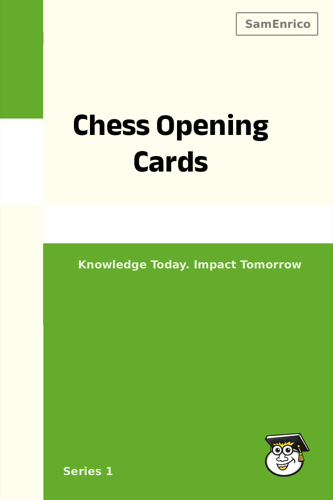
Chess Opening Cards eBook
Memorize chess openings and tactics.
Memorize chess openings and tactics.
Formats
Free sample
Chapter 1: The Portal Effect...--–- You have just spent three hours studying a sharp line of the French Defense Winawer. You followed grandmaster analysis fifteen moves deep. You repeated the sequence until your fingers could play it blindfolded. You felt prepared. You felt confident.
Then, at your club the next evening, your opponent plays the French. You exchange the first five moves without thinking. On move six, they deviate. Not a wild deviation—just a different knight development, a different pawn push. And you freeze.
Your mind becomes a white screen. You cannot remember whether to capture, retreat, or advance. The position looks vaguely familiar, like a face you once met at a crowded party. But the sequence is gone. The fifteen moves you memorized evaporated the moment the board stopped matching the book.This is the Portal Effect.You have entered a portal of study—intense, focused, seemingly productive—and emerged on the other side with nothing usable.
The hours you invested have turned into dust. And if you are like most chess players, you have experienced this not once but dozens of times. You have blamed your memory. You have told yourself that you are simply not good at remembering openings. You have considered switching to the London System just to avoid the pain.
But the problem is not your memory. The problem is how you have been using it.The Hidden Neuroscience of Opening Amnesia The human brain did not evolve to memorize chess openings. It evolved to track moving animals, remember which berries caused stomach pain, and navigate complex social hierarchies. Your working memory—the part of your brain that holds information temporarily—can store roughly seven pieces of information for about twenty seconds. That is the famous 7±2 rule discovered by cognitive psychologist George Miller in 1956.
Seven digits. Seven words. Seven chess moves, if you are lucky.When you study a chess opening by reading a book or watching a video, you are feeding information into your working memory. You see 1.e4 c5 2.Nf3 d6 3.d4 cxd4 4.Nxd4 Nf6 5.Nc3 a6. That is five moves, five chunks.
Your working memory can handle that. Then you add 6.Bg5 e6 7.f4 Qb6. Now you have eight moves, and your working memory is overflowing. You re-read the line. You force it in.
But working memory is like a kitchen counter—you can pile things on it, but once you walk away, someone clears it off. Within twenty seconds of looking away from the page, the sequence begins to decay. Within a minute, most of it is gone.This is not a personal failing. This is neuroscience.The players who seem to remember everything—the grandmasters, the international masters, the strong club players who rattle off twenty moves of the Najdorf without pausing—are not using their working memory differently. They have done something far more important.
They have transferred those sequences from working memory into long-term procedural memory. Procedural memory is the system that lets you ride a bicycle without thinking about balance, type on a keyboard without looking at the keys, or play a musical scale without consciously recalling each finger placement. It is slow to build but nearly permanent once established.The problem is that raw move sequences do not transfer easily into procedural memory. Your brain needs meaning. It needs context.
It needs to know why a move is played, not just which piece goes where. Without meaning, the sequence remains a disconnected list of symbols—and disconnected symbols are what working memory discards first.What Grandmasters Actually Remember Here is a finding that surprises most club players. In controlled studies, grandmasters do not have significantly better raw memory than strong amateurs. When shown random positions that could never occur in a real game—pieces scattered illegitimately across the board—grandmasters remember no more than club players. Their advantage vanishes the moment the board stops making chess sense.But when shown positions from actual games, grandmasters remember nearly everything.
They recall the placement of every piece after a five-second glance. This is not because they have memorized every position they have ever seen. It is because they see the position in chunks that carry meaning. They do not see a knight on f3, a pawn on e4, and a bishop on c4. They see an "Italian Game setup with a pawn on e5 and a knight on c6 threatening d4." That single chunk contains multiple pieces, multiple squares, and a threat.This is contextual memory.
It is memory anchored to reasons, patterns, and strategic ideas.When Magnus Carlsen plays the Ruy Lopez, he does not recite "1.e4 e5 2.Nf3 Nc6 3.Bb5 a6 4.Ba4 Nf6 5.O-O Be7 6.Re1 b5 7.Bb3." He thinks: "I am playing the closed Ruy Lopez. My opponent has committed to ...a6 and ...b5, which weakens the queenside but gives their bishop a retreat square. My plan is to build a pawn center with c3 and d4, then attack the kingside." The moves emerge from the plan. The plan is what he remembers.You can learn to do this. Not at Carlsen's level—that requires decades of pattern exposure—but at a level that will transform your opening play.
The shift is from memorizing moves to memorizing reasons.Introducing the Card System This book is built on a single metaphor: Your opening repertoire is a hand of cards, not an encyclopedia.Imagine you are playing a card game—poker, bridge, or any game where you hold a hand. You do not need to know every card in the deck. You do not need to memorize all fifty-two possible cards and their positions. You need to know how to play the hand you are dealt. You need to know the rules of the game, the probabilities of different draws, and the strategies for your specific cards.Your opening repertoire works the same way.
You do not need to know every possible response to 1.e4. There are hundreds of them—the Sicilian, the French, the Caro-Kann, 1...e5, the Pirc, the Modern, the Scandinavian, the Alekhine, the Nimzowitsch, and more. Attempting to memorize a line against each one is like trying to memorize the entire deck. It is possible in theory but foolish in practice.Instead, you need a limited set of "cards"—variations that cover eighty percent of what you will face at your level. Each card contains a branching path, not a linear list.
A branching path looks like this:If Black plays the Sicilian, I play the Open Sicilian with 2.Nf3 and 3.d4.If Black plays the Najdorf (5...a6), I play the English Attack with Be3, Qd2, O-O-O, and g4.If Black plays the Dragon (5...g6), I play the Yugoslav Attack with Be3, Qd2, O-O-O, f3, and h4.If Black plays the Classical (5...Nc6), I play 6.Be3 and follow the standard plans.If Black plays the French, I play the Advance Variation with 3.e5.If Black plays the Caro-Kann, I also play the Advance Variation with 3.e5.If Black plays 1...e5, I play the Ruy Lopez.Notice what this card does not contain. It does not contain every sideline. It does not contain move twenty of the Najdorf. It contains the first five to seven moves of each major response, plus…
This is the end of the free sample. Get the eBook to keep going. Buy now
About this book
Details
- Author
- Wooldridge Halina
- Publisher
- SamEnrico
- Language
- English
- Genre
- Non-Fiction, Self-Help, Chess Learning
- Released
- 2026-06-07
- Pages (approx.)
- 114
- Available as
- eBook, Audiobook

Read better in the ZLOADR app
Your eBooks on your phone or tablet. Sign in with your SamEnrico account and start reading.
More by Wooldridge Halina
 TMS for Treatment Resistant MDDWooldridge Halina$11.99
 Creative Thinking for Operations ResearchWooldridge Halina$11.99
 Dog Loss Grief WorkbookWooldridge Halina$11.99
 Cholesterol Pregnancy GuideWooldridge Halina$11.99
 Retief Goosen Ice ManWooldridge Halina$11.99
 Verbal Overshadowing Effect on IDWooldridge Halina$11.99
 Fear Of ThunderstormsWooldridge Halina$11.99
 Monte Cassino: The Mountain That Wouldn’t FallWooldridge Halina$11.99
 Iron Storm Over the Coral Sea: The Battle That Saved AustraliaWooldridge Halina$11.99
 Service Providers Guide to Propane Sales & ServicesWooldridge Halina$11.99
 How to Produce Household SundriesWooldridge Halina$11.99
 Equipment Leasing GuideWooldridge Halina$12.99
You may also like
 Hong Kong Handover 1997Dunn Johnnie$11.99
 Zumba For Postnatal Recovery CourseNeal Christian$11.99
 Zumba for BeginnersLadner Nikia$11.99
 YouTube Comment Mining GuideHumes Pandora$12.99
 Worry Box MeditationCarlin Rudy$11.99
 Workplace Stress MeditationNguyen Lynn$11.99
 Workplace Stress and Sleep RepairHawley Ivory$11.99
 Workplace Perfectionism CureDelaney Jeffry$11.99
 Workplace Injustice Anger GuideWallen Isabelle$11.99
 Work Addiction and Burnout LinkGreenwood Ester$11.99
 Women in Yoga and WellnessBeattie Galina$11.99
 Women in Stand Up ComedyChun Evangeline$11.99