
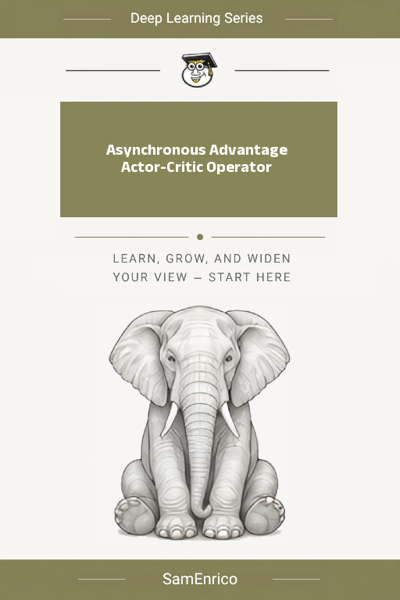
Non-FictionInformativeEducational
Asynchronous Advantage Actor-Critic Operator eBook
A Coursebook on Asynchronous Advantage Actor-Criti
by Fisk Marcelo
A Coursebook on Asynchronous Advantage Actor-Critic Operator
Formats
Free sample
Chapter 1: The Two Deaths--–- In the winter of 2016, two algorithms died. The first was Quick Draw, a production recommendation engine at a mid-sized e-commerce company that had worked flawlessly for eighteen months. Then, without warning, it stopped recommending anything at all. Not bad recommendations—no recommendations. The product team gathered around a dashboard showing flatlines where healthy oscillations once danced.
The second death was quieter: a promising autonomous navigation system that had mastered a simulated warehouse environment, earning praise in a conference paper, only to freeze completely when deployed on real hardware with continuous steering controls.These were not bugs in the conventional sense. No null pointer exceptions. No memory leaks. No obvious typos in the loss functions. These were architectural deaths—the kind that occur when an algorithm meets a problem it was never designed to solve, and rather than fail gracefully, it simply...
stops learning.The engineers who built Quick Draw had used DQN, Deep Mind's celebrated breakthrough that had mastered Atari games with superhuman proficiency. Their logic was impeccable: if DQN can learn to play Breakout, surely it can learn to recommend products. What they discovered, too late, was that DQN works beautifully when actions are discrete and few—left, right, fire, jump. It fails catastrophically when you need to select a continuous value like a recommendation score threshold, a steering angle, or a torque setting. The action space of the real world is not a menu.
It is a dial, a slider, an infinite spectrum of possibilities between zero and one.The robotics team made a different mistake. They had used REINFORCE, the classic policy gradient method that directly optimizes the policy function without needing a value estimator. On paper, REINFORCE handles continuous actions elegantly—the policy outputs the parameters of a probability distribution over actions. In practice, REINFORCE suffers from variance so high that it resembles random search more than learning. A single lucky episode can push the policy in a completely wrong direction.
A single unlucky episode can undo weeks of training. Their warehouse robot worked in simulation because simulation rewards had no noise. Reality, as reality does, introduced noise. The policy oscillated wildly, never converging.This book is about the algorithm that rose from these ashes. An algorithm that combines the discrete-action mastery of DQN with the continuous-action flexibility of REINFORCE, while subtracting the fatal weaknesses of both.
An algorithm that discovered that sometimes, the best way to learn is to let multiple students argue with each other, asynchronously, without a teacher. An algorithm with an unwieldy name—Asynchronous Advantage Actor-Critic—that belies its elegant simplicity.But to understand why Actor-Critic works, we must first understand why DQN and REINFORCE don't.The First Death: When Discrete Thinking Kills Value-based methods, of which DQN is the most famous example, operate on a deceptively simple principle: learn a function that estimates how good each action is in each state, then take the best one. Formally, they learn the Q-function Q(s,a), which predicts the expected cumulative reward for taking action a in state s and following the optimal policy thereafter.In a game of Breakout, this works beautifully. The state is a screen of pixels. The actions are four discrete choices: move left, move right, fire, or do nothing.
The Q-function can be represented as a neural network that takes the screen pixels as input and outputs four numbers—one Q-value for each action. To choose an action, you take the argmax: look at the four outputs, pick the largest one.But consider the problem of controlling a robotic arm with a continuous joint angle. The action is not one of four choices; it is a real number between -180 and 180 degrees. How many discrete actions would you need to approximate reasonable control? If you discretize every degree, you have 360 actions.
The Q-network would need 360 outputs. Fine for 360. But what about a car with steering angle, acceleration, and braking? That's three continuous dimensions. If you discretize each into 100 bins, you have 100³ = 1,000,000 possible action combinations.
The Q-network would need one million outputs.This is not merely impractical. It is theoretically broken. The Q-learning update requires finding the action that maximizes Q(s,a)—the argmax. With one million actions, you must evaluate all one million outputs every time you make a decision. Even worse, the Bellman equation that Q-learning relies on assumes that the optimal policy is deterministic: given a state, the best action is simply the one with the highest Q-value.
When actions are continuous, the optimal policy is rarely deterministic. The perfect steering angle depends on subtle state variations that discrete bins cannot capture.This is the curse of dimensionality in action spaces. DQN died because it thought discretely in a continuous world.The Second Death: When Variance Eats Gradients Policy gradient methods, of which REINFORCE is the simplest example, take the opposite approach. Instead of learning Q-values and deriving a policy, they learn the policy directly. The policy is a function π_θ(a|s) that outputs a probability distribution over actions—discrete or continuous.
You sample an action from this distribution, execute it, observe the reward, and then adjust θ to make good actions more likely and bad actions less likely.The update rule for REINFORCE is elegant in its simplicity:∇_θ J(θ) = E[ ∇_θ log π_θ(a|s) · G_t ]Where G_t is the total reward from time t onward (the "return"). The intuition: if the return was positive, increase the log-probability of the action you took; if negative, decrease it. The magnitude of the update scales with the magnitude of the return.This works, in theory. In practice, REINFORCE suffers from variance so astronomical that it makes stochastic gradient descent look like a precision instrument.Consider a simple environment: a robot trying to reach a goal, with sparse rewards. It gets +1 only when it reaches the goal, and 0 otherwise.
Most episodes, the robot wanders randomly and receives G_t = 0. The gradient updates are zero. Nothing changes. Occasionally, by pure luck, it stumbles into the goal and receives G_t = 1. The update increases the probability of whatever random sequence of actions preceded the goal—even if those actions had nothing to do with reaching it.
The signal is so noisy that learning is impractically slow.Even with dense rewards, variance remains a problem. Imagine a state that is generally terrible: the robot has fallen into a pit, and most actions lead to a reward of -10. A good action in this terrible state—one that enables climbing out—might still yield a reward of -9. With raw returns, that good action receives a negative signal (-9) and is incorrectly penalized. The policy learns that all actions in that state are bad, even though some are less bad than others.This is the baseline problem.
REINFORCE has no baseline. It compares each action's return to... nothing. The absolute value of the return, not its relative merit, drives learning. In a bad state with uniformly negative returns, even the best action looks bad.The variance of REINFORCE scales with the variance of the returns.
In environments with stochastic rewards (which is most real environments), the variance can be orders of magnitude larger than the signal. The…
This is the end of the free sample. Get the eBook to keep going. Buy now
About this book
Details
- Author
- Fisk Marcelo
- Publisher
- SamEnrico
- Language
- English
- Genre
- Non-Fiction, Informative, Educational
- Released
- 2026-05-04
- Pages (approx.)
- 149
- Available as
- eBook, Audiobook

Read better in the ZLOADR app
Your eBooks on your phone or tablet. Sign in with your SamEnrico account and start reading.
More by Fisk Marcelo
 Sleep Meditation for InfantsFisk Marcelo$11.99
 Physical Exercise NeuroprotectionFisk Marcelo$11.99
 Public Speaking Assertiveness GuideFisk Marcelo$11.99
 Lonely Expat Connection GuideFisk Marcelo$11.99
 The Social Creative AccountabilityFisk Marcelo$11.99
 Verdict of the Sphinx: How an Ancient Judge Solved a Murder That Stumped Modern ForensicsFisk Marcelo$11.99
 How to Start a First Aid Boxes (wholesale) Business (Beginners Guide)Fisk Marcelo$11.99
 Learn to Play the BawuFisk Marcelo$11.99
 Category Based Express EntryFisk Marcelo$12.99
 Pre Launch Community ToolsFisk Marcelo$12.99
You may also like
 Hong Kong Handover 1997Dunn Johnnie$11.99
 Zumba For Postnatal Recovery CourseNeal Christian$11.99
 Zumba for BeginnersLadner Nikia$11.99
 YouTube Comment Mining GuideHumes Pandora$12.99
 Worry Box MeditationCarlin Rudy$11.99
 Workplace Stress MeditationNguyen Lynn$11.99
 Workplace Stress and Sleep RepairHawley Ivory$11.99
 Workplace Perfectionism CureDelaney Jeffry$11.99
 Workplace Injustice Anger GuideWallen Isabelle$11.99
 Work Addiction and Burnout LinkGreenwood Ester$11.99
 Women in Yoga and WellnessBeattie Galina$11.99
 Women in Stand Up ComedyChun Evangeline$11.99