
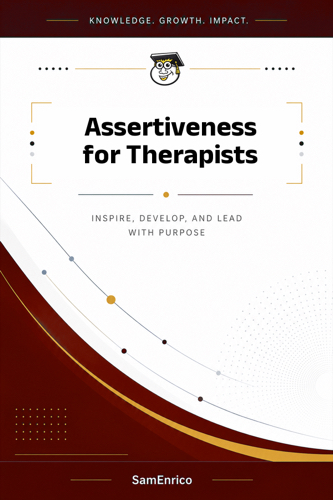
Assertiveness for Therapists eBook
Professional boundaries in clinical practice.
by Powers Luis
Professional boundaries in clinical practice.
Formats
Free sample
Chapter 1: The Kindness Trap--–- The first time a client cried after I said "no," I almost quit therapy. I was three years post-licensure, working at a community mental health center, drowning in a caseload of forty-seven clients. My supervisor had gently suggested that I was "over-functioning." My partner had stopped asking why I came home with red eyes. And my own therapist had asked a question I couldn't shake: "What are you so afraid will happen if you stop being nice?"I didn't have an answer. So I did what most helpers do.
I worked harder. I stayed later. I waived fees for clients who "really needed a break." I answered texts at 11 PM because "they had no one else." I told myself I was being compassionate. I told myself I was being a good therapist. I told myself that burnout happened to other people—the ones who didn't care enough, who set harsh boundaries, who weren't really helpers at heart.Then I ran the numbers.
In the past twelve months, I had worked an average of fifty-three hours per week. I had earned exactly what I earned the year before, despite the extra hours, because I had stopped billing nearly twenty sessions. I had cried in my car after sessions with at least six different clients. And I had secretly, shamefully, begun to resent the very people I had sworn to help.That resentment was the scariest part. Not the exhaustion.
Not the lost income. The resentment. Because if I resented my clients, what kind of therapist was I? What kind of person?I was a therapist trapped in what I have come to call the Kindness Trap.The Kindness Trap is the seductive belief that good therapists are endlessly self-sacrificing. It tells us that boundaries are selfish, that "no" is a form of abandonment, and that our own exhaustion is simply the price of admission to the helping professions.
It rewards the martyr and punishes the one who dares to rest. And it is quietly destroying our profession, one over-run session at a time.This chapter is about the high cost of "being nice." It is about the difference between therapeutic generosity—a conscious, bounded choice that serves the client's treatment—and what I call the Martyr Pattern: the automatic, resentful over-giving driven by our own need to be liked, approved of, and seen as a "good" therapist. By the end of this chapter, you will be able to identify the specific symptoms of passive practice in your own work. You will understand the data linking a lack of assertiveness to burnout, vicarious traumatization, and high turnover rates in mental health. And you will make a crucial distinction that will serve as the foundation for every skill in this book: the difference between giving from choice and giving from fear.The Cultural Myth of the Endlessly Self-Sacrificing Helper Every helping profession carries an unspoken initiation myth.
For therapists, it goes something like this: You entered this field because you care deeply. You are empathetic, intuitive, and generous. These qualities are your greatest strengths. Therefore, any boundary that limits your availability, your emotional access, or your flexibility is a betrayal of who you are.This myth is so deeply embedded in our training and supervision that most of us never notice it. It shows up in the way we talk about "good" clinicians ("She never turns anyone away").
It shows up in the way we judge colleagues who leave on time ("He must not be that committed"). And it shows up most powerfully in the way we treat ourselves when we dare to set a limit.Consider the language we use. A therapist who enforces the cancellation policy is "rigid." A therapist who does not answer after-hours texts is "cold." A therapist who refers out a client beyond their competence is "not a team player." These judgments are rarely spoken aloud. They are whispered in supervision, implied in case conference, and internalized so completely that we begin to say them to ourselves before anyone else can.The result is a profession that systematically rewards self-destruction. We celebrate the therapist who works through lunch, who stays until 8 PM, who "holds" a client's crisis without charging for the extra hour.
We rarely ask the follow-up question: What is the cost of that holding? And who ultimately pays it?The Seven Symptoms of Passive Practice Passive practice is not a personality flaw. It is a learned pattern of behavior—one that can be unlearned. But first, you have to recognize it. Based on clinical observations and the emerging research on therapist self-care, I have identified seven specific symptoms of passive practice.
These are not theoretical. They are the daily, measurable behaviors that distinguish the therapist caught in the Kindness Trap from the therapist who practices assertive, sustainable care.Symptom One: Chronic Lateness The passive therapist is chronically late—not because they are disorganized (though that may also be true), but because they cannot end the previous session on time. Each session bleeds into the next. A client discloses something painful at minute forty-eight, and the therapist thinks, I can't just end now. So they stay ten minutes.
Then fifteen. Then twenty. By the end of the day, they are running an hour behind, rushing between rooms, and apologizing to every client who had to wait.Chronic lateness is not kindness. It is a failure of the frame. Each time you over-run a session, you teach the client that the boundary was never real.
You also teach yourself that your time does not matter. And you guarantee that every subsequent client will receive a frazzled, rushed, already-exhausted version of you.Symptom Two: Over-Running Sessions by Fifteen Minutes or More This symptom is so common that many therapists no longer recognize it as a problem. "Fifteen minutes over" becomes the new normal. The therapist stops setting a timer. They stop giving a ten-minute warning.
They simply let the session unfold until the client stops talking, then glance at the clock and apologize for the time.The clinical cost is substantial. When sessions have no predictable endpoint, clients cannot develop a sense of containment. The work becomes formless. Termination becomes impossible to plan. And the therapist, without realizing it, has abandoned one of the Six Pillars of the Frame—Time—which we will explore in depth in Chapter 2.Symptom Three: Waiving Fees Without Clinical Rationale Money is the boundary that most therapists struggle to hold.
We tell ourselves that we are being "flexible" or "compassionate" when we waive a copay, reduce a fee, or simply forget to bill for a session. But the data tells a different story. Therapists who routinely waive fees without a documented clinical rationale are significantly more likely to report resentment toward their clients, financial stress, and eventual burnout.This is not an argument against reduced-fee slots or pro bono work. Those are conscious, bounded choices—therapeutic generosity, which we will discuss shortly. The problem is the automatic waiving of fees: the missed invoice that never gets sent, the sliding scale that slides indefinitely, the client who has not paid in three months and the therapist who has not said a word.Symptom…
This is the end of the free sample. Get the eBook to keep going. Buy now
About this book
Details
- Author
- Powers Luis
- Publisher
- SamEnrico
- Language
- English
- Genre
- Non-Fiction, Self-Help, Therapy
- Released
- 2026-06-05
- Pages (approx.)
- 133
- Available as
- eBook, Audiobook

Read better in the ZLOADR app
Your eBooks on your phone or tablet. Sign in with your SamEnrico account and start reading.
More by Powers Luis
 Vaginal Birth Recovery GuidePowers Luis$11.99
 Automotive Industry MapsPowers Luis$11.99
 The Metabolic Adaptation for Bariatric PatientsPowers Luis$11.99
 Scarcity Fuels InnovationPowers Luis$11.99
 Inventory Shrinkage DetectionPowers Luis$11.99
 School Call Parent AngerPowers Luis$11.99
 Chess Pattern RecognitionPowers Luis$11.99
 The Drumbeats of Resistance: How a Forgotten Song United China Against JapanPowers Luis$11.99
 The Blood Feuds of the Maori and the Birth of Rugby's First PeacePowers Luis$11.99
 How to Produce Conductor BatonsPowers Luis$11.99
 How to Produce an OvenPowers Luis$11.99
 Synthesis Essay PromptsPowers Luis$12.99
You may also like
 Hong Kong Handover 1997Dunn Johnnie$11.99
 Zumba For Postnatal Recovery CourseNeal Christian$11.99
 Zumba for BeginnersLadner Nikia$11.99
 YouTube Comment Mining GuideHumes Pandora$12.99
 Worry Box MeditationCarlin Rudy$11.99
 Workplace Stress MeditationNguyen Lynn$11.99
 Workplace Stress and Sleep RepairHawley Ivory$11.99
 Workplace Perfectionism CureDelaney Jeffry$11.99
 Workplace Injustice Anger GuideWallen Isabelle$11.99
 Work Addiction and Burnout LinkGreenwood Ester$11.99
 Women in Yoga and WellnessBeattie Galina$11.99
 Women in Stand Up ComedyChun Evangeline$11.99