
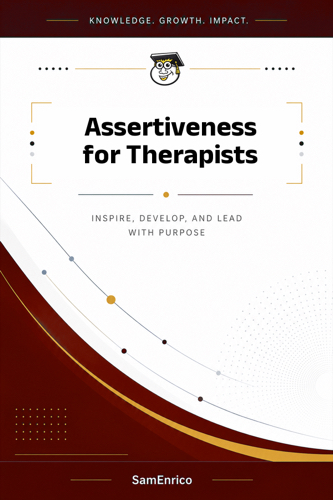
Assertiveness for Therapists Audiobook
Professional boundaries in clinical practice.
by Powers Luis
Professional boundaries in clinical practice.
Formats
Free sample
Chapter 1: The Kindness Trap--–- The first time a client cried after I said "no," I almost quit therapy. I was three years post-licensure, working at a community mental health center, drowning in a caseload of forty-seven clients. My supervisor had gently suggested that I was "over-functioning." My partner had stopped asking why I came home with red eyes. And my own therapist had asked a question I couldn't shake: "What are you so afraid will happen if you stop being nice?"I didn't have an answer. So I did what most helpers do.
I worked harder. I stayed later. I waived fees for clients who "really needed a break." I answered texts at 11 PM because "they had no one else." I told myself I was being compassionate. I told myself I was being a good therapist. I told myself that burnout happened to other people—the ones who didn't care enough, who set harsh boundaries, who weren't really helpers at heart.Then I ran the numbers.
In the past twelve months, I had worked an average of fifty-three hours per week. I had earned exactly what I earned the year before, despite the extra hours, because I had stopped billing nearly twenty sessions. I had cried in my car after sessions with at least six different clients. And I had secretly, shamefully, begun to resent the very people I had sworn to help.That resentment was the scariest part. Not the exhaustion.
Not the lost income. The resentment. Because if I resented my clients, what kind of therapist was I? What kind of person?I was a therapist trapped in what I have come to call the Kindness Trap.The Kindness Trap is the seductive belief that good therapists are endlessly self-sacrificing. It tells us that boundaries are selfish, that "no" is a form of abandonment, and that our own exhaustion is simply the price of admission to the helping professions.
It rewards the martyr and punishes the one who dares to rest. And it is quietly destroying our profession, one over-run session at a time.This chapter is about the high cost of "being nice." It is about the difference between therapeutic generosity—a conscious, bounded choice that serves the client's treatment—and what I call the Martyr Pattern: the automatic, resentful over-giving driven by our own need to be liked, approved of, and seen as a "good" therapist. By the…
This is the end of the free sample. Get the Audiobook to keep going. Buy now
About this book
Details
- Author
- Powers Luis
- Publisher
- SamEnrico
- Language
- English
- Genre
- Non-Fiction, Self-Help, Therapy
- Released
- 2026-06-05
- Pages (approx.)
- 133
- Available as
- eBook, Audiobook

Listen in the VoxFlicks app
Audiobooks and audio dramas wherever you go. Sign in with your SamEnrico account and press play.
More by Powers Luis
 Vaginal Birth Recovery GuidePowers Luis$11.99
 Automotive Industry MapsPowers Luis$11.99
 The Metabolic Adaptation for Bariatric PatientsPowers Luis$11.99
 Scarcity Fuels InnovationPowers Luis$11.99
 Inventory Shrinkage DetectionPowers Luis$11.99
 School Call Parent AngerPowers Luis$11.99
 Chess Pattern RecognitionPowers Luis$11.99
 The Drumbeats of Resistance: How a Forgotten Song United China Against JapanPowers Luis$11.99
 The Blood Feuds of the Maori and the Birth of Rugby's First PeacePowers Luis$11.99
 How to Produce Conductor BatonsPowers Luis$11.99
 How to Produce an OvenPowers Luis$11.99
 Synthesis Essay PromptsPowers Luis$12.99
You may also like
 The Therapy for Emotions GuideTamayo Whitney$11.99
 The Body Language for TherapistsBarraza Charleen$11.99
 Parent Therapy Seeking GuideBoehm Kymberly$11.99
 Imposter Syndrome For TherapistsPederson Kirstie$11.99
 Fear Of Failure In TherapyWorkman Ellsworth$11.99
 Assertive Communication for TherapistsMcclung Tanisha$11.99
 The Parent Anger Therapy GuideCade Jenise$11.99
 Name Memory for TherapistsVillasenor Solange$11.99
 Food Addiction Therapy OptionsWhitten Page$11.99
 Financial Therapist Finding GuideHager Brianne$11.99
 Therapy Maintenance for Emotional HealthHirsch Carman$11.99
 Therapist Client Difficult TalksPotter Mona$11.99