
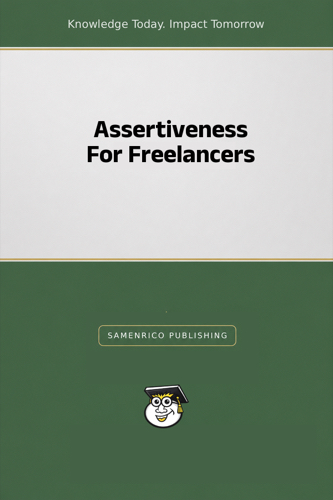
Assertiveness For Freelancers eBook
Negotiate rates, manage scope creep, and fire bad
Negotiate rates, manage scope creep, and fire bad clients.
Formats
Free sample
Chapter 1: The People-Paying Parasite--–- Every morning, Maria opened her email with a wince. The preview pane showed three new messages from the same client: "Quick question," "Just following up," and "One more small change." She had invoiced this client $4,000 for a logo project six weeks ago. She had received $0. She had completed four rounds of revisions beyond the agreed two. And she was currently designing a brochure for them—for free—because she was afraid that if she stopped, they would never pay the original invoice.Maria is not lazy.
Maria is not stupid. Maria is a freelancer who has confused being helpful with being servile, and that confusion is costing her $30,000 per year.This chapter is not about Maria. This chapter is about you. Because if you are reading a book called Assertiveness for Freelancers, there is a very good chance that you have been Maria at least once in the past twelve months. You have undercharged.
You have over-delivered. You have said yes when every molecule in your body screamed no. And you have told yourself that this is just what it takes to be a good freelancer—flexible, accommodating, easy to work with.That story is a lie. And it is a lie that is slowly bankrupting you.The confusion between being helpful and being servile is the single most expensive mistake freelancers make. Not bad marketing.
Not poor time management. Not even the wrong niche. The inability to say no, to charge what you are worth, and to enforce your own boundaries is the parasite that lives in the brain of otherwise brilliant independent professionals. This chapter is the deworming.The "Lucky to Be Here" Fallacy Let us name the parasite. It is called the "Lucky to Be Here" fallacy, and it goes like this: because you do not have a guaranteed salary, a corner office, or a company-sponsored 401(k), you should be grateful for any client who throws you a bone.
You are a freelancer, after all. You chose this insecure life. So when a client asks for a discount, you should feel lucky they are considering you at all. When they ask for a "quick" revision at 10 PM, you should feel lucky they trust you. When they pay sixty days late, you should feel lucky they paid at all.This fallacy is not your fault.
It is the inheritance of a culture that treats freelancing as a hobby with an invoice attached. But it is your responsibility to kill it.Drawing from the 2025 bestseller If It's Outside the Scope, It's Inside the Invoice, we see a brutal pattern: freelancers who leave traditional employment often become more accommodating, not less. They mistake the absence of a boss for the absence of power dynamics. In reality, they have simply traded one boss for many. And without the structure of an HR department or a union, they default to the one strategy that worked in their old job: pleasing the person with the money.The numbers are devastating.
A 2024 survey of 2,500 freelancers found that the average respondent left $18,400 on the table annually due to unbilled work, discounted rates, and unpaid invoices. That is not a rounding error. That is a second income for a partner, a college fund for a child, or twelve months of therapy to figure out why you keep saying yes to people who do not respect you.The "Lucky to Be Here" fallacy has a specific signature. You will recognize it by the following thoughts:"They are taking a chance on an unknown freelancer.""I do not have the portfolio to charge that much.""If I say no, they will find someone else.""This could lead to more work down the line.""They are a big client; I should be flexible."Each of these thoughts is a lie. They are not taking a chance on you; you are solving a problem they cannot solve themselves.
You do have the portfolio; you are just comparing your behind-the-scenes struggles to their polished highlight reel. And that "more work down the line" is almost always a myth—clients who underpay you once will expect to underpay you forever.The Three Faces of Freelance Interaction Before we can build assertiveness, we must diagnose where you currently live. The assertiveness literature, from Your Perfect Right to The Assertiveness Workbook, has long recognized three behavioral styles. But freelancing adds a specific twist to each.Style One: Aggression (Win/Lose)The aggressive freelancer wins the battle and loses the war. They respond to a lowball offer with sarcasm: "Oh, sure, I will work for minimum wage.
Do you want me to bring my own sandwich?" They threaten clients with bad reviews. They fire off angry emails at midnight. They feel powerful in the moment and then watch their referral network dry up.Aggression feels like assertiveness to the untrained ear. Both involve saying no. Both involve standing up for oneself.
But aggression is distinguished by its disregard for the other party's interests. The aggressive freelancer does not want a win/win; they want to punish the client for asking. The result is not a sustainable business but a series of burned bridges and a reputation for being "difficult."In freelancing, aggression is rare because it is self-defeating. Most freelancers overcorrect in the opposite direction.Style Two: Non-Assertion (Lose/Win)The non-assertive freelancer is the people-pleasing parasite in its purest form. They say yes to every request.
They discount their rates at the first sign of hesitation. They absorb scope creep like a sponge absorbing water, then wring themselves out at 2 AM. They are "easy to work with" in the same way a doormat is easy to walk on.Non-assertion is the default setting for most freelancers, especially those who came from service industries or toxic workplaces. It feels safe because it avoids conflict. But it is not safe.
It is a slow bleed. Every unbilled hour, every discounted rate, every "quick question" answered for free is a small cut. Individually, none of them kill you. Collectively, they are fatal.The non-assertive freelancer tells themselves they are being strategic. They are building relationships.
They are investing in future work. This is usually denial. A 2023 longitudinal study of freelancers found that those who said yes to out-of-scope requests were 40 percent more likely to be asked for additional out-of-scope requests within the same month. Saying yes does not train clients to respect you. It trains them to ask for more.Style Three: Assertion (Win/Win or Win/Leave)This book introduces a two-mode model of assertiveness, and we will spend the remaining eleven chapters building your capacity for both.
But let us plant the flag here.Collaborative Assertiveness (Win/Win) is what most people think of when they imagine assertiveness. You stand up for your interests while respecting the client's. You negotiate. You problem-solve. You use the Positive No formula from Chapter 2.
This mode works when both parties have room to move and a shared interest in an ongoing relationship.Protective Assertiveness (Win/Leave) is what most people forget. This mode activates when win/win is impossible. The client has a $500 budget. You need $2,000. There is no stripped-down version that solves their problem.…
This is the end of the free sample. Get the eBook to keep going. Buy now
About this book
Details
- Author
- Steward Dwana
- Publisher
- SamEnrico
- Language
- English
- Genre
- Non-Fiction, Self-Help, Freelance
- Released
- 2026-06-06
- Pages (approx.)
- 106
- Available as
- eBook, Audiobook

Read better in the ZLOADR app
Your eBooks on your phone or tablet. Sign in with your SamEnrico account and start reading.
More by Steward Dwana
 Mindful Healthcare Professional GuideSteward Dwana$11.99
 Calf Strain Recovery ProtocolSteward Dwana$11.99
 UK CMA Merger BlocksSteward Dwana$11.99
 Metta For Evening Wind DownSteward Dwana$11.99
 Mentoring New ManagersSteward Dwana$11.99
 Trace Evidence Collection GuideSteward Dwana$11.99
 Good Father, Bad AngerSteward Dwana$11.99
 A B Testing BiasesSteward Dwana$11.99
 The Clockwork Dreamer: How a 19th-Century Engineer Built the First Practical Steam-Powered CarSteward Dwana$11.99
 The Codebreaker of Southeast Asia: Hoang Tuan's Mathematical RevolutionSteward Dwana$11.99
 The Last Charge of the Qing: The Fall of the Boxer Rebellion (1900)Steward Dwana$11.99
 How to Start a Marine Insurance Survey Business (Beginners Guide)Steward Dwana$11.99
You may also like
 Hong Kong Handover 1997Dunn Johnnie$11.99
 Zumba For Postnatal Recovery CourseNeal Christian$11.99
 Zumba for BeginnersLadner Nikia$11.99
 YouTube Comment Mining GuideHumes Pandora$12.99
 Worry Box MeditationCarlin Rudy$11.99
 Workplace Stress MeditationNguyen Lynn$11.99
 Workplace Stress and Sleep RepairHawley Ivory$11.99
 Workplace Perfectionism CureDelaney Jeffry$11.99
 Workplace Injustice Anger GuideWallen Isabelle$11.99
 Work Addiction and Burnout LinkGreenwood Ester$11.99
 Women in Yoga and WellnessBeattie Galina$11.99
 Women in Stand Up ComedyChun Evangeline$11.99