
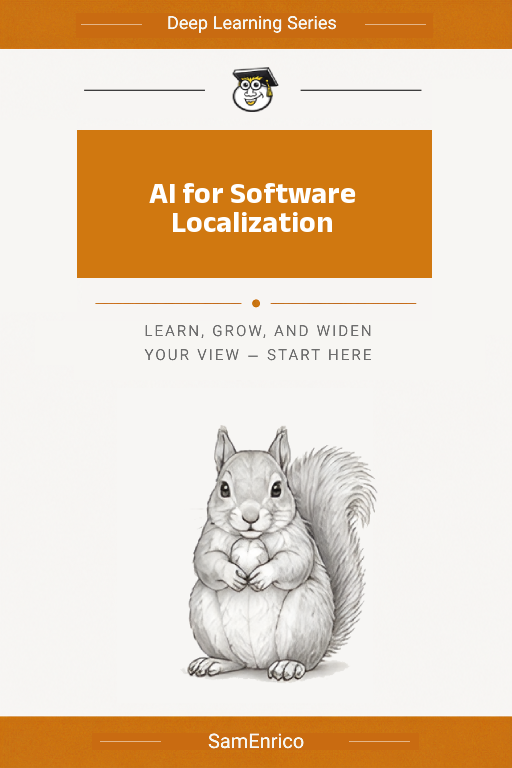
AI for Software Localization eBook
Localize mobile apps, software interfaces, and str
Localize mobile apps, software interfaces, and strings files using AI translation workflows.
Formats
Free sample
Chapter 1: The Great Divergence--–- In 2019, a mid-sized travel booking app called Globe Hopper faced a problem that will sound painfully familiar to any software developer reading this book. They had just closed a $12 million Series A round and received aggressive targets to expand into Japan, Brazil, and Germany within six months. The product was solid, the team was talented, and the market was hungry. But every time they tried to ship a localized version, something broke. Not the translation quality—that was actually fine.
The app itself broke. Placeholders got corrupted, layouts shattered when German words stretched beyond button boundaries, and in one memorable incident, a missing format specifier caused the Japanese version to crash instantly upon login, affecting fifteen thousand beta users who promptly flooded support with one-star reviews.The localization team at Globe Hopper was not incompetent. They were using industry-standard Translation Management Systems (TMS) and working with professional human translators who had decades of experience. The problem was structural. Their release cycle was two weeks, but the localization workflow took three.
Every sprint ended with a frantic scramble: developers would freeze feature work, export strings files, send them to translators, wait seven to ten days, receive the translated files, discover placeholder mismatches, send them back for correction, wait another three days, and then desperately try to merge everything before the release deadline. More than once, they shipped with untranslated English strings showing up in German or Japanese because the pipeline simply couldn't keep up.Globe Hopper is not an outlier. This story plays out daily in thousands of software companies, from two-person startups to Fortune 500 enterprises. The gap between how modern software is built—continuously, iteratively, with multiple daily deploys—and how traditional localization works—batch-oriented, human-centric, with turnaround times measured in days or weeks—has become a chasm wide enough to swallow product roadmaps whole.Then something changed. In 2023, the same Globe Hopper team that had struggled for years with localization bottlenecks quietly re-architected their pipeline.
They stopped sending strings to human translators by default. Instead, they routed everything through a Large Language Model (LLM) with a carefully engineered prompt, added a ten-minute human review step for high-risk strings, and cut their localization turnaround time from fourteen days to forty-five minutes. The app launched in Japan on schedule, with full feature parity, zero placeholder-related crashes, and a budget that came in at twelve percent of the original projection.This book is the story of that transformation. It is a practical, code-first guide to using AI—specifically Large Language Models—to automate software localization at scale, without sacrificing quality, without blowing your budget, and without introducing new categories of bugs. By the time you finish this chapter, you will understand why traditional localization failed, what makes AI translation fundamentally different from everything that came before, and how to measure success in a world where AI does the heavy lifting and humans focus on what they do best: judgment, brand voice, and edge cases.The Post-Mortem of Traditional Localization Let us be precise about what "traditional localization" means in this book.
We are not talking about Google Translate pasted into a spreadsheet. We are talking about the professional ecosystem of Computer-Assisted Translation (CAT) tools, Translation Management Systems (TMS), and human translation workflows that have dominated the industry for the past twenty-five years.CAT tools like SDL Trados, Memo Q, and Wordfast were designed for a specific era of content—an era when most translated material consisted of documents, user manuals, marketing collateral, and legal contracts. These artifacts changed slowly, were reviewed by committees, and had release cycles measured in months. The CAT tool workflow made perfect sense for that world: a translator receives a file, works on it in a specialized editor with translation memory suggestions, passes it to an editor for review, then to a proofreader, and finally back to the client. Four pairs of human eyes, two to three weeks of calendar time, and a cost structure that assumed high value per word.Software never fit this model.
The fundamental unit of software translation is not the document but the string—a single line of text that appears somewhere in the user interface. A modest mobile app might contain five hundred strings. A complex enterprise web application can easily exceed ten thousand. These strings change constantly: new features add strings, old features get reworded, error messages are refined, button labels are A/B tested, and legal disclaimers are updated. In a continuous delivery environment, the difference between two versions of a strings file might be two hundred additions, fifty deletions, and one hundred thirty-seven modifications.
Traditional CAT tools, which expect to receive complete documents and return complete documents, have no efficient way to handle incremental updates.The result is what localization engineers call "file ping-pong." Developer exports strings. Translator translates all strings, including thousands that haven't changed. Developer receives a massive file, extracts the changed translations, merges them into the codebase, and discovers that the translator accidentally broke three placeholders and introduced inconsistent terminology across seven different strings. Developer sends the file back for correction. Translator fixes three placeholders but introduces two new errors.
This cycle repeats until someone gives up and accepts "good enough."Real-world evidence of this failure is not hard to find. In 2022, a major financial services company conducted an internal audit of their localization process. They discovered that the average time from code commit to localized release was eleven days. Of those eleven days, the actual translation work took eight hours. The remaining ten days and sixteen hours were spent on file coordination, context clarification, placeholder repair, and waiting.
Ninety-six percent of the calendar time added no value—it was pure friction.Worse, the friction scales superlinearly with team size. A single developer working alone can often hack together a localization script that works well enough. But add ten developers, two product managers, a QA team, and an external translation agency, and coordination overhead explodes. Every additional stakeholder increases the probability of a handoff failure, a misaligned expectation, or a corrupted file.This is where Large Language Models enter the story. They do not simply improve the existing workflow by making translation faster.
They fundamentally change the workflow by eliminating most of the handoffs.Defining AI Translation: NMT versus LLMBefore we go further, we need to establish precise terminology. "AI translation" has become a catch-all phrase that obscures important distinctions. In this book, we distinguish sharply between two different technologies: Neural Machine Translation (NMT) and Large Language Model (LLM)-based translation.Neural Machine Translation is what powers Google Translate, Deep L, and Amazon Translate. These models are trained on massive parallel corpora—millions or billions of sentences in language A aligned with their translations in language B. When you give an NMT model a sentence, it performs a statistical pattern-matching operation: it has seen similar sentences before, it knows which words tend to map to which other words, and it generates the most probable translation based on that training.NMT models are fast, cheap, and remarkably good at what they do—for certain types of content.
They excel at high-volume, low-context, predictable text: product descriptions, news articles, technical documentation, and conversational phrases. They are terrible at…
This is the end of the free sample. Get the eBook to keep going. Buy now
About this book
Details
- Author
- Bandy Donnell
- Publisher
- SamEnrico
- Language
- English
- Genre
- Non-Fiction, AI Operator, Language Services
- Released
- 2026-06-01
- Pages (approx.)
- 147
- Available as
- eBook, Audiobook

Read better in the ZLOADR app
Your eBooks on your phone or tablet. Sign in with your SamEnrico account and start reading.
More by Bandy Donnell
 Kinesics Movement AnalysisBandy Donnell$11.99
 Local Newspaper InsertsBandy Donnell$11.99
 Canva Brand Identity for RestaurantsBandy Donnell$11.99
 Chronic Smoker Heavy User PlanBandy Donnell$11.99
 The Navigators of the Indian Ocean: How Swahili Mariners Charted the SeasBandy Donnell$11.99
 10 Ways to Use Eggs (Recipe Book)Bandy Donnell$11.99
 Learn to Play the SopranoBandy Donnell$11.99
 Experience ManagerBandy Donnell$11.99
You may also like
 AI Quality Assurance for TranslationGagne Minna$12.99
 AI Post-Editing WorkflowsGossett Gene$12.99
 AI Glossary Management GuideMears Nubia$12.99
 AI for Marketing LocalizationMontanez Merlene$12.99
 AI for Website TranslationNixon Dara$12.99
 AI Translation Management GuideBauman Tana$12.99
 AI for Video Subtitling & DubbingHuskey Halina$12.99
 AI Translation Cost OptimizationPoole Matt$12.99
 AI Localization Workflow GuideAnglin Charlena$12.99