
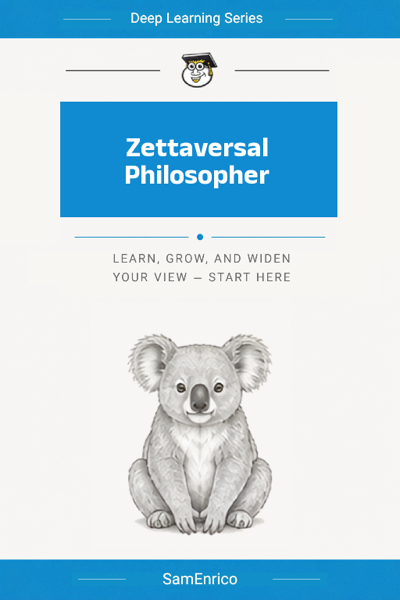
Non-FictionInformativeEducational
Zettaversal Philosopher eBook
A Coursebook on Zettaversal Philosopher
A Coursebook on Zettaversal Philosopher
Formats
Free sample
Chapter 1: The Graveyard Effect--–- Most philosophy students never write a single original idea after graduation. They accumulate highlights, underline sentences, and fill notebooks with marginalia. Then they stop. The notebooks gather dust. The highlights fade into the background noise of forgotten intentions.
This is not a failure of intelligence or effort. It is a failure of architecture.Imagine a scholar who spends forty years reading the greatest works of human thought. She underlines five thousand passages. She fills three hundred notebooks with observations, objections, and half-formed theories. She dies at eighty, and her heirs throw everything into a dumpster.
Or worse, they donate the notebooks to a university archive, where graduate students open them once a decade, sigh at the illegible handwriting, and close them again. All that reading. All those sparks of insight. Gone.This is not a tragedy. It is the default outcome of analog philosophy.The digital age promised to change this.
We have searchable PDFs, cloud storage, note-taking apps with infinite capacity, and artificial intelligence that can summarize anything. Yet most digital note-takers suffer the same fate as their analog ancestors. They accumulate more. They organize more. They forget just as completely.
The problem is not the medium. The problem is the method.This book introduces a different path: the Zettaversal Philosopher. Not a specialist who masters a single sub-field and defends a single thesis for forty years. Not a generalist who dabbles in everything and knows nothing deeply. Something else entirely.
A hybrid thinker who combines philosophical rigor with systems thinking, data literacy, and an external knowledge architecture that scales with complexity. The Zettaversal Philosopher does not trust their biological memory. They do not write linear arguments as if the world were a closed book. They build a second brain—a Zettelkasten—and they let that network of atomic, linked notes generate insights no single mind could produce alone.Before we build that architecture, we must understand why traditional methods fail so spectacularly. This chapter diagnoses three hidden pathologies of analog and linear thinking: the linear fallacy, the memory bottleneck, and the graveyard effect.
Together, these pathologies explain why most reading is wasted, most note-taking is performative, and most philosophical training produces competent critics rather than original thinkers. By the end of this chapter, you will see your own past attempts at knowledge work in a new, unforgiving light. And you will be ready to abandon them.The Linear Fallacy: Why Arguments Are Not Roads Philosophy education trains students to produce linear arguments. Premise one. Premise two.
Premise three. Therefore, conclusion. This is not merely a pedagogical convenience. It reflects a deeper assumption: that reality itself is linear, that causes precede effects in a single chain, that truth can be reached by walking a straight path from accepted first principles to inevitable conclusions.The linear fallacy is the belief that any important argument can be—and should be—reduced to a sequential chain of propositions, read from top to bottom, left to right, beginning to end.This belief is false. It has always been false.
But in the age of print and scarce information, it was a useful fiction. When a scholar owned fifty books and had access to a university library of two thousand volumes, linear arguments were a reasonable compression mechanism. You could not explore every connection because there were not enough connections to explore. The tree of knowledge was sparse. Walking its branches in a straight line did not miss much.The digital age has made the linear fallacy catastrophic.
We now have access to millions of books, billions of articles, and an infinite stream of discourse. More importantly, the connections between these sources are no longer hidden. A single philosophical problem—free will, say—connects to neuroscience, quantum physics, theology, criminal law, artificial intelligence, game theory, evolutionary biology, and every major tradition of ethics. A linear argument about free will that proceeds from premise to conclusion in fifteen steps is not simplified. It is mutilated.
It has amputated all but one thin thread of the problem's rich, tangled, multi-causal reality.The Zettaversal Philosopher rejects the linear fallacy not because linear arguments are useless—they remain useful for communication and teaching—but because linearity is a terrible discovery tool. You cannot discover the shape of a forest by walking a single straight path through it. You need to wander. You need to backtrack. You need to notice side trails that lead to unexpected clearings.
You need a map that shows not just the path you took but all the paths you did not take.That map is the Zettelkasten. Unlike a linear document, which forces a single sequence, the Zettelkasten is a hypertext network. Every note can link to any other note. Every note can be read in any order. The structure emerges from the connections you actually make, not from a predetermined outline imposed from above.
This is not disorder. It is a different order—one that mirrors the actual structure of complex problems.Consider a concrete example. A traditional philosophy paper on causation might proceed as follows: (1) Define causation. (2) Present Hume's critique of necessary connection. (3) Present Kant's response.
(4) Present the modern regularity theory. (5) Present counterfactual theories. (6) Present interventionist theories. (7) Conclude that causation is probably a primitive concept. This is a perfectly respectable linear argument.
It is also a flat, two-dimensional representation of a problem that has at least seven dimensions.In a Zettelkasten, the same material would be distributed across dozens of atomic notes. One note on Hume's definition of causation. Another note on the problem of inductive inference. Another note on Kant's synthetic a priori. Another note on the relationship between causation and explanation.
Another note on causation in physics (where it is surprisingly rare). Another note on causation in biology (where it is ubiquitous). Another note on probabilistic causation. Another note on causation and agency. Each note is complete in itself.
Each note links to others in multiple ways. The reader or writer can enter the network at any point and follow any link. The structure is not chosen in advance. It emerges from the connections that prove useful over time.The linear fallacy persists because it flatters the ego. A linear argument feels like an achievement: I built this chain from first principles to a surprising conclusion.
But the feeling is deceptive. Linear arguments are easy to construct after the fact, once you already know the conclusion. The hard work is not walking the path. The hard work is discovering which path to walk. And discovery requires a non-linear medium.The Memory Bottleneck: Why You Forget Most of What You Read Human working memory holds approximately four chunks of information at once.
Four. Not forty. Not four hundred. Four. This is not a design flaw.
It is a design constraint that evolved for a world of immediate threats and local social dynamics, not a world of abstract philosophical systems with dozens of interdependent concepts.The memory bottleneck is the gap between the complexity of the problems we want to solve and the number of ideas we can hold in our heads simultaneously.Most philosophical problems require juggling far more than four concepts. Consider the problem of free will.…
This is the end of the free sample. Get the eBook to keep going. Buy now
About this book
Details
- Author
- Lucero Annmarie
- Publisher
- SamEnrico
- Language
- English
- Genre
- Non-Fiction, Informative, Educational
- Released
- 2026-05-08
- Pages (approx.)
- 148
- Available as
- eBook, Audiobook

Read better in the ZLOADR app
Your eBooks on your phone or tablet. Sign in with your SamEnrico account and start reading.
More by Lucero Annmarie
 Swedish Green Incentives HandbookLucero Annmarie$11.99
 TM University Research CentersLucero Annmarie$11.99
 Cry It Out Pros and ConsLucero Annmarie$11.99
 Men's Heart Palpitation GuideLucero Annmarie$11.99
 Conflict De Escalation for Stress ReductionLucero Annmarie$11.99
 Shadows of the North Star: Harriet Tubman’s Secret WarLucero Annmarie$11.99
 Endurance: Shackleton's Impossible Voyage of SurvivalLucero Annmarie$11.99
 Understanding Chromosome 17, Deletion 17q23 Q24Lucero Annmarie$17.99
 Executive Personal Development PlanLucero Annmarie$12.99
 British Columbia PNP for GradsLucero Annmarie$12.99
 How to Become a Camera OperatorLucero Annmarie$11.99
You may also like
 Hong Kong Handover 1997Dunn Johnnie$11.99
 Zumba For Postnatal Recovery CourseNeal Christian$11.99
 Zumba for BeginnersLadner Nikia$11.99
 YouTube Comment Mining GuideHumes Pandora$12.99
 Worry Box MeditationCarlin Rudy$11.99
 Workplace Stress MeditationNguyen Lynn$11.99
 Workplace Stress and Sleep RepairHawley Ivory$11.99
 Workplace Perfectionism CureDelaney Jeffry$11.99
 Workplace Injustice Anger GuideWallen Isabelle$11.99
 Work Addiction and Burnout LinkGreenwood Ester$11.99
 Women in Yoga and WellnessBeattie Galina$11.99
 Women in Stand Up ComedyChun Evangeline$11.99