
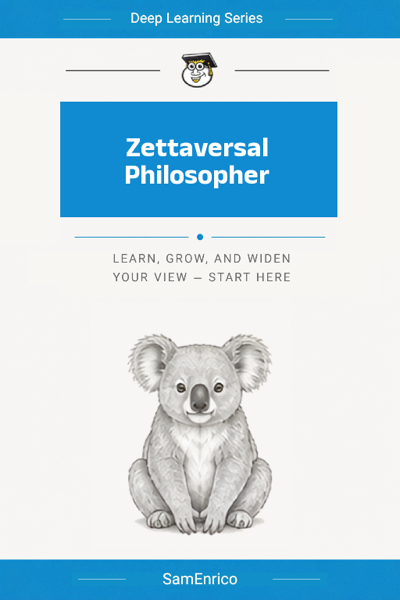
Non-FictionInformativeEducational
Zettaversal Philosopher Audiobook
A Coursebook on Zettaversal Philosopher
A Coursebook on Zettaversal Philosopher
Formats
Free sample
Chapter 1: The Graveyard Effect--–- Most philosophy students never write a single original idea after graduation. They accumulate highlights, underline sentences, and fill notebooks with marginalia. Then they stop. The notebooks gather dust. The highlights fade into the background noise of forgotten intentions.
This is not a failure of intelligence or effort. It is a failure of architecture.Imagine a scholar who spends forty years reading the greatest works of human thought. She underlines five thousand passages. She fills three hundred notebooks with observations, objections, and half-formed theories. She dies at eighty, and her heirs throw everything into a dumpster.
Or worse, they donate the notebooks to a university archive, where graduate students open them once a decade, sigh at the illegible handwriting, and close them again. All that reading. All those sparks of insight. Gone.This is not a tragedy. It is the default outcome of analog philosophy.The digital age promised to change this.
We have searchable PDFs, cloud storage, note-taking apps with infinite capacity, and artificial intelligence that can summarize anything. Yet most digital note-takers suffer the same fate as their analog ancestors. They accumulate more. They organize more. They forget just as completely.
The problem is not the medium. The problem is the method.This book introduces a different path: the Zettaversal Philosopher. Not a specialist who masters a single sub-field and defends a single thesis for forty years. Not a generalist who dabbles in everything and knows nothing deeply. Something else entirely.
A hybrid thinker who combines philosophical rigor with systems thinking, data literacy, and an external knowledge architecture that scales with complexity. The Zettaversal Philosopher does not trust their biological memory. They do not write linear arguments as if the world were a closed book. They build a second brain—a Zettelkasten—and they let that network of atomic, linked notes generate insights no single mind could produce alone.Before we build that architecture, we must understand why traditional methods fail so spectacularly. This chapter diagnoses three hidden pathologies of analog and linear thinking: the linear fallacy, the memory bottleneck, and the graveyard effect.
Together, these pathologies explain why most reading is wasted, most note-taking is performative, and most philosophical training produces competent critics rather than original thinkers. By the end of this chapter, you will see your own past attempts at knowledge work in a new, unforgiving light. And you will be ready…
This is the end of the free sample. Get the Audiobook to keep going. Buy now
About this book
Details
- Author
- Lucero Annmarie
- Publisher
- SamEnrico
- Language
- English
- Genre
- Non-Fiction, Informative, Educational
- Released
- 2026-05-08
- Pages (approx.)
- 148
- Available as
- eBook, Audiobook

Listen in the VoxFlicks app
Audiobooks and audio dramas wherever you go. Sign in with your SamEnrico account and press play.
More by Lucero Annmarie
 Swedish Green Incentives HandbookLucero Annmarie$11.99
 TM University Research CentersLucero Annmarie$11.99
 Cry It Out Pros and ConsLucero Annmarie$11.99
 Men's Heart Palpitation GuideLucero Annmarie$11.99
 Conflict De Escalation for Stress ReductionLucero Annmarie$11.99
 Shadows of the North Star: Harriet Tubman’s Secret WarLucero Annmarie$11.99
 Endurance: Shackleton's Impossible Voyage of SurvivalLucero Annmarie$11.99
 Understanding Chromosome 17, Deletion 17q23 Q24Lucero Annmarie$17.99
 Executive Personal Development PlanLucero Annmarie$12.99
 British Columbia PNP for GradsLucero Annmarie$12.99
 How to Become a Camera OperatorLucero Annmarie$11.99
You may also like
 Hong Kong Handover 1997Dunn Johnnie$11.99
 Zumba For Postnatal Recovery CourseNeal Christian$11.99
 Zumba for BeginnersLadner Nikia$11.99
 YouTube Comment Mining GuideHumes Pandora$12.99
 Worry Box MeditationCarlin Rudy$11.99
 Workplace Stress MeditationNguyen Lynn$11.99
 Workplace Stress and Sleep RepairHawley Ivory$11.99
 Workplace Perfectionism CureDelaney Jeffry$11.99
 Workplace Injustice Anger GuideWallen Isabelle$11.99
 Work Addiction and Burnout LinkGreenwood Ester$11.99
 Women in Yoga and WellnessBeattie Galina$11.99
 Women in Stand Up ComedyChun Evangeline$11.99