
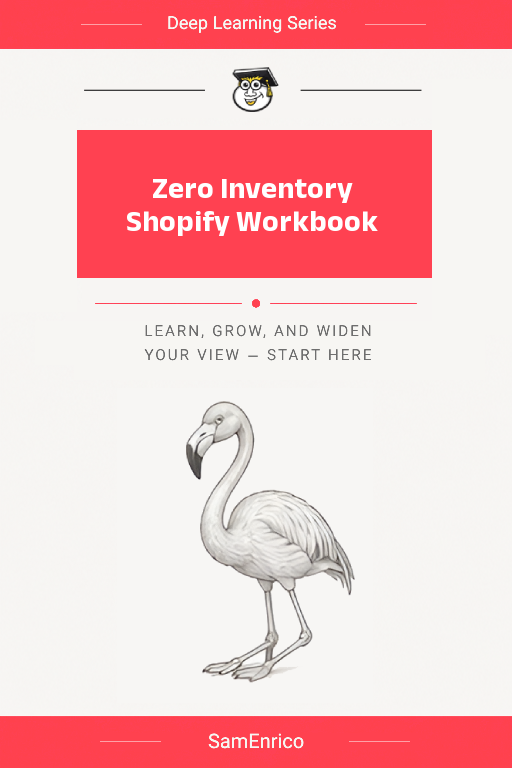
Non-FictionFirst 30 DaysLow-Budget EcomWorkbook
Zero Inventory Shopify Workbook eBook
Start with print-on-demand or dropshipping to avoi
by Cody Kamala
Start with print-on-demand or dropshipping to avoid upfront stock costs. Includes supplier vetting checklists, mockup creators, and sample product research worksheets.
Formats
Free sample
Chapter 1: The Cash Flow Obsession--You are about to make a decision that will determine whether your e-commerce store survives its first ninety days or dies a slow, expensive death. That decision has nothing to do with which product you sell, which theme you install, or even how much money you have. The decision is whether you will buy inventory before you have proof that someone—anyone—actually wants what you are selling.Most first-time store owners get this wrong. They order five hundred units of a product they believe in. They rent storage space.
They pay for custom packaging. They spend weeks setting up a beautiful Shopify store. Then they run Facebook ads, hear crickets, and stare at a garage full of widgets that nobody wants. They have transformed cash into garbage, and they cannot pivot because their money is trapped in cardboard boxes.This book exists to ensure that never happens to you.The zero-inventory model is not a shortcut. It is not a way to get rich without work.
It is a way to preserve your capital, test your ideas with real money on the line but not your life savings, and pivot within hours instead of months when the data tells you that you were wrong. And you will be wrong. That is not a prediction of failure. It is the mathematical reality of e-commerce. Most products fail.
Most ads lose money at first. Most niches are too small or too crowded. The question is not whether you will be wrong. The question is how much it will cost you to find out.This chapter reframes everything you think you know about e-commerce success. We are not building a warehouse empire.
We are not betting on a single home run product. We are building a system that allows you to test, measure, learn, and repeat without the weight of unsold inventory dragging you under. By the end of this chapter, you will understand exactly why cash flow is the only metric that matters in your first year, and you will have completed the first worksheet that saves you from the most common beginner mistake.--The Lie of Inventory Ownership Walk into any business school classroom and you will hear the same refrain: inventory is an asset. On a balance sheet, unsold products sitting in a warehouse are counted as something you own, something with value. That is true for Walmart.
That is true for Apple. That is not true for you.For a solo entrepreneur with limited capital, unsold inventory is not an asset. It is a liability disguised as an asset. It consumes storage space, real or virtual. It ties up money that could be spent on marketing, the only activity that actually generates revenue.
It creates psychological pressure to keep selling a failing product long after the data says stop, because quitting means admitting that you spent two thousand dollars on garbage.The zero-inventory model flips this logic entirely. Instead of asking "What can I buy and resell?" you ask "What can I validate that someone wants to buy before I commit a single dollar to product cost?" That shift from inventory-first to validation-first is the difference between gambling and running a business.Here is what you are not doing in this model. You are not renting a warehouse. You are not packing boxes. You are not calculating storage costs per pallet.
You are not hiring fulfillment staff. You are not ordering three months of supply to hit a minimum order quantity. You are not praying that a slow-moving product eventually sells before you run out of cash.Here is what you are doing. You are building a Shopify store. You are creating product listings with professional mockups.
You are running small, targeted ad campaigns. You are collecting data on what works and what does not. You are fulfilling orders one at a time through suppliers who ship directly to your customers. You are reinvesting your profits into more testing. And when a product fails—not if, when—you lose the cost of the ads you ran and the few hours you spent setting up the listing.
You do not lose two thousand dollars. You do not lose your garage. You lose the price of a nice dinner, and you move on to the next idea the same day.That is the philosophy of zero inventory. It is not about being cheap. It is about being fast, flexible, and honest with yourself about the odds.--The Three Pillars (Reduced to Two)Original versions of this workbook included digital products as a third pillar alongside dropshipping and print-on-demand.
That was a mistake. Digital products—e-books, templates, courses, software licenses—are a completely different business model with different economics, different customer expectations, and different legal requirements. Including them here would confuse the workflow.This book focuses on the two legitimate zero-inventory models for physical products.The first model is dropshipping. You find a supplier who has inventory. You list their products on your Shopify store at a markup.
When a customer places an order, you purchase the item from the supplier at your cost and provide the customer's shipping address. The supplier ships directly to the customer. You never touch the product. Your job is marketing, customer service, and supplier management. Dropshipping works best for products that are not easily customizable, where speed is less important than selection, and where you can add value through curation, bundling, or better photography than the supplier provides.The second model is print-on-demand, which we will call POD throughout this book.
You create designs. You upload those designs to a POD supplier like Printful or Printify. The supplier prints your design onto a blank product—a t-shirt, a mug, a poster, a phone case—only when a customer orders it. The supplier then ships directly to the customer. POD works best for products where the design is the differentiator, where customers expect some production time, and where you have actual artistic skill or access to good designers.Both models share the same core advantage: you pay for the product only after you have been paid by the customer.
There is no upfront product cost. There is no inventory risk. There is only the cost of marketing, software, and your time.Both models also share the same disadvantage: lower margins than bulk purchasing. You pay more per unit because you are not buying in volume. You accept slower shipping times because your supplier is not Amazon.
You accept less control over packaging and unboxing experience. These trade-offs are acceptable in the validation phase. They become less acceptable as you scale, which is why Chapter Eleven covers the transition to private label and third-party logistics when a product proves itself.For now, the only thing you need to remember is this: you will never purchase a product before you have a confirmed sale. That rule is absolute. Break it and you are no longer using the zero-inventory model.
You are gambling.--The Lean Startup Applied to E-Commerce In 2011, Eric Ries published The Lean Startup, a book that changed how software companies build products. The core idea was simple: do not spend months building…
This is the end of the free sample. Get the eBook to keep going. Buy now
About this book
Details
- Author
- Cody Kamala
- Publisher
- SamEnrico
- Language
- English
- Genre
- Non-Fiction, First 30 Days, Low-Budget Ecom, Workbook
- Released
- 2026-05-28
- Pages (approx.)
- 142
- Available as
- eBook, Audiobook

Read better in the ZLOADR app
Your eBooks on your phone or tablet. Sign in with your SamEnrico account and start reading.
More by Cody Kamala
 Parenting Stress And Chronic IllnessCody Kamala$11.99
 Caffeine Energy StrategyCody Kamala$11.99
 Dream Group Facilitation GuideCody Kamala$11.99
 Self Abandonment Relationship GuideCody Kamala$11.99
 Ragnarök and the Fox’s Gambit: Loki’s Pact with the KitsuneCody Kamala$11.99
 The Secret Islands of Knowledge: Medieval Scholars in the South SeasCody Kamala$11.99
 Understanding Hereditary Paroxysmal Cerebral AtaxiaCody Kamala$17.99
 Cloud CRM Outlook 2030Cody Kamala$12.99
 Casting AssistantCody Kamala$11.99
 How to Start a Press Used To Make Wine, Cider, Fruit Juices, Etc. Business (Beginners Guide)Cody Kamala$11.99
You may also like
 Hong Kong Handover 1997Dunn Johnnie$11.99
 Zumba For Postnatal Recovery CourseNeal Christian$11.99
 Zumba for BeginnersLadner Nikia$11.99
 YouTube Comment Mining GuideHumes Pandora$12.99
 Worry Box MeditationCarlin Rudy$11.99
 Workplace Stress MeditationNguyen Lynn$11.99
 Workplace Stress and Sleep RepairHawley Ivory$11.99
 Workplace Perfectionism CureDelaney Jeffry$11.99
 Workplace Injustice Anger GuideWallen Isabelle$11.99
 Work Addiction and Burnout LinkGreenwood Ester$11.99
 Women in Yoga and WellnessBeattie Galina$11.99
 Women in Stand Up ComedyChun Evangeline$11.99