
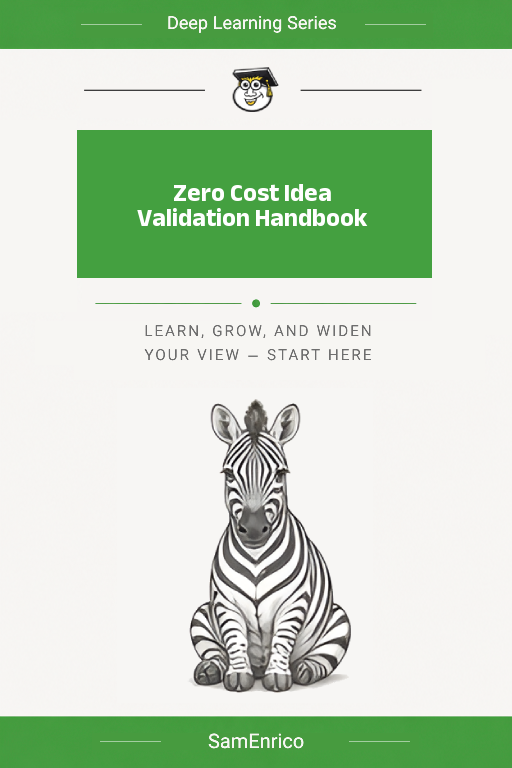
Non-FictionStartup GuideLean MethodologyBootstrapping
Zero Cost Idea Validation Handbook eBook
Test your business idea with free tools and lean m
by Mallory Les
Test your business idea with free tools and lean methods before building anything or spending a single dollar.
Formats
Free sample
Chapter 1: The $50,000 Lie--You have already lost money on your business idea.Not in software subscriptions or logo design. Not in domains or business cards. You have lost money in the most expensive currency there is: time spent building something nobody asked for.Let me guess. You have a notebook full of ideas. Or a notes app with twenty half-written business plans.
Maybe you have already bought a domain name, designed a logo on Canva, and started mocking up screens in Figma. You feel productive. You feel like you are making progress.You are not making progress. You are procrastinating in costume.Every hour you spend designing a logo, writing code, or polishing a pitch deck before you have proven that a single human being will pay for your solution is an hour stolen from the only thing that matters: validated learning. And here is the brutal truth that the $500 billion startup industrial complex does not want you to hear: most businesses do not fail because the founder could not build the product.
They fail because they built a product that nobody wanted.This is not opinion. This is the Law of Market Failure, and it is the single most predictable pattern in entrepreneurship.The Graveyard of Good Intentions Let me tell you about a founder I will call Sarah. Sarah had a brilliant idea. She noticed that small business owners in her city were struggling to manage their social media presence across Instagram, Facebook, and Tik Tok. They were overwhelmed.
They were posting inconsistently. They were losing customers to competitors who seemed more polished online.Sarah did what most founders do. She spent four months learning to code. She built a beautiful dashboard that connected to all three social media platforms. She added analytics, content calendars, and a generative AI tool that wrote post captions.
She launched with a splash on Product Hunt. She had forty-seven email subscribers from her waitlist.Then she asked people to pay.And nobody did.Forty-seven people who said "I would love this" turned into zero people who said "Here is my credit card." Sarah had spent four months and approximately three thousand hours building a solution to a problem that, it turned out, did not hurt badly enough for anyone to open their wallet.Sarah made the same mistake that ninety percent of founders make. She assumed that because she saw a problem, other people would pay to solve it. She confused her own frustration with market demand. She built before she tested.
And she paid the price not in dollars but in the one thing she could never get back: time.Sarah is not unusual. Sarah is the default.Every year, hundreds of thousands of founders repeat her exact pattern. They build. They launch. They fail.
Then they tell themselves the failure was due to bad marketing, or poor timing, or not enough funding. But the real cause is almost always the same: premise failure. The idea itself was wrong.Execution Failure vs. Premise Failure There are only two ways a business can fail.Execution failure happens when you have a good idea—a real problem that people are actively trying to solve—but you mess up the execution. Your pricing is wrong.
Your marketing message misses the mark. You cannot reach your customers. You build the right thing but deliver it poorly. Execution failure is fixable. It means you have a business; you just need to tune the engine.Premise failure happens when your idea itself is wrong.
Nobody needs what you are building. The problem you are trying to solve does not exist, or it exists but does not hurt badly enough for anyone to change their behavior. Premise failure is not fixable. No amount of better marketing, lower pricing, or faster delivery will make people want something they do not need.Here is the uncomfortable truth: most startup failures are premise failures. The founders built something that should never have been built in the first place.Why does this happen?
Because founders fall in love with their solutions before they have validated their problems. They become attached to their ideas. They treat their assumptions as facts. And they mistake activity—designing logos, writing code, building features—for progress.The Lean Startup movement gave us a name for this trap. It is called the Feature Factory Mindset.
You measure progress by how many features you have shipped, not by whether those features solve a real customer need. You celebrate when you hit a thousand lines of code. You feel proud when your Figma prototype has twenty screens. You show your friends the beautiful dashboard you built.But your friends are lying to you. They are polite.
They say "That looks great" because they do not want to hurt your feelings. They are not your customers. And their polite smiles are the most dangerous feedback you can receive.Innovation Accounting: The Only Metric That Matters Eric Ries, the author of The Lean Startup, introduced a radical idea that most founders ignore. He called it Innovation Accounting. The concept is simple but uncomfortable: you cannot measure progress by what you build.
You must measure progress by what you learn.Traditional accounting asks: How many hours did you work? How many features did you ship? How many lines of code did you write? These are vanity metrics. They feel good but tell you nothing about whether you are building a sustainable business.Innovation Accounting asks a different set of questions: What assumptions did you test this week?
What did you learn about your customer? Which of your beliefs turned out to be wrong? How much risk have you removed from your business model?In Innovation Accounting, a week spent conducting five customer interviews is infinitely more valuable than a week spent building a feature that nobody asked for. A day spent running a smoke test that generates thirty email signups is worth more than a month of coding in isolation.This book is built on a single premise: you cannot spend a single dollar on building anything until you have achieved a Validation Score of 4 or 5. We will define the Validation Score in detail later, but here is the short version:Validation Score 1: Vanity metrics (page views, downloads, "I like it")Validation Score 2: Hypothetical interest ("I would use that")Validation Score 3: Behavioral data (clicked a button, shared a link)Validation Score 4: Commitment (email signup, waitlist entry)Validation Score 5: Financial (pre-order, deposit, credit card provided)Most founders start building at Validation Score 1.
They have an idea, they feel excited, and they immediately open Figma or Visual Studio Code. They are building on a foundation of sand. By the time they discover that nobody wants their product, they have already invested weeks or months of their lives.This book will teach you to do the opposite. You will not build anything until you have achieved at least Validation Score 4—and ideally Validation Score 5—from real, paying customers. You will test every assumption before you write a single line of code.
You will spend thirty days running experiments. And at the end of those thirty days, you will either have permission to build, or you will kill…
This is the end of the free sample. Get the eBook to keep going. Buy now
About this book
Details
- Author
- Mallory Les
- Publisher
- SamEnrico
- Language
- English
- Genre
- Non-Fiction, Startup Guide, Lean Methodology, Bootstrapping
- Released
- 2026-06-01
- Pages (approx.)
- 140
- Available as
- eBook, Audiobook

Read better in the ZLOADR app
Your eBooks on your phone or tablet. Sign in with your SamEnrico account and start reading.
More by Mallory Les
 Philippine Overseas Workers TrendsMallory Les$11.99
 Sleep and Sensory ProcessingMallory Les$11.99
 Moroccan Green Tax Credits CourseMallory Les$11.99
 Bodyweight Back Training GuideMallory Les$11.99
 Innocence Project Nebraska CasesMallory Les$11.99
 The Man Who Sold the Moon: How a Visionary Convinced the World to Look UpMallory Les$11.99
 The Silk Road Heist: A Digital Ponzi SchemeMallory Les$11.99
 How to Start a Hobby in Orchid RaisingMallory Les$11.99
 Understanding Chromosome 21 RingMallory Les$17.99
 Business Insurance Basics GuideMallory Les$12.99
 Forensic ScientistMallory Les$11.99
You may also like
 Hong Kong Handover 1997Dunn Johnnie$11.99
 Zumba For Postnatal Recovery CourseNeal Christian$11.99
 Zumba for BeginnersLadner Nikia$11.99
 YouTube Comment Mining GuideHumes Pandora$12.99
 Worry Box MeditationCarlin Rudy$11.99
 Workplace Stress MeditationNguyen Lynn$11.99
 Workplace Stress and Sleep RepairHawley Ivory$11.99
 Workplace Perfectionism CureDelaney Jeffry$11.99
 Workplace Injustice Anger GuideWallen Isabelle$11.99
 Work Addiction and Burnout LinkGreenwood Ester$11.99
 Women in Yoga and WellnessBeattie Galina$11.99
 Women in Stand Up ComedyChun Evangeline$11.99