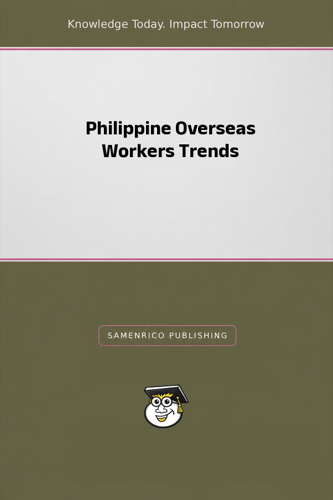
Philippine Overseas Workers Trends
Projects OFW deployment patterns across healthcare
by Mallory Les
Projects OFW deployment patterns across healthcare and maritime sectors.
Formats
About this book
Free sample
Chapter 1: The Remittance Trap...-- In the first week of January 2025, a forty-three-year-old former domestic worker named Lerma returned to her barangay in Nueva Ecija after twelve years in Riyadh. She carried a balikbayan box stuffed with synthetic curtains, electric fans, and powdered milk for her nieces. Her savings account held the equivalent of ₱187,000—less than three months’ salary for a entry-level call center agent in Manila. Her knees were ruined from scrubbing marble floors without a mop. Her left hand bore a scar from a deep fryer accident that her sponsor refused to cover.
She had no health insurance, no pension, no plan. When asked if she would go back, she laughed bitterly and said, “Wala na. Umuwi na ako para mamatay.” (No more. I came home to die.)Lerma is not a statistical anomaly. She is the human face of the Philippine overseas employment project—a project that has, over fifty years, transformed the country into the world’s most prolific exporter of labor.
In 2025, the Philippine Statistics Authority recorded 2.2 million active overseas Filipino workers (OFWs) deployed across 197 countries. Together, they sent home $35.63 billion in cash remittances through formal banking channels alone, a figure that excludes the billions more carried in cash or sent via informal hawala systems. To put that number in perspective, remittances now exceed the combined annual budgets of the Department of Education, the Department of Public Works and Highways, and the Department of Health. They dwarf foreign direct investment, outpace business process outsourcing revenues, and consistently outearn the country’s agricultural exports by a factor of four.And yet, Lerma came home with 187,000 pesos.This is the central paradox that this book will unspool across twelve chapters: the Philippine overseas labor system produces macroeconomic miracles and individual microeconomic disasters. The country’s balance of payments stays afloat because its citizens leave.
The peso stays stable because families in Manila, Cebu, and Davao wait by Western Union counters every fifteenth of the month. But the workers themselves—the so-called bagong bayani (new heroes) of state propaganda—return, by and large, poorer in body and spirit than when…
This is the end of the free sample. Get the eBook to keep going. Buy now
Contents
- Chapter 1
- Chapter 2
- Chapter 3
- Chapter 4
- Chapter 5
- Chapter 6
- Chapter 7
- Chapter 8
- Chapter 9
- Chapter 10
- Chapter 11
- Chapter 12
Details
- Author
- Mallory Les
- Publisher
- SamEnrico
- Language
- English
- Genre
- Non-Fiction, Forecast & Outlook, Philippines
- Released
- 2026-06-12
- Pages (approx.)
- 152
- Available as
- eBook, Audiobook

Read better in the ZLOADR app
Your eBooks on your phone or tablet. Sign in with your SamEnrico account and start reading.
More by Mallory Les
 Sleep and Sensory ProcessingMallory Les$11.99
 Moroccan Green Tax Credits CourseMallory Les$11.99
 Bodyweight Back Training GuideMallory Les$11.99
 Innocence Project Nebraska CasesMallory Les$11.99
 The Man Who Sold the Moon: How a Visionary Convinced the World to Look UpMallory Les$11.99
 The Silk Road Heist: A Digital Ponzi SchemeMallory Les$11.99
 How to Start a Hobby in Orchid RaisingMallory Les$11.99
 Understanding Chromosome 21 RingMallory Les$17.99
 Zero Cost Idea Validation HandbookMallory Les$12.99
 Business Insurance Basics GuideMallory Les$12.99
 Forensic ScientistMallory Les$11.99