
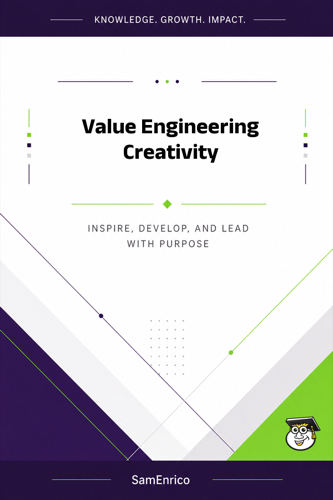
Value Engineering Creativity
Maximize function while minimizing cost using crea
by Page Abraham
Maximize function while minimizing cost using creative substitution.
Formats
About this book
Free sample
Chapter 1: The Accidentologist--–- Larry Miles was not trying to invent a revolution. He was trying to keep the lights on.It was 1946 at General Electric’s Schenectady plant, and the war had just ended. Everyone expected peace to bring abundance. Instead, it brought scarcity. The materials that had flowed freely during wartime—rubber, asbestos, copper, steel—were suddenly rationed or simply unavailable.
Factories that had churned out bomber parts and radio equipment were now scrambling to manufacture household appliances, and they couldn’t get the raw materials to do it.Miles was a buyer in GE’s purchasing department. His job was simple on paper: acquire the parts and materials that engineers specified. But in practice, his job had become impossible. Every day, another engineer would hand him a requisition for a specific part made of a specific material—and every day, that material was either unavailable or priced at ten times the pre-war cost.“We need a steel bracket,” the engineer would say.“There is no steel,” Miles would reply.“Then we can’t build the product.”This conversation happened so often that Miles began to suspect something deeper was wrong. Not with the supply chain.
With the way his colleagues thought.He was a quiet man, not given to grand pronouncements. But he had a habit that irritated his engineering colleagues: he asked questions that sounded childish. “Why does it have to be steel?” he would ask. “What does the bracket actually do?”The engineers would stare at him. “It supports the motor.”“Does steel support the motor?
Or does the bracket support the motor, and we’ve just been making it out of steel because that’s what we had?”These questions earned Miles a reputation. Some called him a nuisance. Others called him the accidentologist—someone who studied the gap between what people intended and what they actually did. But a few noticed something strange. When Miles found a substitute for a scarce material—a ceramic insulator instead of rubber, a plastic gear instead of steel—the substitute often worked better than the original.
It lasted longer. It cost less. It was lighter.By accident, Miles had discovered a truth that would eventually save companies…
This is the end of the free sample. Get the eBook to keep going. Buy now
Contents
- Chapter 1
- Chapter 2
- Chapter 3
- Chapter 4
- Chapter 5
- Chapter 6
- Chapter 7
- Chapter 8
- Chapter 9
- Chapter 10
- Chapter 11
- Chapter 12
Details
- Author
- Page Abraham
- Publisher
- SamEnrico
- Language
- English
- Genre
- Non-Fiction, Self-Help, Value Engineering
- Released
- 2026-06-09
- Pages (approx.)
- 140
- Available as
- eBook, Audiobook

Read better in the ZLOADR app
Your eBooks on your phone or tablet. Sign in with your SamEnrico account and start reading.
More by Page Abraham
 Ectopic Pregnancy RecoveryPage Abraham$11.99
 Pet Ownership LongevityPage Abraham$11.99
 IBS Pain ManagementPage Abraham$11.99
 Virtual Wholesaling BlueprintPage Abraham$11.99
 Gluten Brain Fog MechanismPage Abraham$11.99
 Gambling Support Group GuidePage Abraham$11.99
 Cognitive Restructuring Anger AppsPage Abraham$11.99
 The Leviathan’s Lullaby: Decoding the Song of the DeepPage Abraham$11.99
 The Melodic Revolution: How Japanese Radio Brought Broadway to AsiaPage Abraham$11.99
 Ultimate Handbook Guide to Imbaba : (Egypt) Travel GuidePage Abraham$11.99
 Individual Contributor Promotion GuidePage Abraham$12.99
 Co-Founder LinkedIn Search BlueprintPage Abraham$12.99