
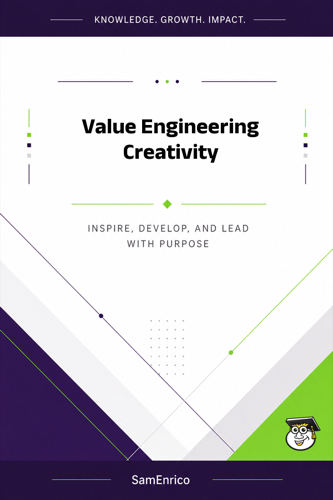
Value Engineering Creativity eBook
Maximize function while minimizing cost using crea
by Page Abraham
Maximize function while minimizing cost using creative substitution.
Formats
Free sample
Chapter 1: The Accidentologist--–- Larry Miles was not trying to invent a revolution. He was trying to keep the lights on.It was 1946 at General Electric’s Schenectady plant, and the war had just ended. Everyone expected peace to bring abundance. Instead, it brought scarcity. The materials that had flowed freely during wartime—rubber, asbestos, copper, steel—were suddenly rationed or simply unavailable.
Factories that had churned out bomber parts and radio equipment were now scrambling to manufacture household appliances, and they couldn’t get the raw materials to do it.Miles was a buyer in GE’s purchasing department. His job was simple on paper: acquire the parts and materials that engineers specified. But in practice, his job had become impossible. Every day, another engineer would hand him a requisition for a specific part made of a specific material—and every day, that material was either unavailable or priced at ten times the pre-war cost.“We need a steel bracket,” the engineer would say.“There is no steel,” Miles would reply.“Then we can’t build the product.”This conversation happened so often that Miles began to suspect something deeper was wrong. Not with the supply chain.
With the way his colleagues thought.He was a quiet man, not given to grand pronouncements. But he had a habit that irritated his engineering colleagues: he asked questions that sounded childish. “Why does it have to be steel?” he would ask. “What does the bracket actually do?”The engineers would stare at him. “It supports the motor.”“Does steel support the motor?
Or does the bracket support the motor, and we’ve just been making it out of steel because that’s what we had?”These questions earned Miles a reputation. Some called him a nuisance. Others called him the accidentologist—someone who studied the gap between what people intended and what they actually did. But a few noticed something strange. When Miles found a substitute for a scarce material—a ceramic insulator instead of rubber, a plastic gear instead of steel—the substitute often worked better than the original.
It lasted longer. It cost less. It was lighter.By accident, Miles had discovered a truth that would eventually save companies billions of dollars: most products contain roughly fifty percent avoidable waste, not because of fraud or laziness, but because of unexamined habit.This is the story of how one man’s annoying questions became a global discipline. And it is the story of how you can learn to ask those same questions—not to annoy your colleagues, but to unlock hidden value in everything you build.The Myth of the Fixed Product Every product you have ever used is, in a very real sense, an accident of history.The QWERTY keyboard layout was designed in the 1870s to prevent typewriter jams. The letters were arranged to slow typists down, not speed them up.
Today, every keyboard on the planet still uses that layout, not because it is optimal, but because it was first. The cost of switching is not technical; it is psychological. We have learned QWERTY. Our fingers know QWERTY. QWERTY is how we have always done it.The same pathology infects engineering.
A bracket is made of steel because the last bracket was made of steel. A pump housing is cast iron because the pump housing before that was cast iron. A fastener is a screw because screws have always worked. Nobody makes a deliberate decision to use steel, cast iron, or screws. They simply repeat what came before.Miles called this psychological inertia—the invisible force that makes smart people do expensive things.
He identified its many forms, but the most destructive is the one that feels the most responsible: reliance on past success. If something worked yesterday, our brains assume it is optimal today. We do not re-evaluate. We do not question. We repeat.The tragedy is that most of the time, repetition is efficient.
You do not need to reinvent the wheel every morning. But the same efficiency that makes repetition useful also makes it dangerous. By the time a product has been manufactured for five years, the original reasons for its design choices have been forgotten. All that remains is tradition. And tradition, as Miles liked to say, is the most expensive consultant you will ever hire.The Function Revelation The breakthrough came when Miles stopped asking “What is this part made of?” and started asking “What does this part do?”This seems trivial.
It is not.When you ask “What is it made of?” you are locked into a specific physical solution. Steel bracket. Rubber gasket. Copper wire. The answer is a noun.
Nouns are anchors. They fix your thinking to a particular implementation.When you ask “What does it do?” you get a verb. Support. Seal. Conduct.
Verbs are liberating. A verb describes a need, not a solution. And a need can be satisfied in infinite ways.Miles codified this insight into what became known as the Two-Word Rule: every function must be described by an active verb and a measurable noun. “Support Weight.” “Conduct Electricity.” “Seal Pressure.” “Transfer Heat.” “Prevent Leakage.”Notice what is missing. There is no material in these descriptions.
No steel. No rubber. No copper. Just pure, abstract need.Once you have the verb-noun pair, you can search for any solution that satisfies it. Does “Support Weight” require a steel bracket?
No. It could be an aluminum bracket, a plastic bracket, a carbon fiber strap, a magnetic field, a compressed gas spring, a tensegrity structure, or even a clever arrangement of cardboard and tape. The function does not care about your traditions. The function only cares about the result.This shift—from noun-thinking to verb-thinking—is the single most powerful tool in value engineering. And it is the foundation for everything that follows in this book.The Case of the Ten-Thousand-Dollar Light Bulb Before we go further, let me tell you a story that illustrates the power of function thinking.
It is the story that opens this book, but it deserves a fuller telling here.A manufacturing plant had a piece of German equipment that required a specialized light bulb. The bulb was long, thin, and had a specific type of base. When it burned out, the plant manager called the equipment supplier.“We need a replacement bulb,” he said.“That will be ten thousand dollars,” the supplier replied.The manager choked. “Ten thousand dollars? For a light bulb?”“It is a specialized component for a precision machine.
We are the only source.”The manager had a problem. The machine was critical to production. Downtime cost the plant ten thousand dollars per hour. He could not afford to wait for a cheaper alternative. He bought the bulb.This happened three more times over the next eighteen months.
Forty thousand dollars. For light bulbs.Then a new buyer joined the plant’s purchasing department. Her name was Maria, and she had been trained in Miles’ methods. She asked to see one of the burned-out bulbs.“What does it do?” she asked.“It lights up the inspection area,” the manager said.“What does it need to do, specifically?”The manager thought for a moment. “It needs…
This is the end of the free sample. Get the eBook to keep going. Buy now
About this book
Details
- Author
- Page Abraham
- Publisher
- SamEnrico
- Language
- English
- Genre
- Non-Fiction, Self-Help, Value Engineering
- Released
- 2026-06-09
- Pages (approx.)
- 140
- Available as
- eBook, Audiobook

Read better in the ZLOADR app
Your eBooks on your phone or tablet. Sign in with your SamEnrico account and start reading.
More by Page Abraham
 Ectopic Pregnancy RecoveryPage Abraham$11.99
 Pet Ownership LongevityPage Abraham$11.99
 IBS Pain ManagementPage Abraham$11.99
 Virtual Wholesaling BlueprintPage Abraham$11.99
 Gluten Brain Fog MechanismPage Abraham$11.99
 Gambling Support Group GuidePage Abraham$11.99
 Cognitive Restructuring Anger AppsPage Abraham$11.99
 The Leviathan’s Lullaby: Decoding the Song of the DeepPage Abraham$11.99
 The Melodic Revolution: How Japanese Radio Brought Broadway to AsiaPage Abraham$11.99
 Ultimate Handbook Guide to Imbaba : (Egypt) Travel GuidePage Abraham$11.99
 Individual Contributor Promotion GuidePage Abraham$12.99
 Co-Founder LinkedIn Search BlueprintPage Abraham$12.99