
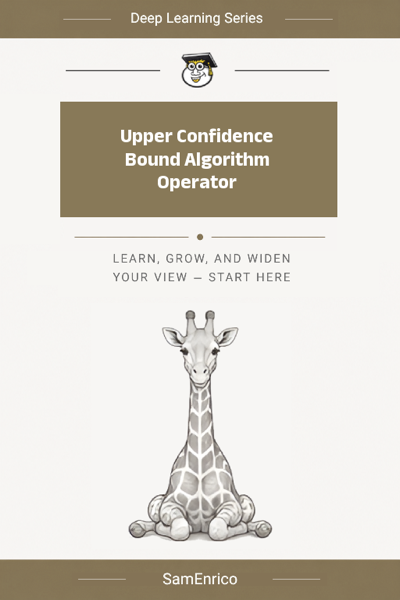
Non-FictionInformativeEducational
Upper Confidence Bound Algorithm Operator eBook
A Coursebook on Upper Confidence Bound Algorithm O
A Coursebook on Upper Confidence Bound Algorithm Operator
Formats
Free sample
Chapter 1: The Certainty Trap--–- Every decision you make in the absence of perfect information carries a hidden tax. You don't see it deducted from your bank account, nor does it appear on any dashboard. But it accumulates relentlessly—each time you choose the familiar over the unknown, each time you stop experimenting because you think you already know the answer, each time you mistake past success for future certainty. This hidden tax is called regret, and it is the single most important concept you will learn in this book.Consider a simple experiment that has been run in hundreds of classrooms and corporate boardrooms around the world. You are given two slot machines.
The left machine pays $1 with an unknown probability. The right machine pays $1 with a different unknown probability. You can pull either machine as many times as you like, but you only have one hundred pulls total. Your goal is to maximize your total winnings. What do you do?Most people, when first confronted with this problem, fall into what we will call the Certainty Trap.
They pull the left machine a few times, then the right machine a few times, quickly form an opinion about which machine seems better, and then pull only that machine for the remaining pulls. This strategy feels reasonable. It feels efficient. It is also, mathematically, almost always wrong.The Certainty Trap is not a failure of intelligence. It is a failure of imagination—specifically, the imagination to consider that what you don't know might be more valuable than what you do know.
This book is about escaping that trap. It is about a family of algorithms called Upper Confidence Bound (UCB) algorithms that solve a fundamental problem that permeates everything from clinical trials to recommendation engines to autonomous vehicles. But before we can understand the solution, we must fully understand the problem.The Multi-Armed Bandit: A Problem With Many Names The scenario described above—choosing repeatedly between uncertain options to maximize cumulative reward—has a formal name in statistics and machine learning: the multi-armed bandit problem. The name is unfortunate but memorable. It comes from the colloquial term "one-armed bandit" for a slot machine, implying that a gambler faces multiple slot machines (each an "arm") and must decide which to play and for how long.But do not let the casino imagery mislead you.
This is not a book about gambling. The multi-armed bandit framework applies wherever you must make sequential decisions under uncertainty with the goal of maximizing total reward over time. Consider these real-world examples:Clinical Trials: A pharmaceutical company has four potential drug formulations for treating a disease. Patients arrive sequentially. Each patient must receive one formulation.
The goal is to maximize the number of patients who improve, while simultaneously learning which formulation is truly best. Giving a patient an inferior drug causes real harm. But stopping exploration too early might mean the best drug is never discovered.News Recommendation: A news website has twenty articles published each hour. Each visitor sees one article on the homepage. The goal is to maximize clicks (or reading time, or ad revenue).
The popularity of articles changes over time as news breaks and public interest shifts. Yesterday's best article may be irrelevant today.Pricing Optimization: An e-commerce site sells a product and can set any price between $10 and $50. Customers arrive sequentially and decide whether to purchase at the offered price. The goal is to maximize revenue. The relationship between price and purchase probability is unknown and may change with time of day, day of week, or competitor pricing.Medical Treatment: A physician has three possible treatment protocols for a chronic condition.
Patients arrive over many years. Each patient receives one protocol and their outcome is observed weeks later. The goal is to maximize patient health outcomes over the physician's career. The best protocol may vary by patient subpopulation.Algorithmic Trading: A trading algorithm can choose among ten execution strategies for a large order. Each strategy has different expected slippage and variance.
The goal is to minimize total execution cost across hundreds of trades. Market conditions evolve throughout the trading day.Robotics: A robot exploring an unknown environment must choose at each step whether to turn left, turn right, or go straight. Each choice leads to different information about the environment and different progress toward the goal. The robot must balance exploring unmapped areas against exploiting known paths to the objective.What unites all these examples? They share three characteristics.
First, decisions are made sequentially, one after another. Second, the outcome of each decision is uncertain but provides information that can improve future decisions. Third, the goal is to maximize cumulative performance over the entire sequence, not just to find the best option by the end.This last point is crucial. Traditional A/B testing—where you run an experiment on a small fraction of users, analyze the results, and then deploy the winner to everyone—optimizes for final knowledge, not cumulative reward. If you are Amazon and you run a two-week A/B test on 1% of traffic before shipping the winning homepage layout to 100% of users, you have sacrificed potential revenue from the 99% of users who saw the suboptimal layout during the test.
For a company of Amazon's scale, that sacrifice could be tens of millions of dollars—for a single test.The multi-armed bandit framework, in contrast, learns continuously. Every decision is both an opportunity to earn reward and an opportunity to learn. This is not a minor difference in implementation detail. It is a fundamental shift in philosophy from batch experimentation to online learning.Regret: The Price of Not Knowing To understand why the Certainty Trap is so costly, we need a precise way to measure the cost of suboptimal decisions. This measure is called regret.Imagine for a moment that you had perfect knowledge from the beginning.
In the two-slot-machine problem, imagine you knew—through some oracle or divine intervention—that the left machine pays out with probability 0.6 and the right machine pays out with probability 0.4. The optimal strategy would be trivial: pull the left machine every single time. Your expected total reward over 100 pulls would be 100×0.6=60100 \times 0.6 = 60100×0.6=60 dollars.Now imagine you are not omniscient. You have to learn which machine is better through experience. You pull the left machine fifty times and the right machine fifty times.
Perhaps you even figure out correctly that left is better and spend your last fifty pulls on left. Your total reward might be 50×0.6+50×0.4=5050 \times 0.6 + 50 \times 0.4 = 5050×0.6+50×0.4=50 dollars if you pulled each equally, or something higher if you shifted more pulls to the left after learning. The difference between what you actually earned and what you could have earned with perfect knowledge is your regret.Formally, for any sequence of T decisions (we call each decision a "round" or "time step"), the regret is:Regret(T)=T⋅μ∗−∑t=1Trt\text{Regret}(T) = T \cdot \mu^* - \sum_{t=1}^T r_t Regret(T)=T⋅μ∗−t=1∑Trtwhere μ∗\mu^*μ∗ is the expected reward of the single best action (the action you would always choose if you knew everything), and rtr_trt is the reward you actually received at round t.This definition deserves careful unpacking. T⋅μ∗T \cdot \mu^*T⋅μ∗ is the total reward the best…
This is the end of the free sample. Get the eBook to keep going. Buy now
About this book
Details
- Author
- Wentz Priscila
- Publisher
- SamEnrico
- Language
- English
- Genre
- Non-Fiction, Informative, Educational
- Released
- 2026-06-02
- Pages (approx.)
- 154
- Available as
- eBook, Audiobook

Read better in the ZLOADR app
Your eBooks on your phone or tablet. Sign in with your SamEnrico account and start reading.
More by Wentz Priscila
 Product Recall Insurance GuideWentz Priscila$11.99
 Beginner Fitness Recovery GuideWentz Priscila$11.99
 Spin Class Climbing Drills GuideWentz Priscila$11.99
 The Introvert's Social Reentry GuideWentz Priscila$11.99
 Meditation for Neuropathic PainWentz Priscila$11.99
 The Abyss Beneath Our Feet: Unveiling the Amazon’s Hidden UnderworldWentz Priscila$11.99
 Silent Storm: The CIA's Secret War Against WeatherWentz Priscila$11.99
 A Beginners Guide to Axe throwing (Volume 1)Wentz Priscila$11.99
 Salesforce Advanced AdminWentz Priscila$12.99
 Swiss BOI Register GuideWentz Priscila$12.99
 Understanding Devic SyndromeWentz Priscila$17.99
You may also like
 Hong Kong Handover 1997Dunn Johnnie$11.99
 Zumba For Postnatal Recovery CourseNeal Christian$11.99
 Zumba for BeginnersLadner Nikia$11.99
 YouTube Comment Mining GuideHumes Pandora$12.99
 Worry Box MeditationCarlin Rudy$11.99
 Workplace Stress MeditationNguyen Lynn$11.99
 Workplace Stress and Sleep RepairHawley Ivory$11.99
 Workplace Perfectionism CureDelaney Jeffry$11.99
 Workplace Injustice Anger GuideWallen Isabelle$11.99
 Work Addiction and Burnout LinkGreenwood Ester$11.99
 Women in Yoga and WellnessBeattie Galina$11.99
 Women in Stand Up ComedyChun Evangeline$11.99