
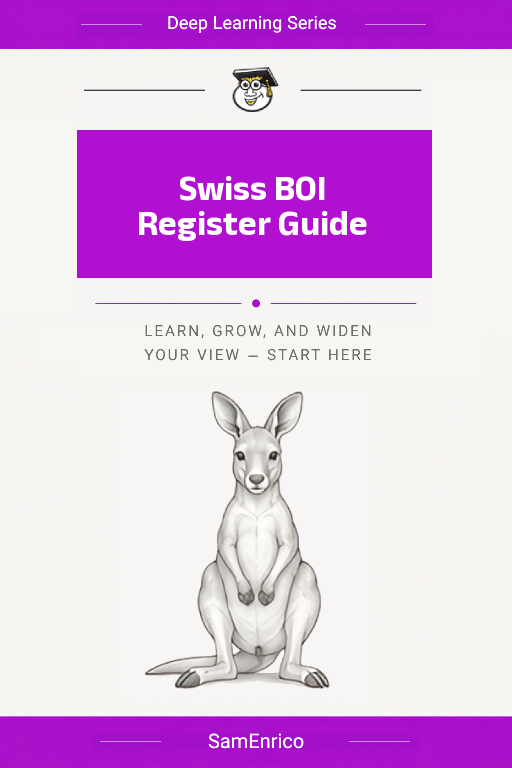
Non-FictionAnnual CheckupSwitzerlandAML
Swiss BOI Register Guide
Navigate Swiss beneficial ownership register requi
Navigate Swiss beneficial ownership register requirements under AML ordinance including transparency rules.
Formats
About this book
Free sample
Chapter 1: The Hidden Boundary...--–- Switzerland, December 2026. For centuries, the alpine nation had perfected the art of discretion. Bank vaults beneath Zurich’s Bahnhofstrasse, numbered accounts whispered across lakefront boardrooms, and corporate registers locked behind cantonal seals—these were the tools of a financial haven built on privacy. But on the first day of that frigid winter month, the old order fractured. The Federal Act on the Transparency of Legal Entities (LETA) came into force, and with it, a centralized register of beneficial owners—a digital ledger that would, for the first time, pierce the veil of Swiss corporate secrecy.
The question was no longer whether your entity had something to hide. The question was whether your entity was even required to report.The Fall of the Cantonal Fortress Before late 2026, Switzerland operated a fragmented system. Each canton maintained its own commercial register, and while companies had to list their shareholders under Article 697 of the Code of Obligations (CO), there was no centralized requirement to identify the natural persons behind those shareholders. A holding company could be owned by another holding company, which was owned by a foundation, which was managed by a trustee. The chain could stretch across Liechtenstein, Delaware, or the Cayman Islands, and Swiss authorities had no legal right to demand its end.The Financial Action Task Force (FATF) had grown impatient.
In its 2016 mutual evaluation report, FATF criticized Switzerland for having “significant shortcomings” in identifying beneficial owners. The country was placed under enhanced follow-up. By 2020, the message was clear: adopt a central register of beneficial owners (BOI) or face inclusion on the grey list. Switzerland, dependent on its reputation as a stable but compliant financial center, chose the former.LETA was passed in September 2025, giving entities just over a year to prepare. But preparation required first understanding a deceptively simple question: who must report?
The answer, as this chapter reveals, is a study in boundaries—between domestic and foreign, between commercial and charitable, between dormant and dead.Domestic Entities: The Usual Suspects The starting point for any compliance officer is the list of Swiss legal forms that…
This is the end of the free sample. Get the eBook to keep going. Buy now
Contents
- Chapter 1
- Chapter 2
- Chapter 3
- Chapter 4
- Chapter 5
- Chapter 6
- Chapter 7
- Chapter 8
- Chapter 9
- Chapter 10
- Chapter 11
- Chapter 12
Details
- Author
- Wentz Priscila
- Publisher
- SamEnrico
- Language
- English
- Genre
- Non-Fiction, Annual Checkup, Switzerland, AML
- Released
- 2026-05-30
- Pages (approx.)
- 156
- Available as
- eBook, Audiobook

Read better in the ZLOADR app
Your eBooks on your phone or tablet. Sign in with your SamEnrico account and start reading.
More by Wentz Priscila
 Product Recall Insurance GuideWentz Priscila$11.99
 Beginner Fitness Recovery GuideWentz Priscila$11.99
 Spin Class Climbing Drills GuideWentz Priscila$11.99
 The Introvert's Social Reentry GuideWentz Priscila$11.99
 Meditation for Neuropathic PainWentz Priscila$11.99
 The Abyss Beneath Our Feet: Unveiling the Amazon’s Hidden UnderworldWentz Priscila$11.99
 Silent Storm: The CIA's Secret War Against WeatherWentz Priscila$11.99
 Upper Confidence Bound Algorithm OperatorWentz Priscila$11.99
 A Beginners Guide to Axe throwing (Volume 1)Wentz Priscila$11.99
 Salesforce Advanced AdminWentz Priscila$12.99
 Understanding Devic SyndromeWentz Priscila$17.99
You may also like
 Hong Kong Handover 1997Dunn Johnnie$11.99
 Zumba For Postnatal Recovery CourseNeal Christian$11.99
 Zumba for BeginnersLadner Nikia$11.99
 YouTube Comment Mining GuideHumes Pandora$12.99
 Worry Box MeditationCarlin Rudy$11.99
 Workplace Stress MeditationNguyen Lynn$11.99
 Workplace Stress and Sleep RepairHawley Ivory$11.99
 Workplace Perfectionism CureDelaney Jeffry$11.99
 Workplace Injustice Anger GuideWallen Isabelle$11.99
 Work Addiction and Burnout LinkGreenwood Ester$11.99
 Women in Yoga and WellnessBeattie Galina$11.99
 Women in Stand Up ComedyChun Evangeline$11.99