
Non-FictionInformativeEducational
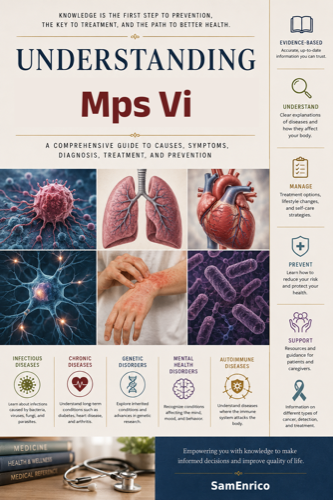
Understanding Mps Vi eBook
This disease publication, published by SamEnrico,
This disease publication, published by SamEnrico, covers Understanding Mps Vi
Formats
Free sample
Chapter 1: The Broken Factory...--–- The human body is a factory of staggering complexity—37 trillion cells, each one a microscopic metropolis of moving parts, conveyor belts, and waste disposal units. In most people, this factory hums along quietly for eighty or ninety years. But for a child with MPS VI, a single machine breaks on the assembly line. One enzyme. One missing gear.
And the trash begins to pile up.This is not a metaphor. It is biochemistry, and it is brutal in its simplicity.Every day, your cells break down old molecules and build new ones. This process is called turnover, and it never stops. Your bones today are not the same bones you had seven years ago. Your heart valves are constantly being remodeled.
Your joints are perpetually being rebuilt and recycled. The body is not a static sculpture; it is a river.But recycling creates waste.Inside nearly every cell of your body sits a specialized compartment called the lysosome—from the Greek lysis (to break down) and soma (body). The lysosome is the cell’s stomach. It is a membrane-bound bubble filled with harsh digestive enzymes, designed to chew up complex molecules into their basic building blocks so they can be reused. Think of it as the recycling center of the cell.For the lysosome to work properly, it needs a full set of specialized tools—enzymes that are each designed to break down a specific type of waste.
One enzyme chews up fats. Another chews up sugars. And one particular enzyme, called Arylsulfatase B (ARSB) , is responsible for breaking down two specific waste products: dermatan sulfate and chondroitin-4-sulfate.These are both members of a larger family of molecules called glycosaminoglycans (GAGs) —long, chain-like sugar molecules that are essential components of connective tissue. GAGs are what give your skin its elasticity, your joints their cushion, and your heart valves their flexibility. They are everywhere: in your bones, your cartilage, your corneas, your blood vessel walls, your heart valves, your skin, and your tendons.In a healthy person, GAGs are constantly being synthesized and then broken down.
ARSB acts like a pair of molecular scissors, snipping off specific chemical groups (sulfate groups) from the ends of dermatan sulfate and chondroitin-4-sulfate chains. Once these sulfate groups are removed, other enzymes can finish the job, reducing the long GAG chains into tiny sugar molecules that the cell can recycle.But in MPS VI, the ARSB gene carries a mutation. The factory produces a broken enzyme—or no enzyme at all. The molecular scissors are dull, missing, or absent.The waste does not get processed.And so the GAGs accumulate. They pile up inside the lysosome like uncollected garbage bags in a city that has forgotten to run the sanitation trucks.
The lysosome swells, bloated with undigested material. It grows larger and larger, crowding out other organelles, disrupting calcium signaling, and triggering inflammation. Eventually, the cell cannot function. It releases toxic signals that damage neighboring cells. And in many tissues, the overloaded cell dies—a process called apoptosis, or programmed cell death.This is the storage disorder paradigm.
One broken enzyme. One type of accumulating waste. And a cascade of cellular catastrophe that spreads through the body like ripples in a pond.But here is the critical question—and the answer that distinguishes MPS VI from almost every other lysosomal storage disorder: Which cells die?In MPS I (Hurler syndrome) and MPS II (Hunter syndrome), the accumulating GAGs cross the blood-brain barrier. They deposit inside neurons—the cells of the brain and spinal cord—and those neurons die. The result is progressive cognitive decline, developmental regression, and intellectual disability.In MPS VI, that does not happen.The blood-brain barrier—a tightly sealed layer of cells that protects the brain from toxins, pathogens, and large molecules circulating in the blood—is impermeable to dermatan sulfate and chondroitin-4-sulfate.
These GAGs are too large and too charged to slip through. Moreover, the brain produces very little of these specific GAGs on its own. The neurons of a child with MPS VI are not flooded with waste. Their lysosomes remain clean. Their cognitive function remains intact.This is not a minor distinction.
It is the single most important fact about MPS VI, and it has profound implications for every aspect of care—from education to ethics to end-of-life decisions.A child with MPS VI will learn to read. They will go to school. They will understand their own disease. They will ask questions about their future. They will have hopes, dreams, fears, and opinions.
Their intelligence is preserved, often entirely normal, sometimes remarkably high. The body may betray them, but the mind remains their own.But the rest of the body is not so lucky.Because while the brain is protected, every other tissue is vulnerable. The bones, the joints, the heart, the lungs, the eyes, the ears, the liver, the spleen, the blood vessels, the connective tissue—all of them produce dermatan sulfate and chondroitin-4-sulfate. All of them require ARSB to recycle those molecules. And all of them, in the absence of that enzyme, begin to fill with garbage.The result is a disease that attacks the body from the inside out, slowly, silently, and systematically.The Skeleton Hardens Bone is not dead tissue.
It is a living, dynamic organ, constantly being broken down and rebuilt by cells called osteoclasts (which eat old bone) and osteoblasts (which build new bone). For this process to work, the bone matrix—the scaffolding of collagen and GAGs that gives bone its structure—must be properly maintained.In MPS VI, GAGs accumulate in the growth plates (the regions at the ends of long bones where new bone is formed), in the cartilage that cushions the joints, and in the bones themselves. The accumulation disrupts the delicate balance between bone formation and bone resorption. The result is a constellation of skeletal abnormalities collectively called dysostosis multiplex—a term that simply means "many malformed bones."Children with MPS VI stop growing. Not because of a hormone deficiency (growth hormone levels are usually normal), but because their growth plates are clogged with waste.
The long bones of the arms and legs become disproportionately short. The trunk remains relatively normal in length. The child develops a short stature with a normal sitting height—a pattern called "short-limbed dwarfism."The ribs become thick and oar-shaped. The vertebrae (the bones of the spine) develop abnormal beaking on their anterior edges. The hip joints become shallow and malformed, leading to progressive dislocation.
The hands develop a characteristic "claw" deformity as the fingers stiffen into fixed flexion contractures.And the joints themselves—the hinges of the body—begin to freeze.The Joints Lock Cartilage is the smooth, slippery tissue that covers the ends of bones where they meet to form a joint. It is rich in GAGs—specifically chondroitin-4-sulfate—which give cartilage its ability to resist compression and slide effortlessly against opposing surfaces.In MPS VI, the cartilage becomes overloaded with undegraded GAGs. The chondrocytes (cartilage cells) swell and die. The smooth surface becomes rough, pitted, and irregular. The joint fluid becomes thick and viscous.
The surrounding ligaments and tendons become infiltrated with GAGs, losing their elasticity and becoming stiff, thick, and unyielding.The result is…
This is the end of the free sample. Get the eBook to keep going. Buy now
About this book
Details
- Author
- Witherspoon Thomasena
- Publisher
- SamEnrico
- Language
- English
- Genre
- Non-Fiction, Informative, Educational
- Released
- 2026-05-18
- Pages (approx.)
- 158
- Available as
- eBook, Audiobook

Read better in the ZLOADR app
Your eBooks on your phone or tablet. Sign in with your SamEnrico account and start reading.
More by Witherspoon Thomasena
 Self Doubt for PilotsWitherspoon Thomasena$11.99
 Secret Garden JourneyWitherspoon Thomasena$11.99
 Rwanda Revolution Hutu GuideWitherspoon Thomasena$11.99
 Chronic Illness Wellness SpendingWitherspoon Thomasena$11.99
 Metta for ArtistsWitherspoon Thomasena$11.99
 Pixel Pioneers: The Secret War of the 8-Bit TitansWitherspoon Thomasena$11.99
 Networking Group or Mastermind BusinessWitherspoon Thomasena$11.99
 Video Call Conflict Management GuideWitherspoon Thomasena$12.99
 AI Motion Tracking GuideWitherspoon Thomasena$12.99
 A Beginners Guide to Cyclo-cross (Volume 1)Witherspoon Thomasena$11.99
You may also like
 Hong Kong Handover 1997Dunn Johnnie$11.99
 Zumba For Postnatal Recovery CourseNeal Christian$11.99
 Zumba for BeginnersLadner Nikia$11.99
 YouTube Comment Mining GuideHumes Pandora$12.99
 Worry Box MeditationCarlin Rudy$11.99
 Workplace Stress MeditationNguyen Lynn$11.99
 Workplace Stress and Sleep RepairHawley Ivory$11.99
 Workplace Perfectionism CureDelaney Jeffry$11.99
 Workplace Injustice Anger GuideWallen Isabelle$11.99
 Work Addiction and Burnout LinkGreenwood Ester$11.99
 Women in Yoga and WellnessBeattie Galina$11.99
 Women in Stand Up ComedyChun Evangeline$11.99