
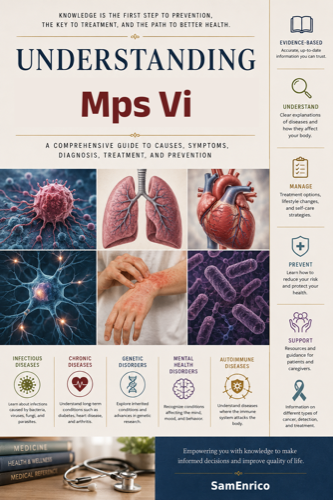
Non-FictionInformativeEducational
Understanding Mps Vi Audiobook
This disease publication, published by SamEnrico,
This disease publication, published by SamEnrico, covers Understanding Mps Vi
Formats
Free sample
Chapter 1: The Broken Factory...--–- The human body is a factory of staggering complexity—37 trillion cells, each one a microscopic metropolis of moving parts, conveyor belts, and waste disposal units. In most people, this factory hums along quietly for eighty or ninety years. But for a child with MPS VI, a single machine breaks on the assembly line. One enzyme. One missing gear.
And the trash begins to pile up.This is not a metaphor. It is biochemistry, and it is brutal in its simplicity.Every day, your cells break down old molecules and build new ones. This process is called turnover, and it never stops. Your bones today are not the same bones you had seven years ago. Your heart valves are constantly being remodeled.
Your joints are perpetually being rebuilt and recycled. The body is not a static sculpture; it is a river.But recycling creates waste.Inside nearly every cell of your body sits a specialized compartment called the lysosome—from the Greek lysis (to break down) and soma (body). The lysosome is the cell’s stomach. It is a membrane-bound bubble filled with harsh digestive enzymes, designed to chew up complex molecules into their basic building blocks so they can be reused. Think of it as the recycling center of the cell.For the lysosome to work properly, it needs a full set of specialized tools—enzymes that are each designed to break down a specific type of waste.
One enzyme chews up fats. Another chews up sugars. And one particular enzyme, called Arylsulfatase B (ARSB) , is responsible for breaking down two specific waste products: dermatan sulfate and chondroitin-4-sulfate.These are both members of a larger family of molecules called glycosaminoglycans (GAGs) —long, chain-like sugar molecules that are essential components of connective tissue. GAGs are what give your skin its elasticity, your joints their cushion, and your heart valves their flexibility. They are everywhere: in your bones, your cartilage, your corneas, your blood vessel walls, your heart valves, your skin, and your tendons.In a healthy person, GAGs are constantly being synthesized and then broken down.
ARSB acts like a pair of molecular scissors, snipping off specific chemical groups (sulfate groups) from the ends of dermatan sulfate and chondroitin-4-sulfate chains. Once these sulfate groups are removed, other enzymes can finish the job, reducing the long GAG chains into tiny sugar molecules that the cell…
This is the end of the free sample. Get the Audiobook to keep going. Buy now
About this book
Details
- Author
- Witherspoon Thomasena
- Publisher
- SamEnrico
- Language
- English
- Genre
- Non-Fiction, Informative, Educational
- Released
- 2026-05-18
- Pages (approx.)
- 158
- Available as
- eBook, Audiobook

Listen in the VoxFlicks app
Audiobooks and audio dramas wherever you go. Sign in with your SamEnrico account and press play.
More by Witherspoon Thomasena
 Self Doubt for PilotsWitherspoon Thomasena$11.99
 Secret Garden JourneyWitherspoon Thomasena$11.99
 Rwanda Revolution Hutu GuideWitherspoon Thomasena$11.99
 Chronic Illness Wellness SpendingWitherspoon Thomasena$11.99
 Metta for ArtistsWitherspoon Thomasena$11.99
 Pixel Pioneers: The Secret War of the 8-Bit TitansWitherspoon Thomasena$11.99
 Networking Group or Mastermind BusinessWitherspoon Thomasena$11.99
 Video Call Conflict Management GuideWitherspoon Thomasena$12.99
 AI Motion Tracking GuideWitherspoon Thomasena$12.99
 A Beginners Guide to Cyclo-cross (Volume 1)Witherspoon Thomasena$11.99
You may also like
 Hong Kong Handover 1997Dunn Johnnie$11.99
 Zumba For Postnatal Recovery CourseNeal Christian$11.99
 Zumba for BeginnersLadner Nikia$11.99
 YouTube Comment Mining GuideHumes Pandora$12.99
 Worry Box MeditationCarlin Rudy$11.99
 Workplace Stress MeditationNguyen Lynn$11.99
 Workplace Stress and Sleep RepairHawley Ivory$11.99
 Workplace Perfectionism CureDelaney Jeffry$11.99
 Workplace Injustice Anger GuideWallen Isabelle$11.99
 Work Addiction and Burnout LinkGreenwood Ester$11.99
 Women in Yoga and WellnessBeattie Galina$11.99
 Women in Stand Up ComedyChun Evangeline$11.99