
Non-FictionInformativeEducational
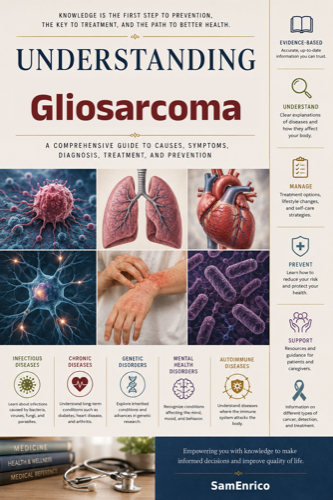
Understanding Gliosarcoma eBook
This disease publication, published by SamEnrico,
This disease publication, published by SamEnrico, covers Understanding Gliosarcoma
Formats
Free sample
Chapter 1: The Uninvited Guest...--The headache started on a Tuesday. Not the kind you blame on caffeine withdrawal or a poor night’s sleep, but something deeper—a dull, persistent pressure behind the left eye that felt less like pain and more like a presence. By Friday, Sarah, a 52-year-old high school history teacher, found herself staring at her classroom whiteboard, unable to recall the name of a student she had taught for four months. The word sat on the tip of her tongue, just beyond reach, while eighteen pairs of adolescent eyes watched her falter. She laughed it off as “senior moment,” but the laughter didn’t reach her eyes.Three weeks later, a generalized tonic-clonic seizure collapsed her onto the kitchen floor while she was making morning coffee.
Her husband, David, found her unconscious, her body rigid and shaking, a thin line of blood where she had bitten her tongue. The ambulance ride was a blur of sirens, fluorescent lights, and a paramedic asking questions Sarah couldn’t answer because she couldn’t remember what year it was.In the emergency department, a CT scan revealed something abnormal in her left temporal lobe. Then came the MRI with contrast—a long, loud tube that felt like lying inside a drum solo. The radiologist’s report used words like “heterogeneous enhancing mass” and “ring enhancement” and “mass effect on the medial temporal lobe.” The ER doctor, a young woman with kind eyes and bad news delivery, said the word “tumor” and then immediately started talking about a neurosurgeon named Dr. Chen who would be coming by in the morning.No one used the word “gliosarcoma.” Not yet.
That word would arrive later, like a second knock on the door when you thought the worst was already over.The Moment Everything Changes If you are reading this book, you or someone you love has likely just received a diagnosis that has turned your world inside out. Perhaps you are Sarah, sitting in a hospital room at 2 AM, unable to sleep because the beeping monitors and the weight of uncertainty will not let you close your eyes. Perhaps you are David, holding a cold cup of coffee and a clipboard full of consent forms, trying to remember the name of the second oncology fellow who came by earlier. Perhaps you are the adult child of an aging parent, suddenly thrust into the role of medical interpreter, appointment scheduler, and emotional anchor.This chapter is for all of you.Understanding Gliosarcoma is not a textbook, though it contains the clinical accuracy of one. It is not a memoir, though it will share the stories of patients and families who have walked this path.
It is, instead, a compass—a tool to help you navigate a rare and aggressive disease with clarity, compassion, and agency. This book will not promise you false hope, because you deserve better than lies dressed in optimism. But it will offer you something rarer and more valuable: honest information, practical guidance, and the quiet assurance that you are not alone.Before we dive into the science of gliosarcoma—the genetics, the imaging, the treatment protocols—we must first establish what this disease actually is. And perhaps more importantly, what it is not.Defining the Beast: What Is Gliosarcoma?Gliosarcoma is a rare and aggressive cancer of the central nervous system. In the World Health Organization (WHO) classification system, which serves as the global standard for diagnosing brain tumors, gliosarcoma is designated as a Grade IV tumor—the highest grade, indicating rapid growth, invasive behavior, and a tendency to recur despite aggressive treatment.
To put this in perspective, the most common and well-known Grade IV brain tumor is glioblastoma (GBM), the disease that claimed Senator John Mc Cain and baseball legend Gary Carter.Here is the critical distinction that defines gliosarcoma and sets it apart from other brain cancers: Gliosarcoma is not simply a variant of glioblastoma, though the two are closely related. Rather, gliosarcoma is a biphasic tumor, meaning it contains two distinct types of cancerous tissue.Imagine, if you will, a hybrid vehicle. A hybrid car has both a gasoline engine and an electric motor. They function together, but they remain separate systems within the same machine. Similarly, gliosarcoma contains:A glial component – This resembles standard glioblastoma, composed of abnormal glial cells (the supportive cells of the brain) that grow rapidly, invade surrounding brain tissue, and resist cell death.A sarcomatous component – This resembles a soft tissue sarcoma, composed of spindle-shaped cells embedded in a meshwork of reticulin fibers.
Sarcomas are typically cancers of connective tissue—muscle, bone, cartilage—but in gliosarcoma, this sarcomatous tissue appears within the brain, which ordinarily does not contain such elements.Under a microscope, these two components often exist side by side, sometimes intermingled, sometimes in distinct regions of the same tumor. The pathologist who examines your biopsy or surgical specimen will look for both patterns to make the diagnosis. (We will explore what that pathology report looks like—and how to read it—in Chapter 5.)This biphasic nature is not merely an academic curiosity. It has real consequences for how the tumor behaves, how it appears on scans, and potentially how it responds to treatment. For reasons that researchers are still working to understand, the sarcomatous component may alter the tumor’s biology in ways that distinguish gliosarcoma from standard glioblastoma.How Rare Is Rare?Let us be honest with one another.
When a doctor says a disease is “rare,” your heart sinks in a particular way. Rare means fewer researchers studying it. Rare means fewer clinical trials. Rare means that when you search for information online, you find more academic papers than patient stories. Rare means that even at major cancer centers, you may encounter oncologists who have seen only a handful of cases in their entire careers.Gliosarcoma accounts for approximately 2% of all glioblastoma cases.
Because glioblastoma itself is relatively uncommon—affecting about 3 to 4 people per 100,000 annually in the United States—gliosarcoma is correspondingly rarer. To put numbers on it: if 10,000 people are diagnosed with a malignant brain tumor in a given year, roughly 200 of them will have gliosarcoma.This rarity creates challenges. Your local community hospital may have never treated a gliosarcoma patient. The first-line treatments described in national guidelines were developed primarily for glioblastoma, not gliosarcoma specifically, because no large clinical trials have ever been conducted exclusively for this subtype. Your medical team will likely extrapolate from glioblastoma data while making adjustments based on gliosarcoma’s unique features.But rarity also creates opportunity.
Because gliosarcoma is rare, any patient who enrolls in a research registry or consents to genomic sequencing of their tumor contributes meaningfully to scientific knowledge. Your case matters. Your tumor’s genetic profile could help the next patient. This is not a platitude; it is a fact of rare-disease research.Primary Versus Secondary: Two Paths to the Same Diagnosis Not all gliosarcomas arise in the same way. The distinction between primary and secondary gliosarcoma affects prognosis and, in some cases, treatment decisions.Primary gliosarcoma (also called de novo gliosarcoma) develops without any prior history of brain tumor or cranial radiation.
The patient experiences symptoms—perhaps a seizure, perhaps cognitive changes, perhaps persistent headaches—and imaging reveals a mass that ultimately proves to…
This is the end of the free sample. Get the eBook to keep going. Buy now
About this book
Details
- Author
- Mayfield Stephenie
- Publisher
- SamEnrico
- Language
- English
- Genre
- Non-Fiction, Informative, Educational
- Released
- 2026-05-11
- Pages (approx.)
- 159
- Available as
- eBook, Audiobook

Read better in the ZLOADR app
Your eBooks on your phone or tablet. Sign in with your SamEnrico account and start reading.
More by Mayfield Stephenie
 Burnout In Creative ProfessionsMayfield Stephenie$11.99
 The Reading by FirelightMayfield Stephenie$11.99
 The Genetic Counseling Session GuideMayfield Stephenie$11.99
 The High Protein Keto GuideMayfield Stephenie$11.99
 Parent Hospice Care Companion GuideMayfield Stephenie$11.99
 The Serpent’s Curse: Nefertiti’s Lost ExileMayfield Stephenie$11.99
 The Grid That Built America: How Robert Moses Reshaped New YorkMayfield Stephenie$11.99
 How to Start a Printing of Banknotes Business (Beginners Guide)Mayfield Stephenie$11.99
 Interstellar Medium CollectorMayfield Stephenie$11.99
 Exchange Rates ExcelMayfield Stephenie$12.99
 Discrimination Hiring Trap GuideMayfield Stephenie$12.99
You may also like
 Hong Kong Handover 1997Dunn Johnnie$11.99
 Zumba For Postnatal Recovery CourseNeal Christian$11.99
 Zumba for BeginnersLadner Nikia$11.99
 YouTube Comment Mining GuideHumes Pandora$12.99
 Worry Box MeditationCarlin Rudy$11.99
 Workplace Stress MeditationNguyen Lynn$11.99
 Workplace Stress and Sleep RepairHawley Ivory$11.99
 Workplace Perfectionism CureDelaney Jeffry$11.99
 Workplace Injustice Anger GuideWallen Isabelle$11.99
 Work Addiction and Burnout LinkGreenwood Ester$11.99
 Women in Yoga and WellnessBeattie Galina$11.99
 Women in Stand Up ComedyChun Evangeline$11.99