
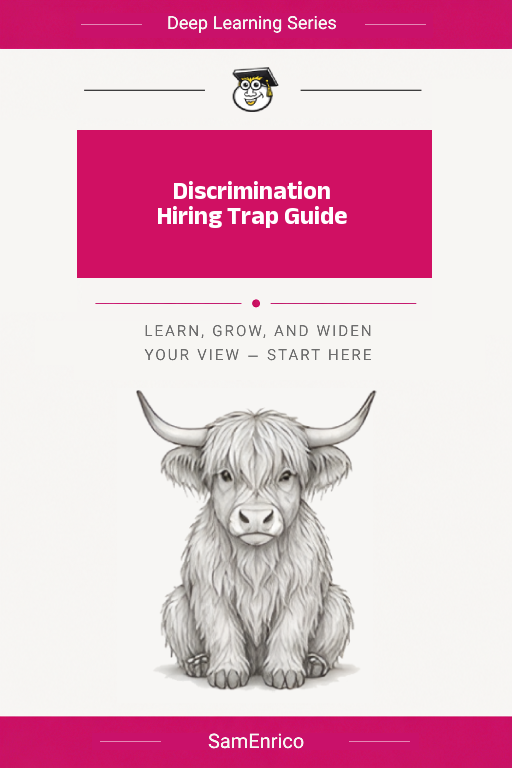
Non-FictionBusiness BriefEEO Law
Discrimination Hiring Trap Guide
Avoid illegal interview questions and hiring discr
Avoid illegal interview questions and hiring discrimination including protected class status and disparate impact claims with first employee selection.
Formats
About this book
Free sample
Chapter 1: The $250,000 Question...--–- The manager leaned back in his chair, smiled warmly at the applicant across the table, and asked what he genuinely believed was a harmless, get-to-know-you question: "So, you're engaged? Congratulations. Are you planning to have children soon?" The applicant, a qualified 28-year-old woman with five years of relevant experience, did not get the job. A male candidate with three years of experience and a lower performance rating was hired instead. She sued.
The jury returned a verdict of $250,000—not because the manager had written "don't hire pregnant women" in an email, not because he had a documented history of bias, but because the question itself created a presumption of discrimination. The question was the smoking gun.Welcome to the most expensive small talk in business.This book is not about avoiding lawsuits because you are afraid. It is about building a selection process so fair, so transparent, and so job-relevant that lawsuits never materialize in the first place. But to get there, we must first understand how ordinary, well-intentioned managers—people who would never consciously discriminate—walk into legal traps that cost their companies hundreds of thousands of dollars. The question about children cost a quarter of a million dollars.
A question about where someone was born cost 180,000.Aquestionabout"fittingin"cost180,000. A question about "fitting in" cost 180,000.Aquestionabout"fittingin"cost400,000. None of those managers woke up intending to break the law. They simply did not know what they did not know.This chapter is the foundation. It will establish three critical pillars for everything that follows: First, the shift from evaluating intent (what you meant) to evaluating impact (what happened).
Second, a clear, working knowledge of every protected class under federal and state law. Third, the "First Employee Paradox"—why the smallest employers are often the most vulnerable, and why the moment you hire your first person, you enter a legal landscape that demands competence, not malice, to avoid disaster.Let us begin with the story that gives this chapter its name.The $250,000 Question: A Case Study in Unintentional Liability The case is EEOC v. JBS USA…
This is the end of the free sample. Get the eBook to keep going. Buy now
Contents
- Chapter 1
- Chapter 2
- Chapter 3
- Chapter 4
- Chapter 5
- Chapter 6
- Chapter 7
- Chapter 8
- Chapter 9
- Chapter 10
- Chapter 11
- Chapter 12
Details
- Author
- Mayfield Stephenie
- Publisher
- SamEnrico
- Language
- English
- Genre
- Non-Fiction, Business Brief, EEO Law
- Released
- 2026-06-01
- Pages (approx.)
- 151
- Available as
- eBook, Audiobook

Read better in the ZLOADR app
Your eBooks on your phone or tablet. Sign in with your SamEnrico account and start reading.
More by Mayfield Stephenie
 Burnout In Creative ProfessionsMayfield Stephenie$11.99
 The Reading by FirelightMayfield Stephenie$11.99
 The Genetic Counseling Session GuideMayfield Stephenie$11.99
 The High Protein Keto GuideMayfield Stephenie$11.99
 Parent Hospice Care Companion GuideMayfield Stephenie$11.99
 The Serpent’s Curse: Nefertiti’s Lost ExileMayfield Stephenie$11.99
 The Grid That Built America: How Robert Moses Reshaped New YorkMayfield Stephenie$11.99
 How to Start a Printing of Banknotes Business (Beginners Guide)Mayfield Stephenie$11.99
 Interstellar Medium CollectorMayfield Stephenie$11.99
 Exchange Rates ExcelMayfield Stephenie$12.99
 Understanding GliosarcomaMayfield Stephenie$17.99
You may also like
 Hong Kong Handover 1997Dunn Johnnie$11.99
 Zumba For Postnatal Recovery CourseNeal Christian$11.99
 Zumba for BeginnersLadner Nikia$11.99
 YouTube Comment Mining GuideHumes Pandora$12.99
 Worry Box MeditationCarlin Rudy$11.99
 Workplace Stress MeditationNguyen Lynn$11.99
 Workplace Stress and Sleep RepairHawley Ivory$11.99
 Workplace Perfectionism CureDelaney Jeffry$11.99
 Workplace Injustice Anger GuideWallen Isabelle$11.99
 Work Addiction and Burnout LinkGreenwood Ester$11.99
 Women in Yoga and WellnessBeattie Galina$11.99
 Women in Stand Up ComedyChun Evangeline$11.99