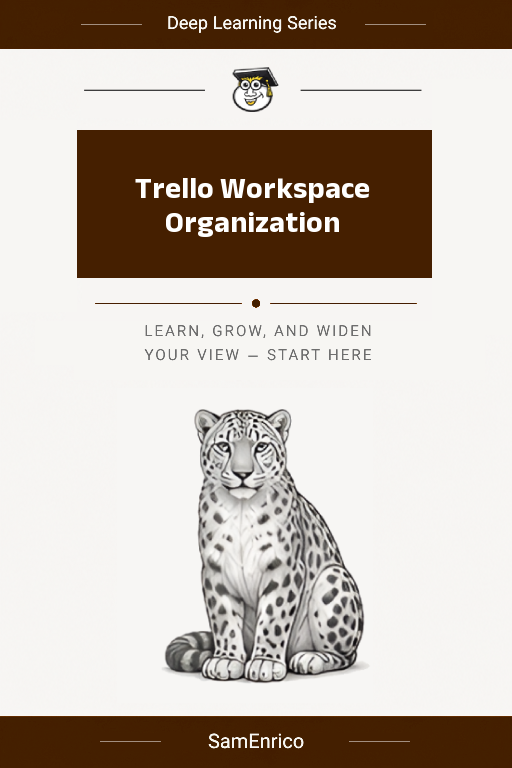
Trello Workspace Organization
Organize Trello workspaces boards and teams for sc
Organize Trello workspaces boards and teams for scalable project management across departments.
Formats
About this book
Free sample
Chapter 1: The Visibility Trap--–- It started with a single board. That’s how it always starts. Someone – a project manager, a team lead, an overachieving individual contributor – discovered Trello. They created a board for their personal to-do list. Three lists: To Do, Doing, Done.
A few cards. Colorful labels. It felt good. Clean. Controlled.
That person showed a colleague. The colleague made their own board. Then a manager asked to see progress on a cross-functional initiative, so someone created a board for that. Then another. Then another.
Within eighteen months, that same organization had eighty-seven boards across fourteen Workspaces. The average employee belonged to twelve boards. Nobody could find anything. The CEO asked for a status update on the Q3 flagship project, and three different directors pointed to three different boards, each showing different information. The “clean” system had become a digital landfill.
And nobody knew how to fix it.This is the Visibility Trap. It is the single most common reason that Trello implementations fail at scale, and it is almost entirely invisible to the people trapped inside it. You cannot see the trap because you are too busy looking at boards. You believe that more boards mean more transparency. More cards mean more accountability.
More labels mean more clarity. But the opposite is true. Beyond a certain threshold – and that threshold is surprisingly low – every additional board reduces organizational visibility. Every additional card creates noise. Every additional automation beeps into an already crowded room.The Visibility Trap has a simple mathematical reality.
A human being can effectively monitor between five and nine active information streams at any given time. This is not an opinion; it is a finding from cognitive psychology, specifically Miller’s Law, which established that the average working memory holds seven plus or minus two chunks of information. When you belong to twelve Trello boards, you are not actually monitoring twelve boards. You are ignoring six of them, vaguely aware of three, and actively using three. The other nine are creating what we call “board sprawl” – the illusion of organization without the reality of…
This is the end of the free sample. Get the eBook to keep going. Buy now
Contents
- Chapter 1
- Chapter 2
- Chapter 3
- Chapter 4
- Chapter 5
- Chapter 6
- Chapter 7
- Chapter 8
- Chapter 9
- Chapter 10
- Chapter 11
- Chapter 12
Details
- Author
- Walker Thelma
- Publisher
- SamEnrico
- Language
- English
- Genre
- Non-Fiction, Professional's Cheat Sheet, Workspace
- Released
- 2026-05-29
- Pages (approx.)
- 155
- Available as
- eBook, Audiobook

Read better in the ZLOADR app
Your eBooks on your phone or tablet. Sign in with your SamEnrico account and start reading.
More by Walker Thelma
 The Bosnian Immigrant SuccessWalker Thelma$11.99
 MBSR for Anxiety CourseWalker Thelma$11.99
 Male Pattern Balding ExplainedWalker Thelma$11.99
 Snapchat Streak Pressure GuideWalker Thelma$11.99
 DoorDash Customer Rating ManagementWalker Thelma$11.99
 The Colossal Heads: Secrets of the Olmec GiantsWalker Thelma$11.99
 Construction Project Skills GuideWalker Thelma$12.99
 Ultimate Handbook Guide to Yaroslave : (Russia) Travel GuideWalker Thelma$11.99
 Understanding Melanoma-astrocytoma SyndromeWalker Thelma$17.99
 Receiving InspectorWalker Thelma$11.99