
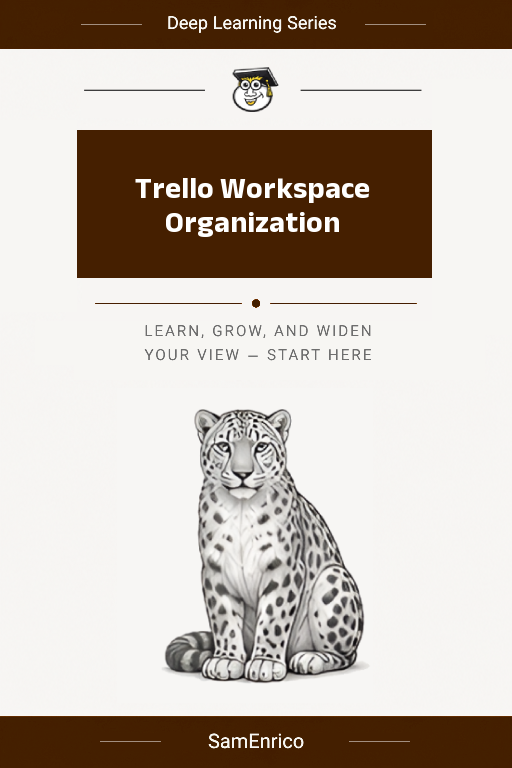
Non-FictionProfessional's Cheat SheetWorkspace
Trello Workspace Organization eBook
Organize Trello workspaces boards and teams for sc
Organize Trello workspaces boards and teams for scalable project management across departments.
Formats
Free sample
Chapter 1: The Visibility Trap--–- It started with a single board. That’s how it always starts. Someone – a project manager, a team lead, an overachieving individual contributor – discovered Trello. They created a board for their personal to-do list. Three lists: To Do, Doing, Done.
A few cards. Colorful labels. It felt good. Clean. Controlled.
That person showed a colleague. The colleague made their own board. Then a manager asked to see progress on a cross-functional initiative, so someone created a board for that. Then another. Then another.
Within eighteen months, that same organization had eighty-seven boards across fourteen Workspaces. The average employee belonged to twelve boards. Nobody could find anything. The CEO asked for a status update on the Q3 flagship project, and three different directors pointed to three different boards, each showing different information. The “clean” system had become a digital landfill.
And nobody knew how to fix it.This is the Visibility Trap. It is the single most common reason that Trello implementations fail at scale, and it is almost entirely invisible to the people trapped inside it. You cannot see the trap because you are too busy looking at boards. You believe that more boards mean more transparency. More cards mean more accountability.
More labels mean more clarity. But the opposite is true. Beyond a certain threshold – and that threshold is surprisingly low – every additional board reduces organizational visibility. Every additional card creates noise. Every additional automation beeps into an already crowded room.The Visibility Trap has a simple mathematical reality.
A human being can effectively monitor between five and nine active information streams at any given time. This is not an opinion; it is a finding from cognitive psychology, specifically Miller’s Law, which established that the average working memory holds seven plus or minus two chunks of information. When you belong to twelve Trello boards, you are not actually monitoring twelve boards. You are ignoring six of them, vaguely aware of three, and actively using three. The other nine are creating what we call “board sprawl” – the illusion of organization without the reality of it.I have consulted with organizations ranging from five-person startups to five-thousand-person enterprises.
The pattern is identical everywhere. The symptoms are always the same. And the cure – the real cure, not another board or another Power-Up – begins with a single, uncomfortable admission: most of your Trello boards should not exist.The Anatomy of Board Sprawl Board sprawl is not a moral failure. It is a structural inevitability in organizations that adopt Trello without governance. Trello is designed to make board creation effortless.
You click a button, type a name, and you have a board. No approval workflow. No permission review. No “are you sure you need this?” gate. This is a feature when you are a solo user or a small team.
It becomes a bug when you are an enterprise.Board sprawl manifests in three distinct forms, each with its own pathology and cure.The first form is Ghost Boards. These are boards that were created for a specific project, meeting, or temporary initiative. The project ended. The meeting series concluded. The initiative was canceled or completed.
But the board remains. It sits in the Workspace, unchanged for months, accumulating cobwebs. Ghost boards are harmless in isolation, but they are not isolated. They clutter search results. They confuse new employees who cannot tell which boards are active.
They create a subtle but persistent cognitive load: the feeling that you might be missing something important because there is so much stuff.The second form is Mirror Boards. These are boards that duplicate information from other boards because teams do not trust each other’s data or do not know how to share it. The engineering team has a bug board. Customer support creates a separate board where they manually copy bugs that affect their customers. Sales has another board where they track feature requests that came from deals.
Each of these boards starts with accurate information, but over time they diverge. Engineering fixes a bug but forgets to update the support board. Support updates their board but uses different terminology. Within two weeks, three boards claim to be the “source of truth” about bugs, and none of them agree. This is not sprawl; it is active misinformation.The third form is Vanity Boards.
These are boards created because someone wanted to look organized rather than be organized. A manager creates a board for strategic planning, fills it with cards, invites fifteen people, and then never references it again. An executive demands a dashboard board to show “real-time progress” but never actually looks at it. A team creates a board for “ideas” that becomes a graveyard of abandoned concepts. Vanity boards are the most dangerous because they feel productive.
You spent an hour setting up lists and custom fields. You invited stakeholders. You felt accomplished. But you accomplished nothing except adding to the noise.The Card Graveyard Problem Boards are the skeleton. Cards are the organs.
And when cards die, they rot.A card graveyard is any list that contains cards that have not been updated in more than fourteen days and are not blocked, waiting, or intentionally paused. Every Trello implementation develops card graveyards. They are inevitable. But they are not harmless.Consider a typical marketing board. A card is created: “Write blog post about Q4 feature release.” It sits in “To Do” for three days.
Moves to “Writing” for two days. Moves to “Editing” for four days. Moves to “Review” where it waits for stakeholder approval. The stakeholder is on vacation. The card sits in “Review” for eleven days.
By day eleven, nobody on the marketing team is sure if the blog post is still relevant. The feature was released eight days ago. The post is now outdated. But the card remains. It moves to “Done” out of habit.
It sits in “Done” for six months. It is never archived. It is never deleted. It is never referenced again.That single card consumed approximately forty-five minutes of cumulative human attention over its lifecycle. Multiplied across dozens of cards per board, across dozens of boards, across an entire organization, the math becomes staggering.
A 2023 study of knowledge worker productivity found that the average employee spends 2.5 hours per week managing task tracking systems – not doing tasks, not completing tasks, but updating, moving, and cleaning task tracking systems. Two and a half hours. Every week. That is 130 hours per year. That is more than three full work weeks.And most of that time is spent managing dead cards.
Cards that will never be completed. Cards that are no longer relevant. Cards that exist only because nobody has bothered to archive them.The Personal vs. Departmental Confusion One of the most consequential errors in Trello implementation is the failure to distinguish between a personal task list and a departmental asset. This sounds academic.
It is not. It is the difference between a system that works and a system that generates constant low-grade frustration.A personal task list is a board that belongs to one person. It contains their individual to-dos, reminders, notes, and personal workflow. It can be messy. It can use idiosyncratic labels…
This is the end of the free sample. Get the eBook to keep going. Buy now
About this book
Details
- Author
- Walker Thelma
- Publisher
- SamEnrico
- Language
- English
- Genre
- Non-Fiction, Professional's Cheat Sheet, Workspace
- Released
- 2026-05-29
- Pages (approx.)
- 155
- Available as
- eBook, Audiobook

Read better in the ZLOADR app
Your eBooks on your phone or tablet. Sign in with your SamEnrico account and start reading.
More by Walker Thelma
 The Bosnian Immigrant SuccessWalker Thelma$11.99
 MBSR for Anxiety CourseWalker Thelma$11.99
 Male Pattern Balding ExplainedWalker Thelma$11.99
 Snapchat Streak Pressure GuideWalker Thelma$11.99
 DoorDash Customer Rating ManagementWalker Thelma$11.99
 The Colossal Heads: Secrets of the Olmec GiantsWalker Thelma$11.99
 Construction Project Skills GuideWalker Thelma$12.99
 Ultimate Handbook Guide to Yaroslave : (Russia) Travel GuideWalker Thelma$11.99
 Understanding Melanoma-astrocytoma SyndromeWalker Thelma$17.99
 Receiving InspectorWalker Thelma$11.99
You may also like
 Hong Kong Handover 1997Dunn Johnnie$11.99
 Zumba For Postnatal Recovery CourseNeal Christian$11.99
 Zumba for BeginnersLadner Nikia$11.99
 YouTube Comment Mining GuideHumes Pandora$12.99
 Worry Box MeditationCarlin Rudy$11.99
 Workplace Stress MeditationNguyen Lynn$11.99
 Workplace Stress and Sleep RepairHawley Ivory$11.99
 Workplace Perfectionism CureDelaney Jeffry$11.99
 Workplace Injustice Anger GuideWallen Isabelle$11.99
 Work Addiction and Burnout LinkGreenwood Ester$11.99
 Women in Yoga and WellnessBeattie Galina$11.99
 Women in Stand Up ComedyChun Evangeline$11.99